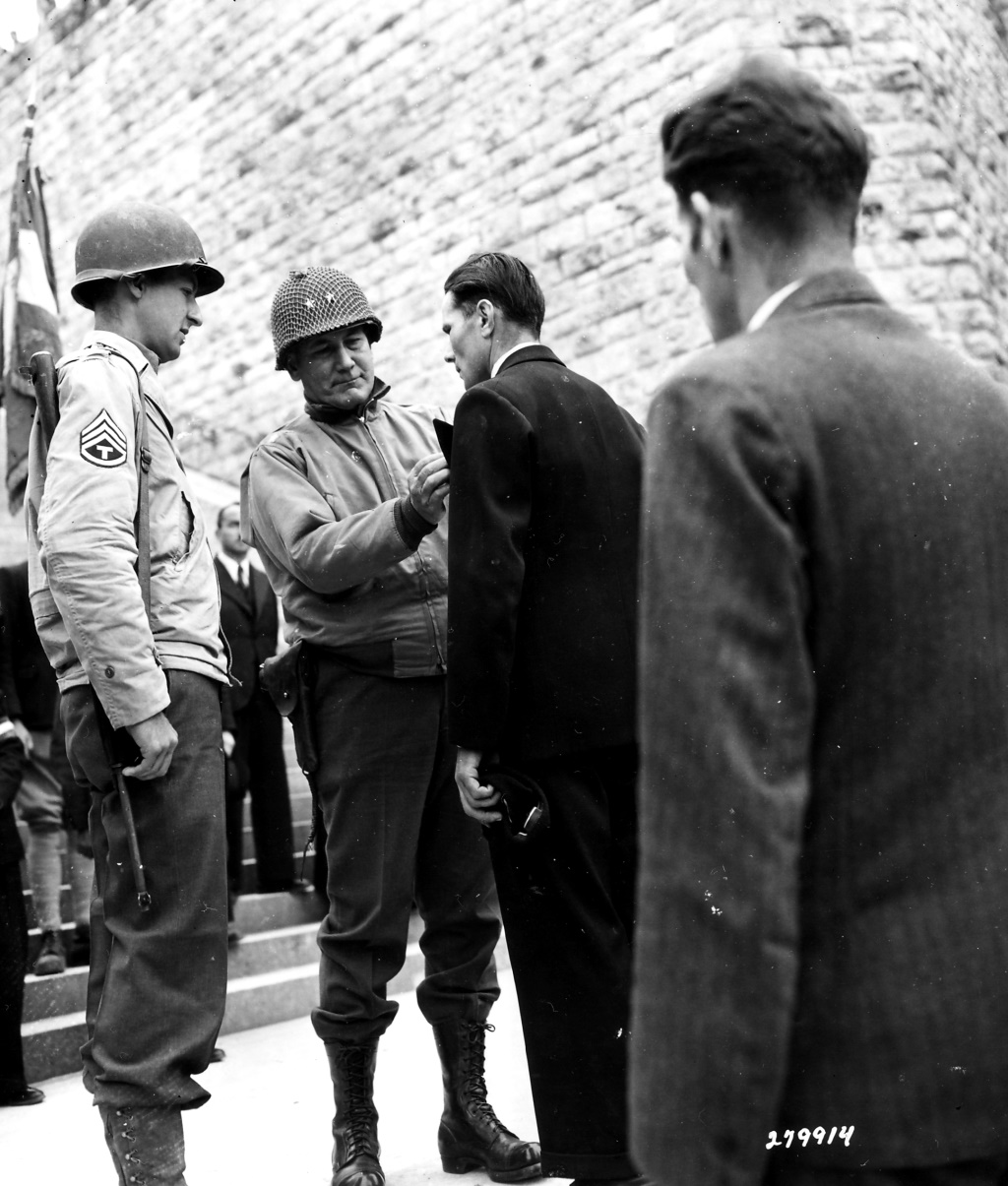
The attack was then launched and canalized up two main streets to the underpass. The enemy had a strong position here. On the railroad embankment to the west of the attack, he had employed AT and machine guns fire, protected by riflemen. The enemy had AT and machine guns sighted for night firing. They had also heavily mined the two avenues of approach. The attack made little headway. Prior to dawn, the force was withdrawn. It had been planned to renew the attack at 0900 but this was not executed as the division commander directed a coordinated attack by the division at 1500.
CCR attacked as directed. Engineers removed the mines and the attack carried the troops through the city to the northeast part, south of the river. The bridge was demolished. One company of infantry, Able Co 1/38-AIR, made the crossing to the island using the remains of the old bridge spans, the support in the center of the river, and by swimming. The advance and crossing were made under heavy rifle and machine gun fire. The Corps commander, Gen Walker, was present when the crossing was made and he personally supervised it. Able Co affected the crossing and seized the southern part of the island that night and the remainder of the island the next day. The next morning a footbridge was placed across and constructed between the island and the mainland. One platoon of Able Co, in charge of 2/Lt Walter H. G. Weissenberger, was directed to proceed east after reaching the island. After going about 2 blocks the platoon was completely surrounded by the enemy. Lt Weissenberger showed initiative and sound judgment by secreting remnants of his platoon in a building and keeping them intact until 1000 despite repeated enemy attacks.
At 1000, another patrol from Able Co found them and they rejoined their company and assisted in mopping up the island. CCR now had that portion of the city south of the river and the island. A point of interest is the fact that on the island was a prison containing several hundred felons, who, as soon as the enemy withdrew, escaped and attempted to cross south to the mainland. The Civil Affairs Officer, Maj Rex Thomson arrived promptly and coordinated efforts of the Military and civil authorities, and the prisoners were rounded up under armed guards and returned to the prison, then guarded by our own men.

Guns and arms were given to carefully selected FFI men to relieve our soldiers as guards, but even so, one platoon of infantry was left. Complete order was restored to the island and in that part of the city south of the river through the Civil Affairs Officers and the town was turned over to the local authorities. Meanwhile, at Tilly, the 48-AIB, succeeded in crossing the river in assault boats and developed a slender bridgehead. A Treadway bridge company was brought up and with the assistance of Able Co 33-AECB, began building a Class 40 bridge at 1600. This bridge was built during the night while enemy 88-MM artillery fire registered in the vicinity of the bridge site. The bridge was completed by 0900 on August 24. CCA then developed the bridgehead while CCB crossed over and assaulted Melun from the northeast. This attack began at 0200 on August 25 but was held up from time to time by hasty minefields. The 23-AIB moved into the city at 0715. The infantry mopped up small pockets of resistance during the day and outposted the town to the north. The enemy’s attempt to establish a defensive line on the east bank of the Seine River had been broken by a determined and rapid assault. It was evident that the enemy was disorganized, and could muster only isolated resistance with small arms, AT guns, and some 88-MM artillery. To take advantage of this situation, the division prepared an attack for the quick pursuit of the enemy to the east. In spite of the fatigue of the personnel, and the worn condition of the equipment, on Corps order, the attack took place on the general axis, Melun – Nangis – Provins with CCA on the left and CCB on the right. The attack jumped off from the Melun bridgehead at 1900 on August 25, but due to scattered resistance, the progress was slow. Both columns just cleared the line of departure by nightfall and secured their positions.

 Meanwhile, CCR which had taken over the defensive bridgehead at Tilly was placed in Corps Reserve and moved to guard the bridgehead at Fontainebleau. The reason for the change was that the Corps boundary between the VII Corps and XX Corps had been shifted southward. The Tilly bridgehead was taken over by VII Corps and all XX Corps traffic was to move by the Fontainebleau bridge. The attack of CCA and CCB continued the following morning, August 26. It was known that there would be increased enemy resistance in this area. Horse-drawn artillery had been encountered east of Melun and armor was being used in a defensive role to screen the enemy disengagement movement which was slow due to their inferior equipment. Whether or not there were major elements in this area was not positively known but the presence of enemy tanks in some strength in the vicinity of Provins – Donnemarie-Dontilly was established. The threat of German units known to be south of the division sector, and the threat of attack by units escaping from Paris, on the north, was a constant concern for the division in its advance. By nightfall, CCA had advanced as far as Jouy-le-Châtel while CCB had cleared the town of Nangis. At this time the division was alerted for a change in direction to the northeast to begin about 1200 August 27, after CCB had cleared the town of Provins, and advanced as far as Villenauxe-la-Grande.

Attack on Reims
The plan for the attack, on August 27, was as follows: to attack north across the line of departure, generally, an east-west line through Rozay-en-Brie, attacking in a northeasterly direction in six columns: CCB on the right in three columns and CCA on the left in three columns. Each column consisted of a company of infantry, a company of tanks, a battery of field artillery, a platoon of engineers, and a platoon of tank destroyers. The 87-CRS, reconnoitered the division’s zone of advance, while CCR followed in the rear of the six columns. CCB was given orders to bypass Provins and the opposition that had developed there. It halted at Sézanne and organized its three task forces. On August 29, it moved out at 0730 encountering small pockets of resistance. South of Epernay a roadblock of four AT guns was knocked out and the town was entered by infantry commanded by Col Leslie Allison at 1800. The attack proceeded to the Marne River where the tanks were halted by heavy AT and machine guns fire. The bridge in Epernay was blown by electric charges before it could be reached. The force halted in Epernay until 0700, August 29, and then moved to cross the river on a Treadway bridge that the engineers had constructed at Pont-à-Vinson.
The Combat Command continued its attack on Warmeriville. Meanwhile, CCA organized its task forces in the vicinity of St Hilliers and moved out at 1300 on August 27. At La Ferté-Gaucher, considerable German equipment was captured and about 20 prisoners were taken. During the day there were skirmishes with enemy forces at La Ferté-Gaucher, Montmirail and at the junction of highways N-33-GC-11. At the latter, an enemy artillery column was surprised and destroyed. In the day’s action, three 155-MM guns, three half-tracks, and five tanks of the enemy were destroyed, at least 70 prisoners were taken. The Command secured its positions for the night two miles north of La Ferté-Gaucher and continued its advance the next morning.
Meanwhile, Task Force McConnell advanced on the left boundary of the division until 0300, August 28, when it was forced to halt to refuel. This task force during the early morning hours continued its advance in the direction of Château-Thierry meeting roadblocks and artillery fire to the south of the town. In an aggressive engagement, he forced the roadblocks and seized the bridges crossing the Marne River before they could be destroyed. This stroke made it possible to exploit the Marne bridgehead before the enemy could set up a defense, and also resulted in the capture of considerable enemy equipment. Meanwhile, the task force approaching the Marne River at Dormans overcame resistance on the outskirts of the city and passed two platoons of infantry across the bridge, when the enemy succeeded in blowing the electric charges on the bridge. During the night of August 27/28, the 33-AECB assisted by the 135-ECB, put two bridges across the Marne for the use of CCB. All of CCA and CCR passed over the bridge at Château-Thierry.
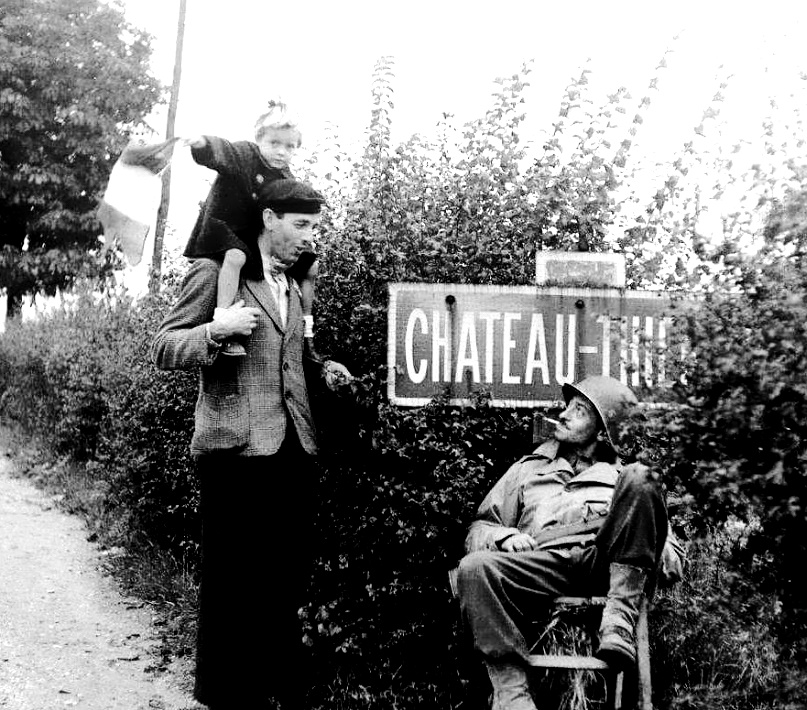
The task force under Col McConnell, after taking Château-Thierry, had worked its way north as far as Fismes. A second column, under Maj John C. Brown (CCA) after crossing the bridge at Château-Thierry and a column of the reserve Task Force Keller, crossed at Château-Thierry to support Col McConnell’s drive to the north. On the morning of August 29, all columns moved back to their original routes in order to advance on a broad front encircling Reims and seize crossings over the Aisne RiverAisne River reconnoitering for crossings, and by nightfall, bridgeheads had been secured at Pontavert, Neufchâtel-sur-Aisne, Berry-au-Bac, and other localities. By 1200, August 29, CCB had seized bridges in the vicinity of Château-Porcien. This operation entailed the encirclement of Reims and made it possible for the 5-ID to outpost the city with little opposition. Thus the city of Reims was liberated without combat in its streets. The Aerodrome east of the city was of considerable tactical value for future operations and was easily occupied with no opposition.
Capture of Verdun
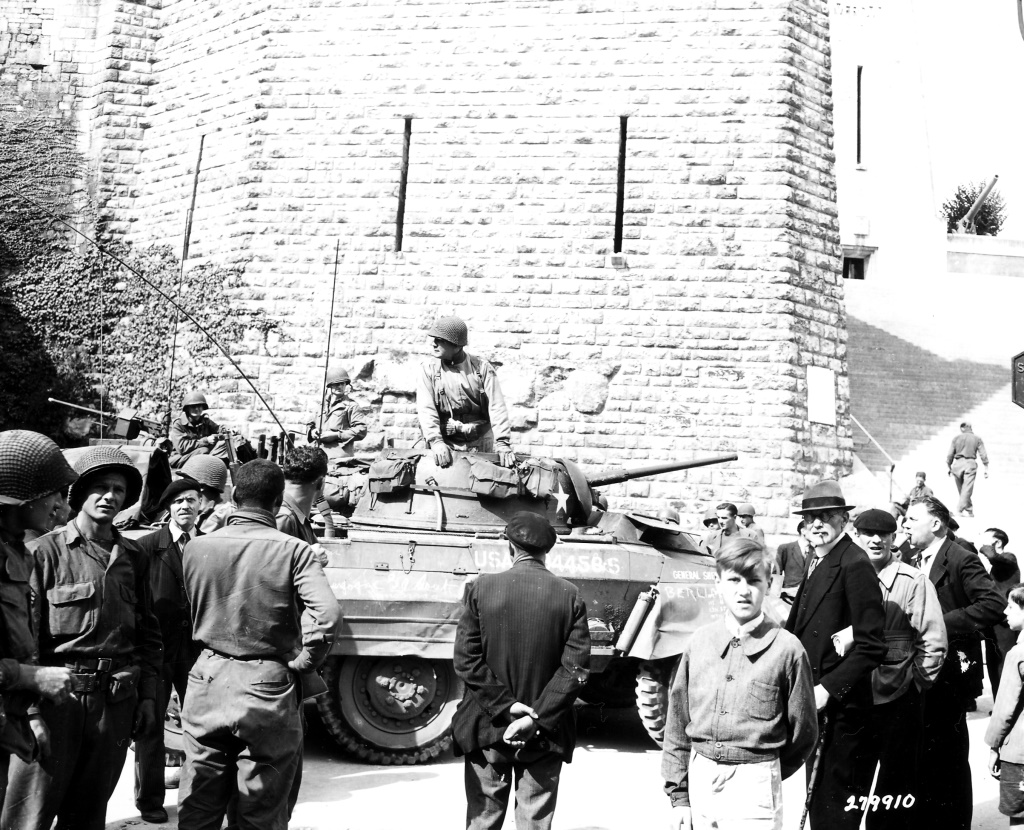
Early in the morning of August 29, a warning order was received by the division to prepare for an attack to the east with the objective being Verdun and a bridgehead over the Meuse River in that area. This attack was to be made by all three combat commands moving abreast through difficult terrain including the Argonne Forest. Reports from all sources indicated that the enemy was retreating to assembly points, to the east and northeast. The 9.Panzer-Division was reported to be assembling in part in Verdun. However, the enemy retreat had been so rapid and so many units had been disorganized and overrun that no major opposition was expected if the bridgehead was seized immediately. All units of the division exercised caution against isolated attacks by overrun enemy bands. CCA and CCB, holding bridges and bridgeheads over the Aisne River were hastily assembled in the vicinity of Beine-Nauroy reorganized, and by 1800 began their attack to the east.
CCB advanced as far as St-Étienne-à-Arnes by nightfall. CCA was in a position generally south of the Argonne Forest. CCR had been held up due to a lack of gasoline. At daybreak, all columns continued to advance to the east. By 1255, a unit of CCA led by Col McConnell had crossed the bridge at Verdun and occupied the city. The enemy had laid mines under the bridge but had been forstalled from blowing them by the quick action of the FFI. At the same time the bulk of the force of CCA had made crossings in the vicinity of Villers-sur-Meuse, to the south of Verdun. Due to their difficult routes over numerous streams and small rivers, which had to be forded, and bridged, CCB and CCR were delayed in reaching the Meuse River. They succeeded in crossing on August 31. Supplying an armored division is normally a rather difficult job but becomes even more so when such a division travels. tremendous distances in a short period of time. The 7-AD traveled more than 600 miles in three weeks and although a Service Park carrying stocks of Class I, II, III and IV supplies functions close enough to combat elements to be of great value, the supply lines were drawn to the breaking point as the division reached the objective Verdun.