

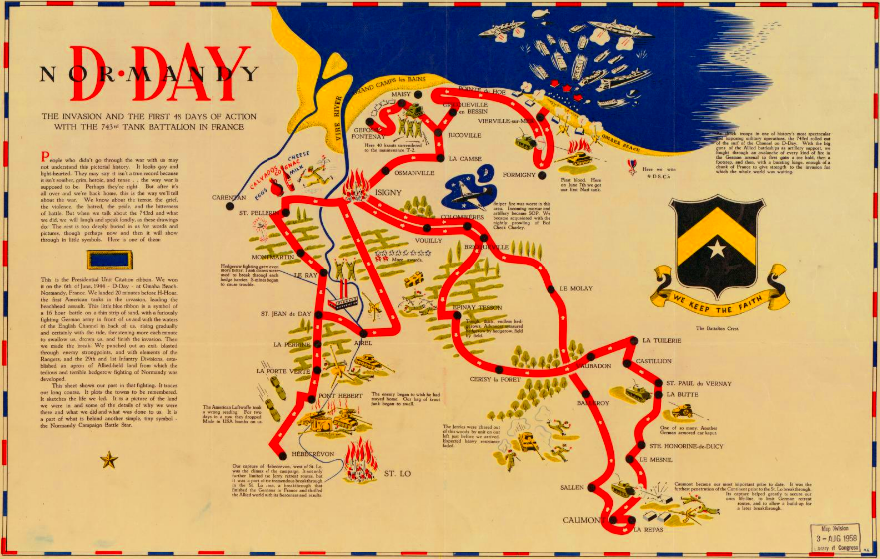


 On June 12, folks back in the States picked up their newspapers and read that ‘more than’ 1400 US bombers, the largest number ever sent over Europe to that time, hit 16 German air bases in a 400-mile area. The war was also going on down on the ground. Four miles south of where the 743-TB was waiting in the fields for orders existed what war left of the town of Caumont, a town once of respectable size and still of considerable military importance. A half dozen main roads radiated from this hub. To an army intent on building up a superiority against the enemy in men and arms, it was vital. To the tankers and the doughs, Caumont was just another town, a little bigger than most they had seen so far. The orders were to take it. While Baker Company was held in reserve, Able and Charlie Companies moved out at 0330 in the morning to work south toward Caumont with the 26-IR of the 1-ID. An occasional house or a bush or a position suspected of harboring undesirable tenants was given a treatment of lead by trigger-happy machine gunners and riflemen. Tanks joined the spraying parties whenever the infantry called for it. In working with infantry, a separate tank battalion learns not to shoot at everything in sight. It might turn out to be a platoon of friendly infantry. Tank-infantry coordination is a difficult operation. It might appear to be an easy matter of simply moving tanks along with men. It was far from that, as tankmen and infantrymen were to learn so well later in the hazardous hedgerows beyond the Vire River.
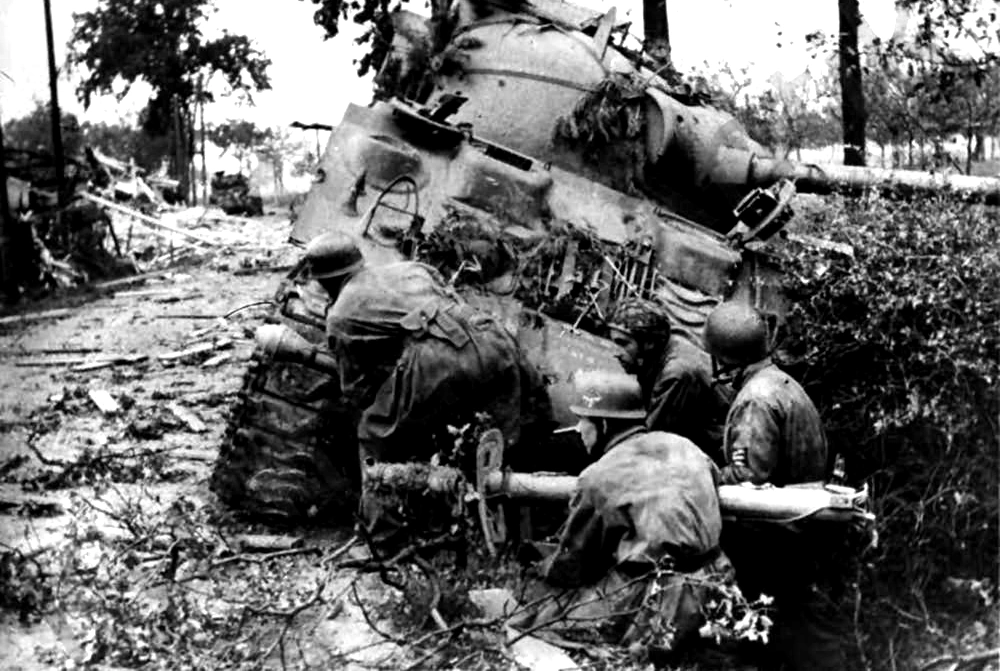
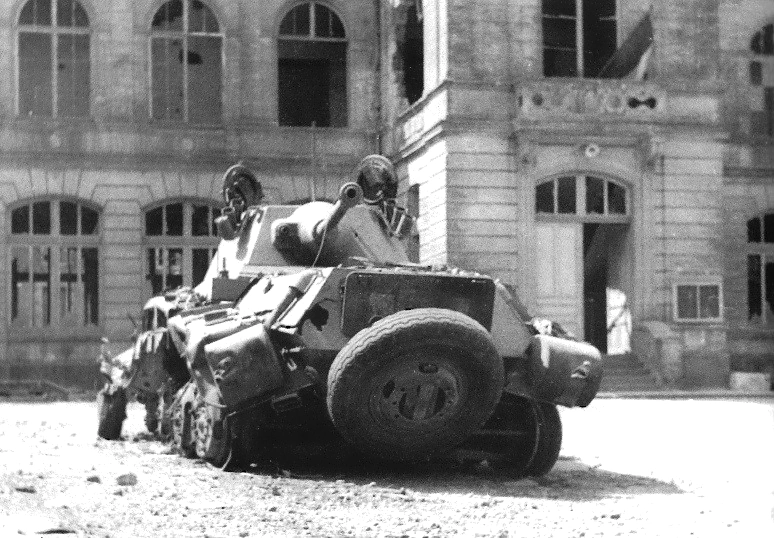
On this day, tank-infantry operations were going smoothly as ever set down in an official Army field manual on the subject. But before more than a few hundred yards had been gained southeast of Sallen, it became obvious that the doughboys weren’t just going to walk right in and take over a place like Caumont. Jerry was going to fight for it. On the way down, Baker Company encounter two pillboxes manned by machine gunners. They were destroyed. A little farther along, the tanks met the formidable obstacle of an 88-MM AT gun capable of sending a projectile through a Sherman as if its hull was made of cheese. This AT gun was destroyed too. Charlie Company on its way spotted a number of German armored cars on the roads outside of Caumont. It was successful in knocking one of these out. The others played hide and seek among the roadside trees and embankments, firing and running. The tanks pressed on and as the evening wore along both companies began receiving heavy concentrations of artillery fire mixed in with the customary mortars.
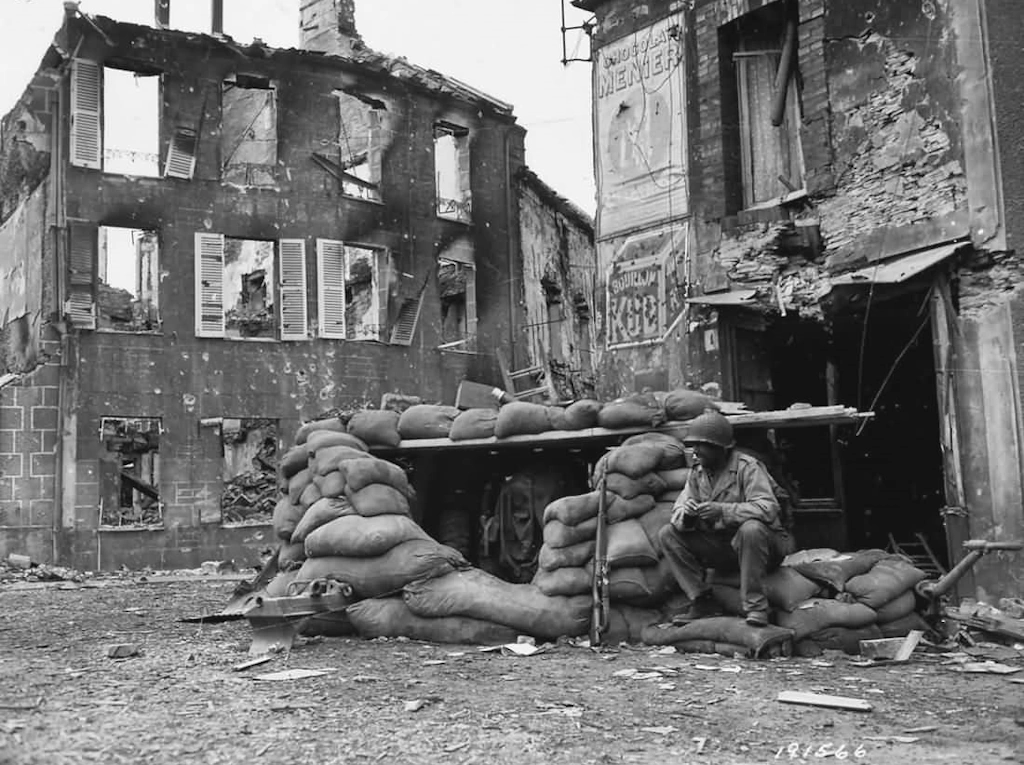
 Direct fire from AT guns worried tank commanders. Machine gun fire pinned down the doughboys. The attack, however, kept moving in toward the objective. It was slow and cautious work. The tank infantry coordination of the 26-IR, veterans of the proud and battle-hardened, in Africa and Sicily, 1st Infantry Division, remained extremely good on this attack as strong point after strong point was reduced and overrun with the minimum of casualties to the doughs. The infantry efficiently infiltrated AT gun positions – a tank cannot bull its way past an AT gun without somebody getting hurt, a sorry lesson learned in Africa by Armored Force men. Machine gun positions, deadly to doughs, was another story to tanks. A few rounds of HE (High Explosive) from the 75-MM fired into the laps of the crews usually was all that was required. An AT gun was almost always protected by flanking machine gun nests. Each was a tactical problem to be worked out by infantry and tankers. By 11 o’clock, with the last flush of twilight leaving the sky, men and tanks had worked problem by problem to the outskirts of Caumont. A few of the infantry kept right on going into the town, but darkness made it too tough to take. The line was pulled back to the edge of town. Caumont was to be stormed by daylight.
Able Company, northeast of Caumont at Mitrecamp, pulled out of a farmer’s cow pasture at 0530, the low morning sun casting long shadows beside the southward moving tanks. It was hardly a quiet sunrise. The Germans, expecting the attack, were throwing in plenty of mortar and artillery, making it hard going for the infantry. At 0600, Charlie Company pushed in from the northwest. A German scout car went up in a sudden burst of flame touched off by a blast of HE from platoon leader Lt Al Williams’ tank. An AT gun position spotted by the 29-year-old company commander, Capt Ned Elder, was knocked out by his gunner. All Charlie tanks were in action, crashing shells into German-occupied buildings, spraying enemy infantry with hundreds of rounds of machine gun fire.
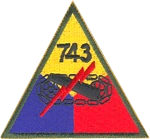
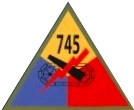 When Able Company rolled up to Caumont, the Germans were pouring out of the town trying to escape to the southeast. Gunners lined up their sights on several armored cars and self propelled guns. Nobody kept track of the actual number knocked out. Things were too hot and too busy. But not all the Germans got away. As dusk set in, the 743-TB line companies were together except for the three Able Company tanks holding with the infantry at Le Repas where the British were seen on the left flank. And then, Sgt Mayo’s tank showed up – battered, muddy, nearly out of gas, badly in need of maintenance, but still running. It came rumbling into Sallen after Sgt Mayo and his crew had fought with the 745-TB since getting mixed up on the beach D-Day. As night and enemy shells fell on the bivouac area at Sallen, the rumor went around from tank to tank that here it was, men – a break. It was a rumor based on information from higher headquarters. For the Battalion Commander was told that the 743-TB would be given enough time to maintenance their vehicles and rest their men before going on. It was a logical time for a rest, even a short one. The tanks had been in constant action since something like 10 minutes before H-hour on D-Day. They had taken heavy losses in the first two days of combat. They had helped crack open Hitler’s allegedly impregnable Atlantic Wall, established a beachhead across which would pour armies of men, and had aided to secure that beachhead by clearing out the road network behind Omaha Beach, then had rolled inland more than 50 road miles to take their most important prize to date — Caumont. For Caumont was the furthest penetration made by the Allies into France prior to the later St Lô breakthrough. Its capture helped in a great measure to secure our brand new life-line. It sealed off roads that limited German retreat routes, and it was to be an Allied supply hub through which would pour the raw material of men and machines that would result in a great all-out offensive to break into the interior of France.
The tankers thought the taking of Caumont was a good place to blow the whistle for a rest. And that’s how matters stood the night of June 13. On the morning of Juine 14, Maj Duncan received orders detaching the 743-TB from the V Corps, under which the Battalion had been fighting, and attaching it to XIX Corps and the 30th Infantry Division, just landed in France and assembling south of Isigny. Once again it was ‘Move out, Verify!’ And Verify, now a battalion of veterans, moved out.
(French)
