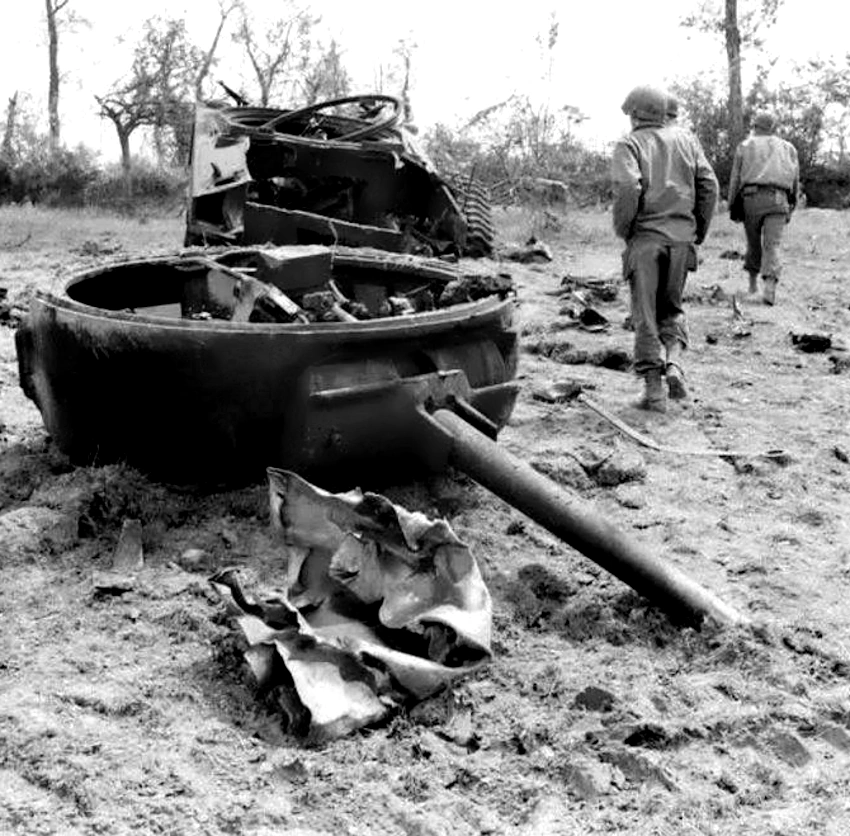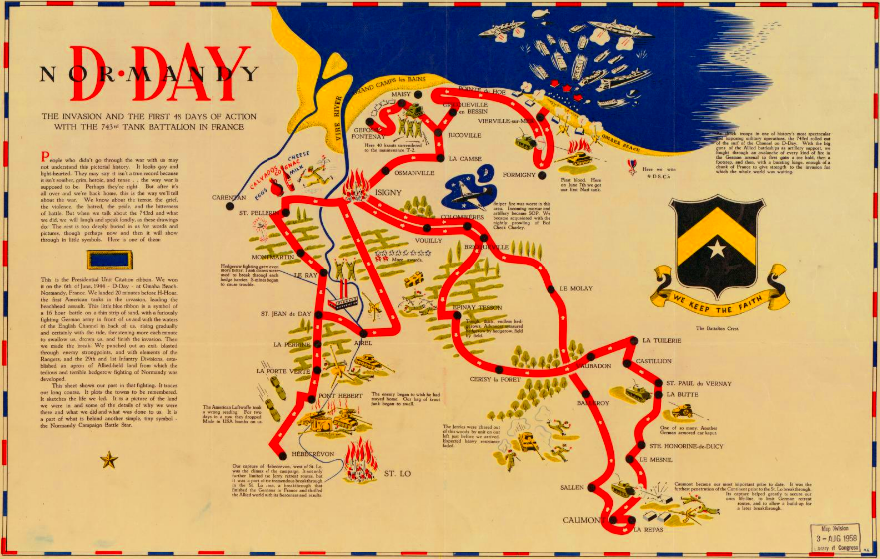


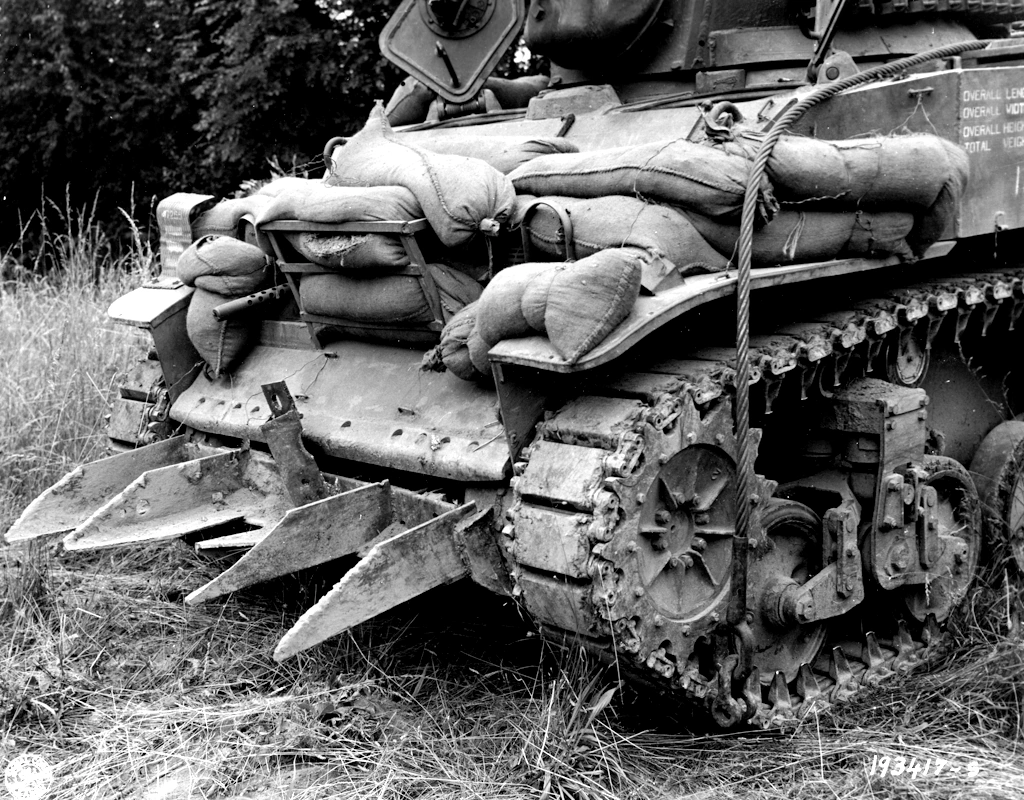
Able Company was held back in Division reserve, ready to move out as soon as needed. It was not an idle day. Some tanks helped mop up Vierville-sur-Mer, as snipers were making themselves deadly nuisances there. Two tanks were sent back to the beach to assist the shore brigade in towing loaded but stranded invasion craft out of the surf. Maintenance crews recovered two more tanks and got them in shape to make their way off the sand under their own power. In mid-afternoon, Able Company moved to the battleground west of a group of houses called St Laurent-sur-Mer where it backed up Charlie Company in decontaminating that area of the Wehrmacht. When darkness near midnight at last called a halt to the long day’s work, the company assembled in the Vierville-sur-Mer bivouac fields.
The story of Skipper and the Sniper is typical of D-plus-One.
Capt Lloyd J. (Skipper) Adkins, a fountain pen salesman from Peoria (Illinois), had brought his live-wire energy a month ahead of the Battalion in England and begged his way into the combat assault wave on D-Day. He landed as Battalion Supply officer, which meant he had responsibility for the vital ammunition and engine fuel to keep the tanks fighting. As could be expected under the circumstances, the M-9 Army trailers loaded with these vital supplies were landed all over the French Coast. Two out of four trucks got in on D-Day, the other two put their wheels ashore on D-plus-One. Skipper Adkins located the M-9 trailers and got nine of them off the beach into the first assembly area. As his trucks readied France, he began the job of seeing supplies through to the tanks.
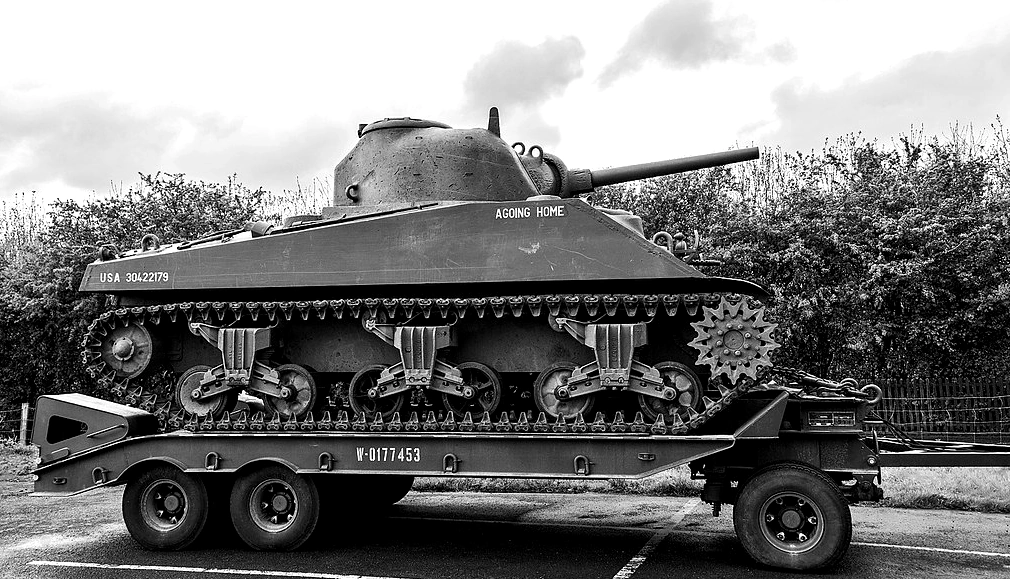
Near the close of D-plus-One, at least one man in the Battalion was sure the Skipper was dead. Lt Floyd Mitchell, a liaison officer, had come in on the same LCT, and at the close of this day he happened to be flat on his face by the side of the Pointe du Hoc road, under sniper fire, waiting for a pre-arranged meeting with Capt Adkins and the first supply trucks. He had a worm’s eye view of a clump of buildings from which smoke was rising. This had been a village until a few minutes ago. The Jerry had thrown in a terrific artillery barrage, pin-pointed directly on the road at the center of town, Vierville-sur-Mer. And by Mitchell’s watch, when that barrage hit, that was precisely the time Skipper Adkins would be leading his trucks up to find the tanks. An infantry dough confirmed Mitchell’s fears. ‘They caught a whole bedpot full of trucks, sir’, the dough who had just been there said. ‘Trucks and GIs knocked out all over the place. I couldn’t tell what outfit’. The recon officer was still pinned down by the side of the road when he heard the motor of a jeep. He raised his head cautiously and took a look. There in the jeep was Capt Adkins. He had missed the barrage by seconds.
But artillery barrages were not the only worry to hamper a man about his job just off Omaha Beach. There were the hundreds of sharpshooting snipers. The barrages were noisy and terrifying, but they did have the mechanical, impersonal quality which is a quality behind a catastrophe that is hurled across miles. The sniper was a personal villain, one man sighting one gun, selecting a personal target and purposefully, deliberately aiming the bullet. The barrage and the bullet were both deadly. But at least the whine of a large shell gave warning. The bullet came suddenly. It came from a bush, or a tree, or an attic window, a cellar doorway, a hedge, or a log. The sniper was everywhere.
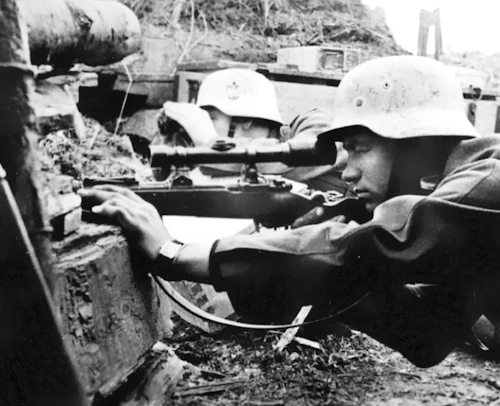 And here Lt Mitchell saw Capt Adkins’ jeep rolling along as if for a garrison jaunt between the company area and the post exchange. It was heading directly for an intersection where already lay a young American fresh dead from a sniper’s slug. The German sharpshooter had the intersection covered from a nearby house. He could pick off anything that tried to move past that corner — except a tank, and a jeep is not a tank. ‘Skip!’ shouted Mitchell. The jeep squealed to a sudden stop. ‘Don’t move past that corner — you’ll be killed!’ Mitchell yelled. ‘There’s a sniper in that house!’ ‘There is?’ said the Captain, taking a quick look at the house. At the same time he jumped out of the jeep. ‘Well, let’s get him!’ Without any further ado, Capt Adkins led the way up and into the house.
Grenades were tossed in. Then every room was given a quick search — each room a short, grimmer drama of an old childhood game, hide-’n-seek. It was an old French house of many rooms and many passages. It would take a long time to probe every spot. A well-concealed sniper could easily be overlooked in a quick search. Capt Adkins squinted at an innocent plaster wall and thought of his trucks and the supplies and the tanks that needed shells and fuel. He thought of one sniper that was holding up his trucks. The Skipper clipped out his decision: ‘Everybody out!’ he said. As they left the house, Capt Adkins struck a match. By the time he got back to his jeep, the house was burning fine. Traffic began moving undisturbed past the intersection.
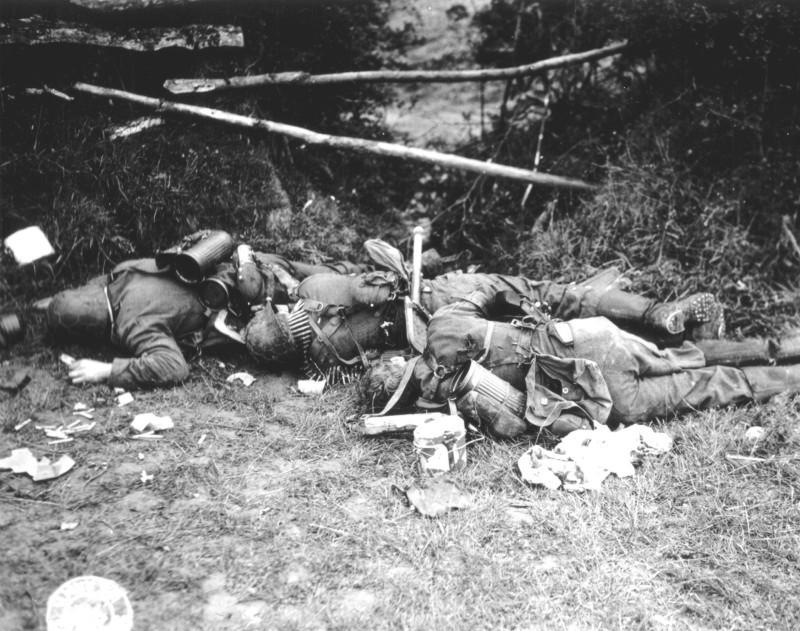
In other ways the 24-hour a day nature of combat was being brought home. Darkness in Normandy brought a close to tank action until daylight, but by night tanks did not just stop where they were and wait for dawn. Whenever possible, the companies withdrew to a bivouac where the tanks could set up a perimeter defense, each tank covering a field of fire. Men exhausted from fighting all day then had to stand a share of guard through the watches of the night. At least one man on each vehicle stayed awake at all times, ready to alert the rest. The Battalion was never asleep. It could never completely relax. Its men lived on a day-to-day life or death basis. There was ever the presence of danger. S/Sgt Vernon D. Skaggs, a tough and popular tank commander from Clarkson (Kentucky), took his tank to the ‘rear’ on a routine supply mission. On the way a whole platoon of German infantry popped up and tried to ambush the Sherman. Skaggs grabbed his tommy gun and began shooting at point blank range. The Germans were driven off, leaving their dead behind. The tank continued its routine mission. The days – and nights – would go like that from now on.

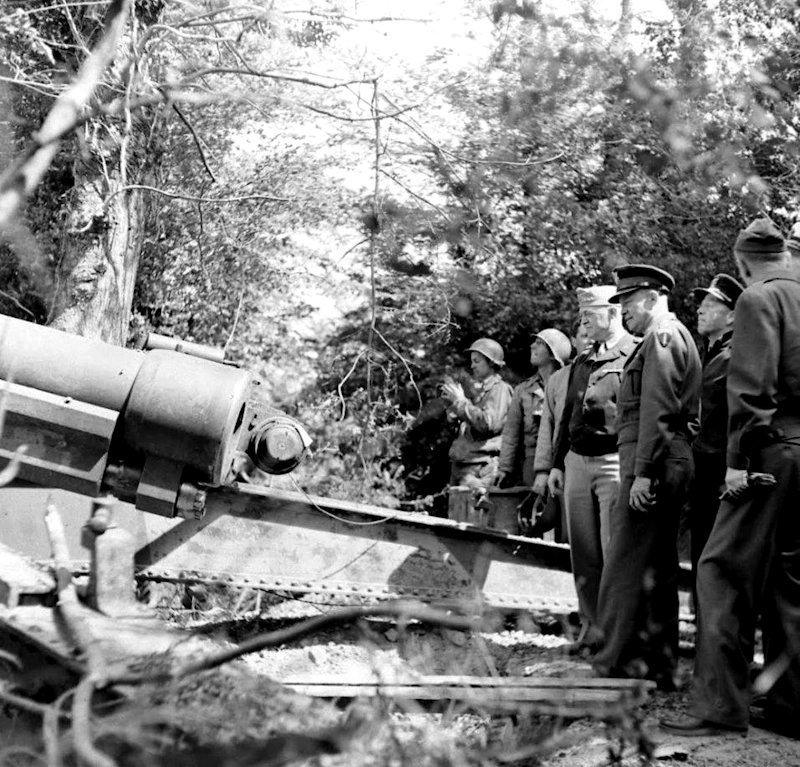
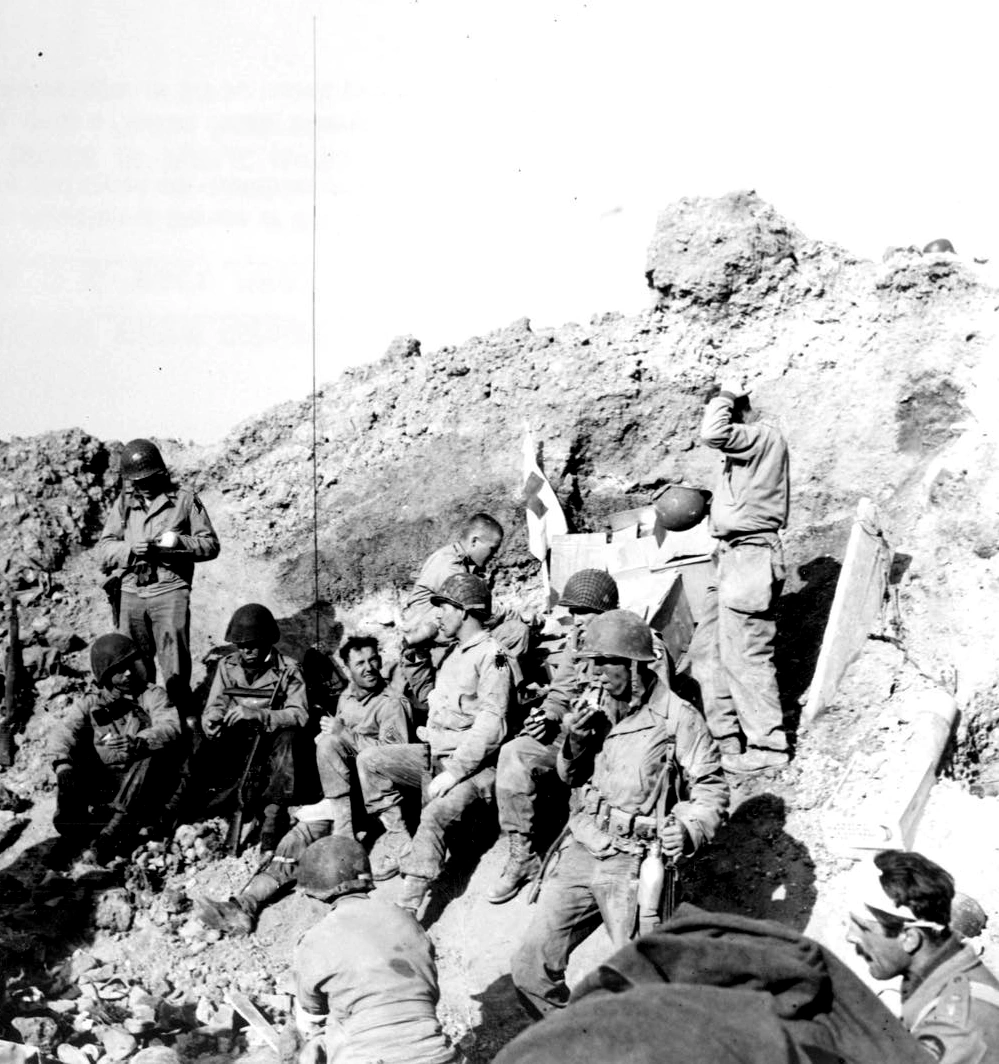 For three days, the Rangers had found themselves in trouble. On D-Day they had sealed the perpendicular cliffs rising up from the beach at a hot spot on the map called La Pointe du Hoc. This steep-walled jut of land was one of the Germans’ key strongpoints in its big-gunned coast defense system. The big caliber artillery pieces had been installed on high ground so as to point down the throats of an invading army, and the gun crews were protected from counter-fire by thick steel and concrete fortifications. In this well-shielded position, the Germans thought they had an impregnable gun site. The American Rangers, trained to tackle anything, proved it wasn’t. They were assigned the job of knocking out La Pointe du Hoc. On D-Day morning, they had clawed their way up the cliffs, broken into the defenses, knocked out the key guns. But while they had occupied the gun emplacements, the enemy in turn had surrounded them. The surviving Rangers found themselves in a siege circle.
On the third day, June 8, they were fighting on with their last remaining bullets, in some instances using German guns and ammunition after their own last rounds had been expended. They had no food, no water. At six in the morning, Able and Charlie Companies of the 743-TB moved out from Vierville-sur-Mer to break through the siege circle and relieve the hard-pressed Rangers. As the tanks, with Able Company commanded by Lt Joseph Ondre leading, rolled along the coastline road without meeting early resistance, the Battalion Headquarters section made their way out of the Transit Area off the beach. With the command half trade and command tank, Maj Duncan joined Able and Charlie Companies Advancing on Grandscamps. The assault had begun at 1015. By noon, contact had been made with the Rangers and infantry of the 3rd Battalion, 116-IR (29-ID), moved in to relieve them.
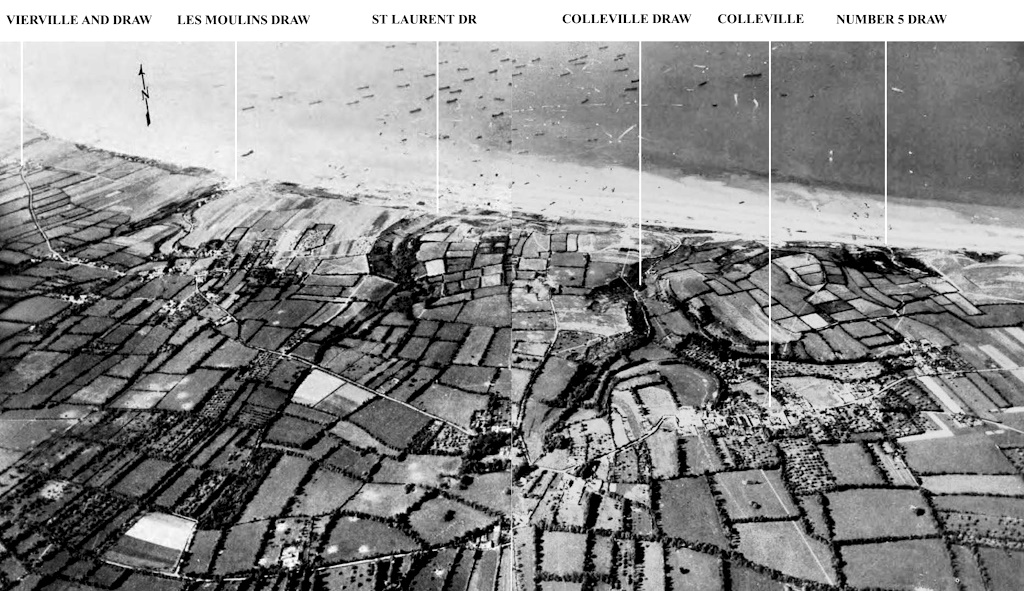
 Charlie Company ran into trouble with anti-tank mines. During its assault maneuvering about ‘the Point’ three of its tanks were damaged and stopped. Two more dropped out with engine trouble. As maintenance crews came up to start the work of getting these tanks back into action, the two companies moved on west toward Grandcamps. They didn’t get very far. Anti-tank mines were everywhere. Combat engineers had a grim job cut out for them, sweeping this road. Able Company split from the column to go a mile south through sniper-infested, hedged terrain to a scattering of houses called Cricqueville-en-Bessin, where it followed a route west again toward Maisy. There wasn’t much that was impressive about Maisy. It was a station stop for the railroad and it controlled a network of two important roads and several lesser routes, but the town itself was little more than a stone pile – all the once-quaint and once-quiet French villages in that sector were being reduced to so much rubble and so many shattered walls to mark where dwellings once stood. The Germans were determined to defend these piles of masonry, for each place defended meant delaying the invading forces. And delay meant time for German FM von Rundstedt to throw in his powerful mobile armored reserves. As tanks and infantry came up to take Maisy from its rear, the rattle of machine gun fire and the sudden fall of mortars and artillery greeted the advance. Tank gunners went to work with the 75-MM cannon and re-assorted the rubble heaps. The enemy was knocked out of Maisy, but he continued to put down heavy artillery on the place in an attempt to keep Americans from occupying the ruins.
One tank of Able Company (with Maj Duncan, Capt Miller and Lt Jones giving it close support with carbines) was sent through this storm of artillery. They went right through Maisy. Two enemy pillboxes were sighted by Maj Duncan and Capt Miller on this expedition. Lt Jones handled the fire orders over the radio that brought destruction to both fortifications. On June 9, D+3, Baker Company, which had been maintenancing the day before, now took over to support the work of the 116-IR around Maisy. The Rangers, still fighting on after being released from their costly siege battle at La Pointe du Hoc, found themselves handed another tough assignment – a series of strong pillboxes just south of Maisy. They began the job of blowing the deadly ground fortifications sky high. But it was a costly business, the Rangers asked for support. Baker Company moved south of Maisy to help. The Rangers wiped out the pillboxes and 125 ex-occupants were taken prisoner, the first sizeable batch of Wehrmacht to be taken in the early fighting.
Able Company, in the evening, saw 40 more Germans into the Prisoner of War cage. The two-score Nazis gave themselves up to the maintenance T2 – an old Grant medium tank rigged out as a tank recovery vehicle with block and tackle hitches, bulging with extra bogey wheels and strung like some strange Christmas tree with a variety of chains, tools, special maintenance equipment. An imposing looking gun projected from its turret – a fake barrel. The T2 recovery tank was armed with nothing bigger than a machine gun. But it bagged 40 krauts with its ferocious appearance. All companies camped near Maisy that night. Maisy had by now all but disappeared – except for the wine shop. Either by chance of war or through some sentiment of German gunners, the wine shop stood invitingly, practically undamaged and intact.
The night of June 9, is marked by Sgt (then PFC) Jean M. Blanchette, of Woonsocket (Rhode Island), as the night on which, after four days of fighting, he finally got some food, some sleep, and a remarkable letter from the FBI in Washington. S0t Blanchette, who once had to make up his mind whether he would join the American or the Canadian forces and decided to pitch in with the forces of the United States, waded through the surf on D-Day at H-hour plus 15 minutes. His job was to maintain radio contact between the 743-TB and the 116-RCT. Ahead of him through the water, the French-Canadian pushed a water-proofed radio on a lifebelt pontoon. Through the next four days he moved with the commanding officer of the 116-RCT directly behind the assault force, relaying over the radio to the tanks orders for fire support. The tank radios were of utmost importance during these first four days of fighting, as the infantry had lost most of their communications in getting to the beach had to rely almost entirely on tank radio relays to get important field commands and information through.
Once during this time, the Woonsocket soldier’s radio brought fire from the Navy offshore to help the tanks through a tough spot. On June 6, while many of the tanks were held on the beach by enemy artillery fire falling on the only exit, Blanchette radioed the Headquarters section adrift in the Channel aboard LCT-29. He gave the position of the enemy battery. This information was relayed by the radio in the command halftrack aboard LCT-29 to the Navy. The ancient battleships standing offshore gave the position a broadside. The enemy battery was silenced. By the time he was sitting outside La Pointe du Hoc controlling fire on the assault to relieve the Rangers (his radio went dead and he was unable to correct the few rounds that smashed into the Rangers’ positions) Blanchette was beginning to get mighty hungry. On June 8, and June 9, he was still with infantry, still with his radio, and much hungrier. A begged chocolate bar was a feast. Everybody in the infantry seemed to be in the same fix – no rations. On the close of June 9, Blanchette got back to his own outfit. Somebody dug him up a K-ration box. There are a few times in the Army when a cold K-ration tastes just fine. This was one of them. But before the dog-weary soldier from Woonsocket grabbed himself some sleep, he was handed a long, white, official envelope that had come over with some last-minute mail tossed into the reconnaissance halftrack just before the invasion convoy left Southampton. It was a letter addressed to Pvt Blanchette from the Federal Bureau of Investigation. The letter informed him that because he was not a naturalized citizen of the United States, he would report ‘immediately’ to the FBI branch office in New York City (New York), without delay. The matter failed to keep Blanchette awake that night.
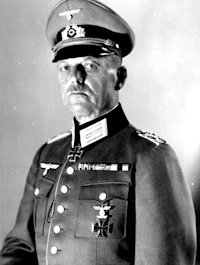
By D+4, June 10, the Allied Combined Chiefs of Staff meeting in London could consider the beachhead won. Despite German reserves rushed into Normandy by Gen FM Gerd von Rundstedt and Gen FM Erwin Rommel, thousands of American and British soldiers landed as reinforcements, ferried from Britain in the face of high winds and heavy seas. 60 miles of costal front was in Allied hands. But a beachhead was hardly enough room in which armies could maneuver. And it would take armies to knock Germany out of France. The Allies began driving inland. The infantry pushed through the hedges southward and cleared the wooded area called Foret de Cerisy a big block of green shown on waterproof combat maps that smelled like linoleum. Able and Charlie Companies teamed with the 115-IR (29-ID) to sweep with the southward attack. The tanks moved out at 0330 in the morning just before first light. The 29-ID jumped off from Colombières, a town distinguished by a church and a steeple a few miles from the night’s bivouac near Maisy.
The advance swept three miles to the vicinity of some dwellings named Baynes. That was the push for the day. Terrain was the toughest obstacle. Although enemy resistance was expected every foot of the way through hedges and fields, no real opposition developed. Bivouac was made a mile farther south of Baynes at six in the evening near a sprinkling of farmhouses and barns known as La Communette. There Able and Charlie Companies waited for gas and supplies. In the old horse cavalry, the horses were combed and fed before the men looked after themselves. In the tank battalions, the crews gas up and re-stock their shell loads when the supply trains reach them before any other consideration. This was done often under shellfire.
The following day, June 11, Col Duncan went back to Maisy for Baker Company and led it to La Communette just in time to catch Able and Charlie Companies at noon before a move to Vaudebon. The afternoon move was a 32-mile road march through an area previously swept by infantry and placed the Battalion near Vaubadon beyond the heavy woods of the Cerisy-la-Forêt. The tankers had learned to dig in. A medium tank during the fall of artillery is about as safe a place a man could be, unpleasant as the experience is. But a human being – being human – does not want to stay canned inside a steel shell for days and nights on end. Tankers would tell of times when they spent three days and nights buttoned up inside their vehicle, never daring to expose themselves, and throwing their refuse out in empty shell casings or a steel helmet. In the fields of France, tankmen always within a few yards of the enemy, got out of their vehicles during night halts and preserved their lives by a bit of energetic spadework. Enough earth was dug to allow the men to lie down with some degree of comfort underneath the tank. First the hole was dug, then the tank driven up over it. Extra dirt was heaped up at the front of the tank which always faced the enemy.