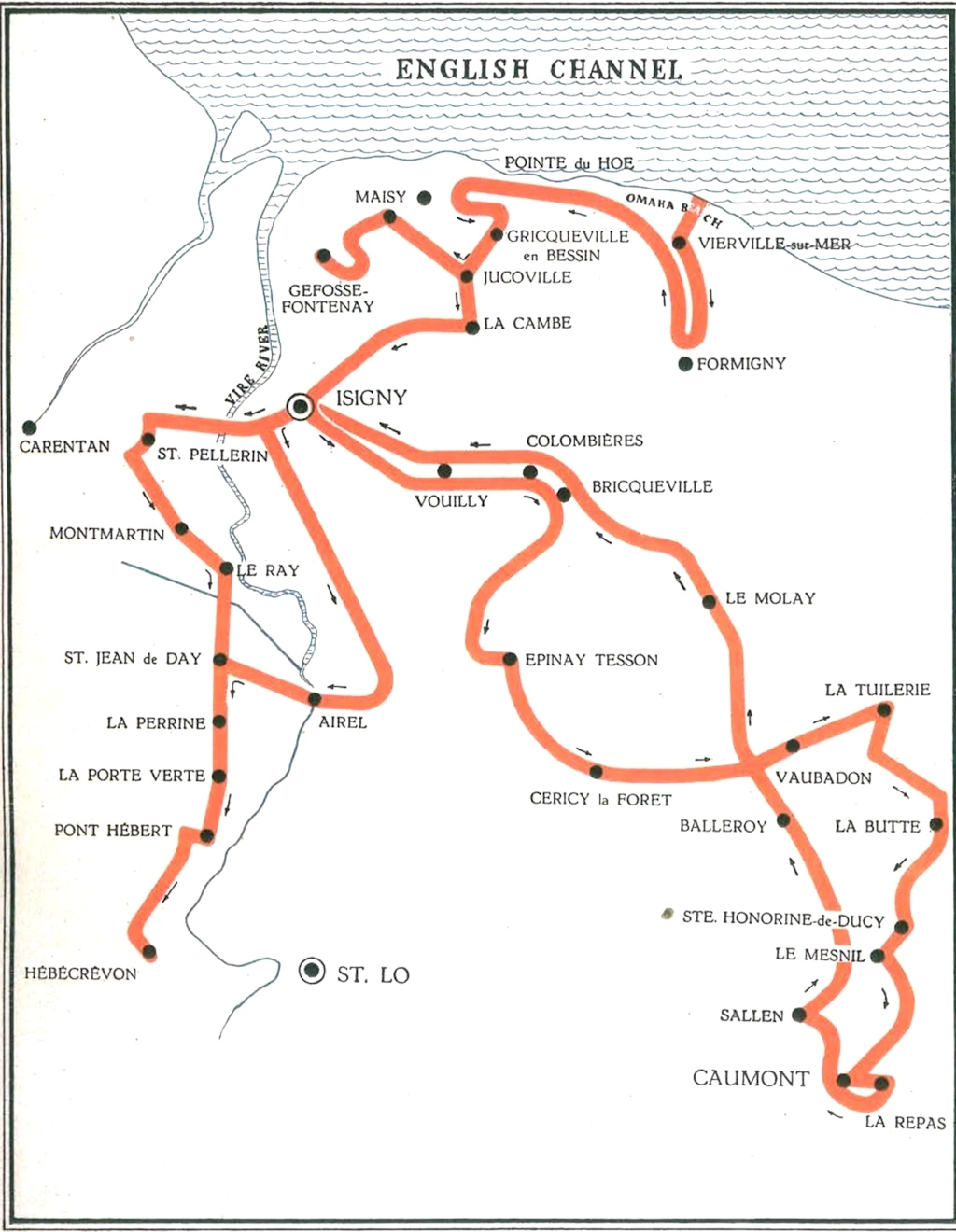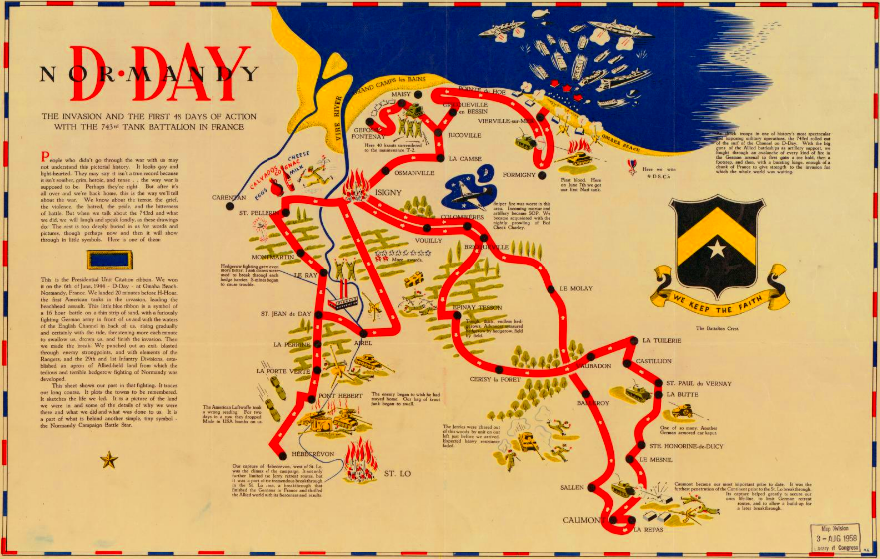


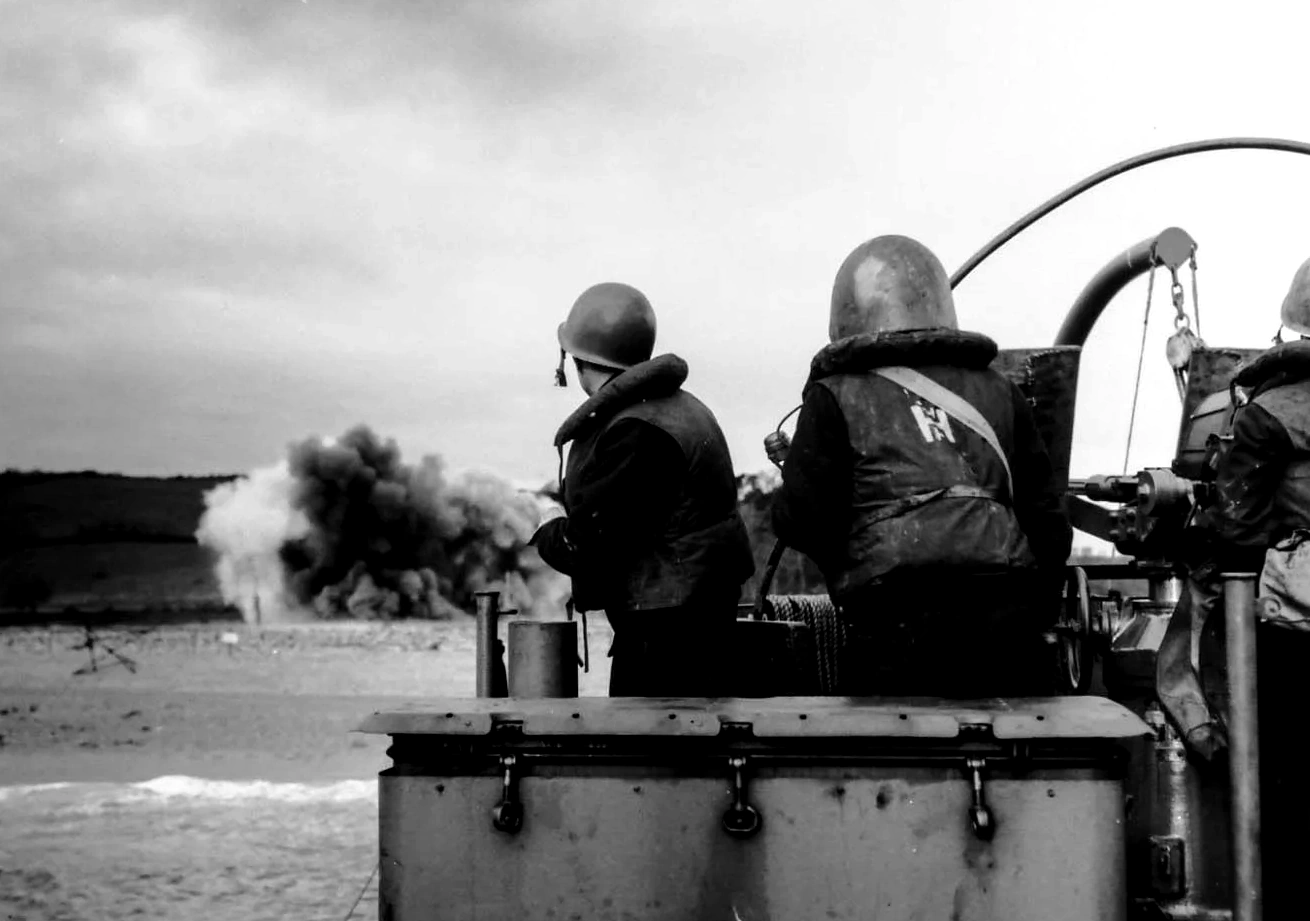
We knew what we were going to do. Yes, before men hit the beach, it had all been reduced to a neat battle plan, with neat maps, and neat orders. Everybody knew his exact part. Everybody knew what he was supposed to do. Or did he? No matter. Forget the men a moment as individuals. Forget that but a short time ago most of them were not soldiers, trained to the business of war. Forget them a moment except as one part of the vast plan to put armies ashore on France. This is the background of the landing. Months before the assault wave started out from England, the battle for a beachhead began. It began through the air. The American Eighth Air Force and the British Royal Air Force, smashed at Germany’s war industry for nearly a year, hammering with special purpose at aircraft factories. In the Battle for the Sky, the Luftwaffe was steadily reduced in power day by day while Allied air superiority increased. As the time for D-Day narrowed down to weeks, German land fortifications and supply points were heavily and repeatedly bombed along the whole invasion coast.
The vast military wheel which was the Invasion of Europe began turning toward the French Coast east from its starting point in Britain on the night and morning of June 5, and 6. It was the greatest amphibious operation by armed forces in all military history. It was as well the most highly complex undertaking ever put into effect. The vast and complicated scheme of getting men and guns ashore on France was accomplished despite all hazards — sea and land mines, enemy submarines, E-boats, and Nature’s own fickleness: a fierce gale whipped up in the North Sea that swept down the Channel and postponed the big jump-off by one day, from the early morning of the 5, to the 6.
Some six hours before the tanks in their LCTs moved toward shore, Allied paratroopers were dropped in the largest landing of airborne troops ever attempted — everything about this invasion was on a huge scale. Behind Omaha and Utah beaches, the two land points selected for the ground troops assault, the American 82nd and 101st Airborne Divisions ’chuted from their air armadas of low-flying big planes, struggled out of their harness on hitting the night-black ground, then swiftly assembled into combat teams to strike inland on the right or west flank of the beachhead zone. The British 6th Airborne anchored the left or east flank. Gliders were also used in great numbers at this time.
Army Intelligence thought there would be only a light holding force of German infantry to defend the Omaha Sector. This ‘thin’ coastal garrison turned out to be the whole German 352.Infantry-Division — moved up for combat ‘maneuvers’ in the beach area a few hours before the invasion put out from Britain. At Utah Beach on the right flank, the assault went like clockwork — the carefully designed clockwork planned and built months before, this not without cost. The treacherous waters off the coast swamped boats, drowned men, caused confusion and casualties. There was fighting at Utah. There was equipment destroyed and American youth slain there. But such casualties were held to minimum, and the advance inland was at the beginning swift and sure. It was at Omaha Beach, to the left, that war’s special hell broke loose.
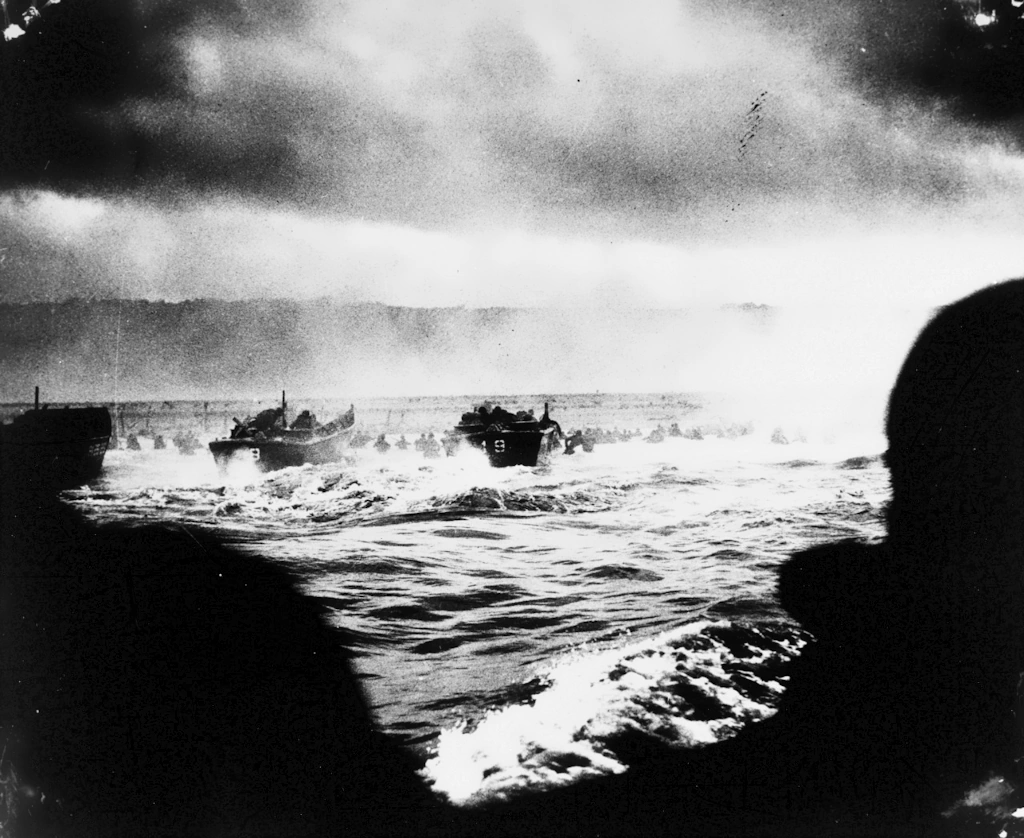
For a time it looked like the non-bombed enemy coastal guns plus the weight of the defending German 352.Infantry-Division was going to doom the assault — to make the difference between success and disaster, to tip the balance from a precarious foothold to the loss of this foothold beneath an in-surging tide. The plan was very big, very neat, and ably directed by the Allied Forces. Every unit had its own battle plan as one small part of the whole vast scheme. the 743-TB’s Battle Plan went like this: for combat purposes, the sandy strip that was Omaha Beach was divided into sectors. These were named Easy Green, Dog Red, Dog White and Dog Green.
<br
The tactical plan was carefully worked out and marked with meaningful phase lines in colored grease pencil on waterproof maps. Baker and Charlie Cos’ DD tanks were to hit the beach at H-minus-10, with Baker Co on Dog Green at the right, and with Charlie Co on Dog Red in the middle. At H-hour, Able Co was to put its regular M-4 Shermans ashore from LCTs on all four sectors of Omaha, so that a ‘dozer’ — a medium tank rigged with a bulldozer blade up front — would be available on each beach. Combat engineers with demolition explosives were to be on the beach al H-minus-20, ten minutes before the armor, to destroy obstacles in the water and on the coastal front. As a particular mission, they were to blow the road blocks built by the enemy across two of the possible exits off the beachfront. When the tanks reached the beach, they were to give the engineers covering fire for this operation. But Battle Plans don’t stay the way they are drawn on paper.
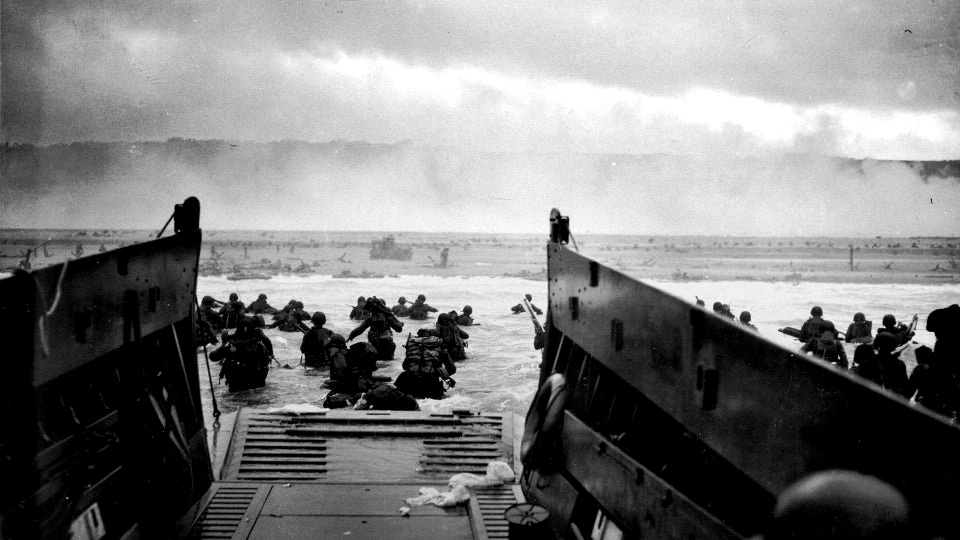
The first departure from initial planning came in the Channel when it was decided not to launch the unseaworthy DD Shermans but to take these tanks to the shore in the LCTs. Under enemy fire and buffed by rough surf, the LCTs brought in the tanks everywhere and anywhere they could along the four beach sectors, although the general plan was followed. Charlie Co had the first lank ashore on Dog White at H-minus-6, four minutes behind the paper-planned time. Baker Co, got units on land at almost the same time, and Able Co followed. The LCT carrying Baker and Charlie staff tanks, and another LCT with Headquarters Section aboard, tried unsuccessfully to reach the beach. Headquarters did not get ashore until the following day. The way it was planned, the tanks would give support with covering fire for the combat engineers, move out across the beach and drive inland as soon as two exits had been cleared. The Shermans were then to advance as far as they could inland 2 miles to a phase line. That again was the plan, which didn’t work out that way.
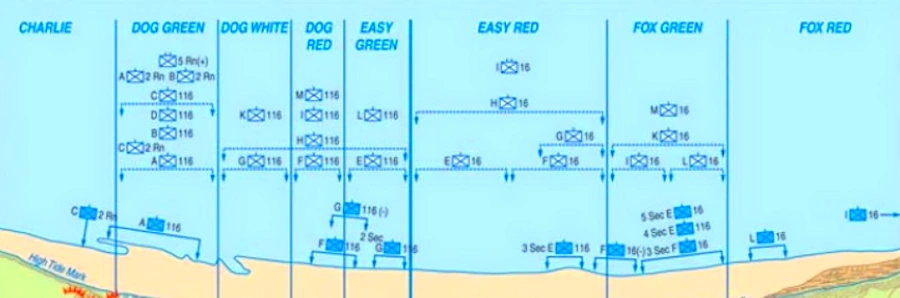
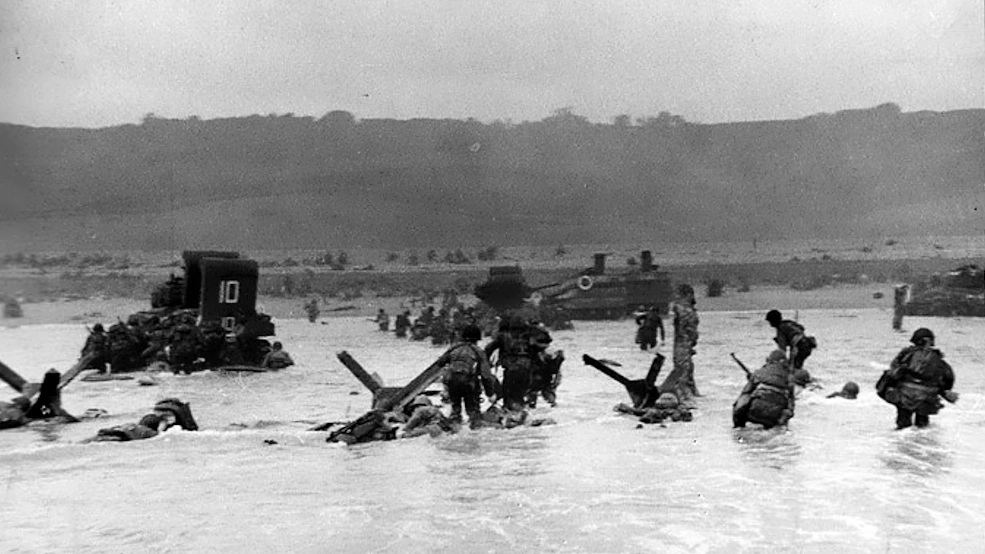
The ice-cold Channel Waters in an unkind mood played hob with the mission of the combat engineers loaded into small, tipsy invasion craft with heavy demolition equipment. Many of these craft capsized before ever gaining shore. The engineer doughboys suffered additional heavy casualties under the raking enemy fire that swept down from the cliffs on both flanks of the beach zone. The tactical result was that the road blocks at the exits — heavy concrete structures too thick to be destroyed by the 75-MM tank guns — were not removed and the assault wave of men and tanks became bottlenecked on the beach, exposed to the murderous fire from the cliffs.
The tanks were grouped in this open position for 16 hours of heavy fighting as the tide went out, then returned, threatening to engulf the assault operation before it could move inland. It was not until 10 o’clock D-Day night that, as the last twilight was leaving the late evening sky, the combat engineers with the aid of tankmen and officers succeeded in blowing the concrete road block at Exit Dog-1. Meanwhile the rising tide had forced Baker and Charlie Cos to move their tanks to Dog Red beach on their left in order to avoid being trapped by the incoming tide. They moved across the sea wall just before the water rose up to cover this passage. It was here on Dog Red, still under constant enemy fire — the artillery had the narrow strip of sand zero-ed in — that all tanks assembled before finally moving out through the blasted remains of Exit Dog-1. Not all tanks — and not all men — moved off the sectors called Easy Green, Dog White, Dog Red, and Dog Green. The tide was to come up and seek and find motionless steel and lifeless flesh in the night.

Steel in the Surf: The 743rd Tank Battalion and the Sherman DD at Omaha Beach, June 6, 1944
 I. Introduction — A Gamble on Armor
On June 6, 1944, the success of the largest amphibious assault in history hinged on a thousand moving parts — tides, weather, artillery, infantry, naval bombardment, and armor. Among the latter, a peculiar type of tank would mark a critical innovation: the Sherman Duplex Drive, or DD tank. Designed to ‘swim’ ashore under its own power, the DD tank was intended to provide immediate armored support to infantry in the critical opening hours of the Normandy landings. At Omaha Beach, the 743-TB — attached to the 29th Infantry Division — was one of two armored units equipped with DD tanks. Unlike the 741-TB, whose DDs were launched too far offshore and largely sank, the 743-TB made critical tactical decisions that contributed significantly to the tenuous Allied hold on the beachhead.
II. Genesis of the Duplex Drive Concept
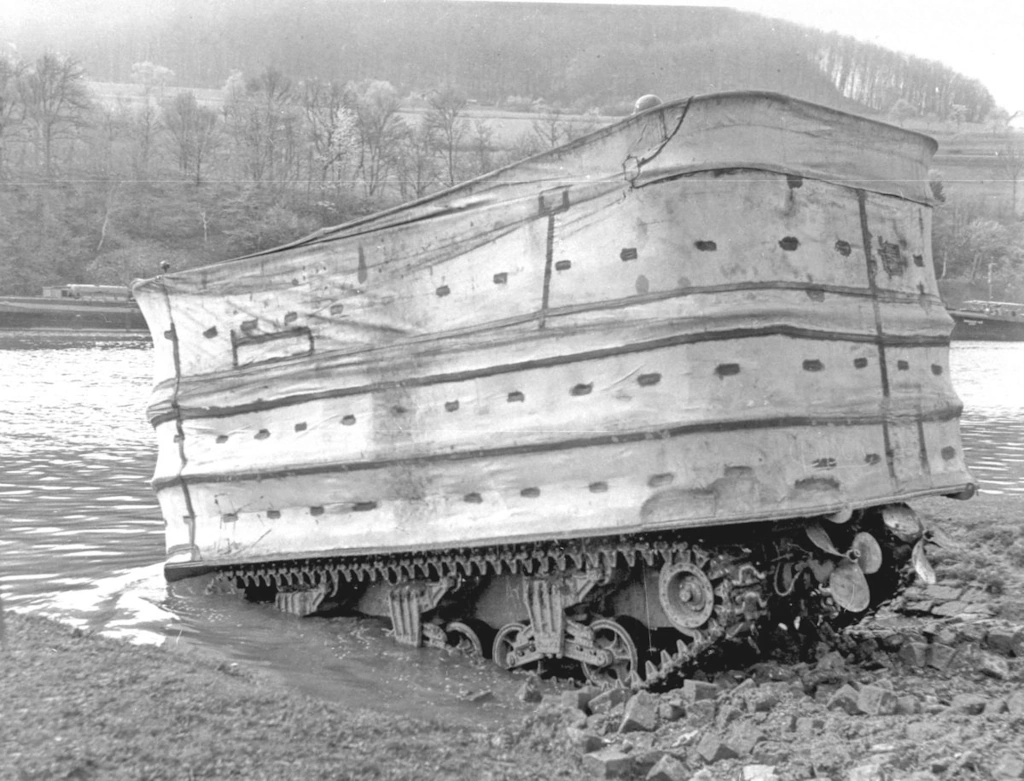
The Duplex Drive (DD) was born of necessity and desperation. Allied planners knew that the first waves of infantry would face well-fortified German beach defenses. Armored support was essential — but how to get tanks ashore when landing craft were vulnerable, scarce, and limited by tides? The British firm Vickers-Armstrong proposed a novel solution: adapt existing M-4 Sherman tanks to swim. The conversion involved: A collapsible canvas flotation screen, raised vertically around the tank hull; Two rear-mounted propellers, driven by the tank’s engine; A rudder and steering mechanism for maritime control. The tank would be launched from Landing Craft, Tank (LCTs), several thousand yards offshore, and motor itself to the beach. Once ashore, the screen would be collapsed, and the tank would operate as normal.
III. Technical Overview of the DD Sherman
Key features of the M-4A1 or M-4A2 Sherman DD included: Flotation screen: Fabric and rubberized canvas, supported by inflatable tubes and steel rods; Buoyancy: Enough to keep a 30-ton tank afloat in calm seas; Speed in water: Approx. 4 knots under its own power; Armament: 75-MM main gun, .30 caliber coaxial and hull machine guns, and a .50 caliber on the turret.
Vulnerabilities included: Poor sea-keeping in waves over 2-3 feet; Minimal protection during water travel; Susceptibility to wind drift and current; Difficulty navigating surf and landing obstacles.
IV. Operational Planning: The 743rd and Omaha Beach
The 743-TB (as seen above), formed in 1942, was an independent tank unit under V Corps, trained extensively for amphibious operations. For D-Day, the 743-TB was assigned to support the 116th Infantry Regiment (RCT) of the 29th Infantry Division, landing on the western sectors of Omaha: Dog Green, Dog White, and Easy Green.
Composition: Baker Company was equipped with DD Shermans; Able and Charlie Companies fielded conventional Shermans transported directly onto the beach via LCTs.
Plan: DD tanks to launch 2000 yards offshore, just before H-Hour, arriving minutes before the infantry; Able and Charlie Companies to land by LCTs once the beach was ‘softened’; But sea conditions forced a revision of this plan.
V. June 6, 1944 — Omaha Unfolds
In the pré-dawn darkness of June 6, rough seas in the English Channel were immediately apparent. Swells reached 5 to 6 feet, winds gusted to Force 4–5, and visibility was limited. While the 741-TB adhered to the initial plan and launched their DDs 5000 yards offshore — losing 27 of 29 tanks almost instantly — the 743-TB’s leadership opted for discretion over doctrine.
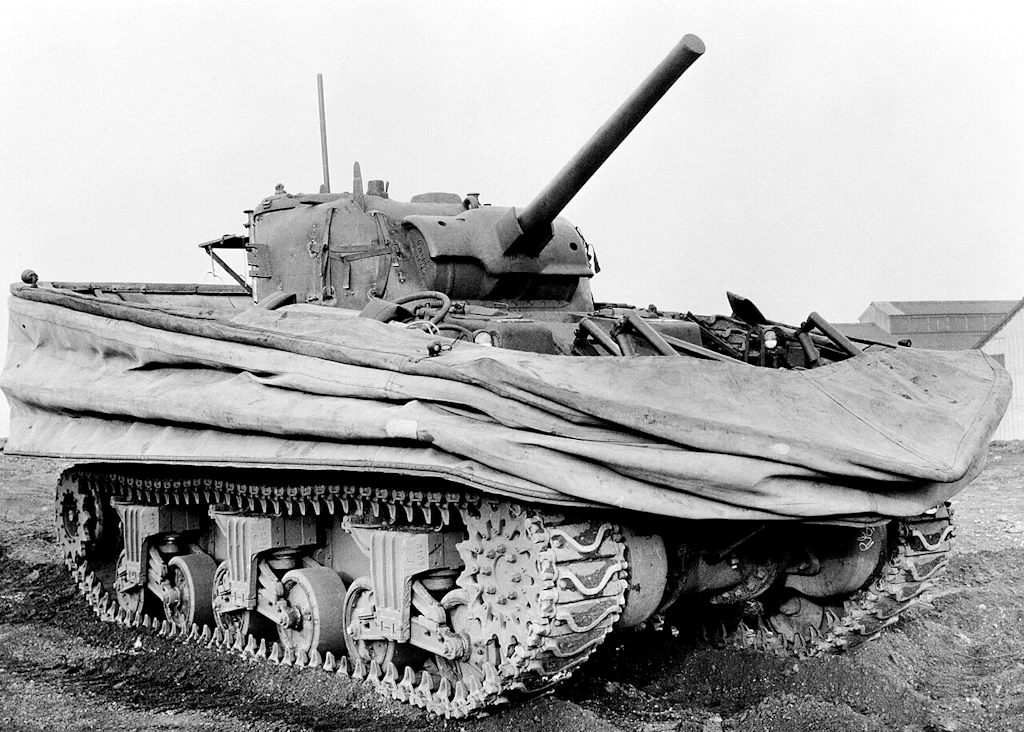
Key Decision: Launch From the Beach: Captains of the LCTs carrying Baker Company of the 743-TB, in coordination with battalion HQ, decided to avoid water launch and land the DDs directly onto the beach ramps. This decision saved lives and preserved combat power.
VI. The Fight for the Bluffs — 743-TB in Action
At approximately H+10 minutes, tanks of Baker Company rolled off their LCTs onto Dog White and Easy Green sectors. Despite heavy German fire and beach congestion, many tanks engaged immediately: Tank commanders dismounted to guide drivers through minefields; DD Shermans suppressed German pillboxes and MG nests at Point 67; One platoon supported the 2nd Battalion 116-RCT’s advance toward the draw at Les Moulins; By H+30, most of Baker Company’s DDs were on the beach and firing. Meanwhile, Able Company’s conventional Shermans came ashore amid wreckage, but added firepower inland and Charlie Company, scheduled for later waves, landed under fire but supported pushes toward Vierville. Despite fierce German resistance, the armor-infantry team established a foothold, buying time for engineers and follow-on forces. The 743-TB’s adaptive leadership and battlefield judgment were critical to the 29th Infantry Division’s ability to penetrate German defenses west of Les Moulins.
VII. Comparison: 743-TB vs 741-TB Outcomes
| Battalion | Launched Offshore | Lost at Sea | Reaching Shore | Notes |
|---|---|---|---|---|
| 741st | 29 DD tanks | 27 | 2 | Launched too far in rough seas |
| 743rd | 0 DD tanks launched | 0 | ~14 DDs landed dry | LCT to beach decision was key |
VIII. Notable Actions and Aftermath
Lt Charles C. Smith, commanding a DD platoon, directed suppressive fire on WN-67 from a forward hull-down position, aiding the 2nd Battalion’s breakthrough. Tank #B-23, struck by an 88-MM shell, burned out but crew survived — later awarded Bronze Stars for rejoining the fight on foot. Several DD tanks became mobile pillboxes, firing from static positions to support infantry movement through the beach exit draws. Casualties in the 743-TB were relatively light compared to expectations: 10 tanks disabled or destroyed by end of June 6 and 2 KIA, 11 WIA in Baker Company on D-Day.
IX. Tactical Evaluation & Lessons Learned
The performance of the 743-TB DD tanks on Omaha demonstrated: The vital role of armored support in breaching fortified beach defenses; The perils of over-reliance on untested amphibious gear in unpredictable conditions; The importance of junior officer initiative and field judgment. Had the 743-TB launched its DDs like the 741-TB, the story of Omaha Beach — and possibly the entire American front — may have taken a far darker turn.
X. Legacy and Historical Assessment
In post-war evaluations, the 743-TB received commendation for: Tactical flexibility; Effective cooperation with infantry and engineers; Rapid inland penetration once beach exits were secured; Several tanks from the battalion remained in action for weeks, supporting the 29th’s push toward St Lô and beyond. The DD Sherman, while flawed, marked a key milestone in amphibious warfare doctrine. And the 743-TB’s use of it on June 6, stands as a case study in adaptation, courage, and professionalism.
XI. Conclusion — ‘Steel Came Ashore’
At Omaha Beach, when chaos reigned and slaughter seemed imminent, the 743-TB — and its canvas-skirted Shermans — rolled ashore, fired on the move, and fought to the bluffs. The decision to land DDs directly onto the sand rather than trust them to the sea was a turning point that helped crack the Atlantic Wall. The Duplex Drive may have been an experiment, but in the hands of the 743-TB, it became a lifeline. Victory, as always, favored the bold.
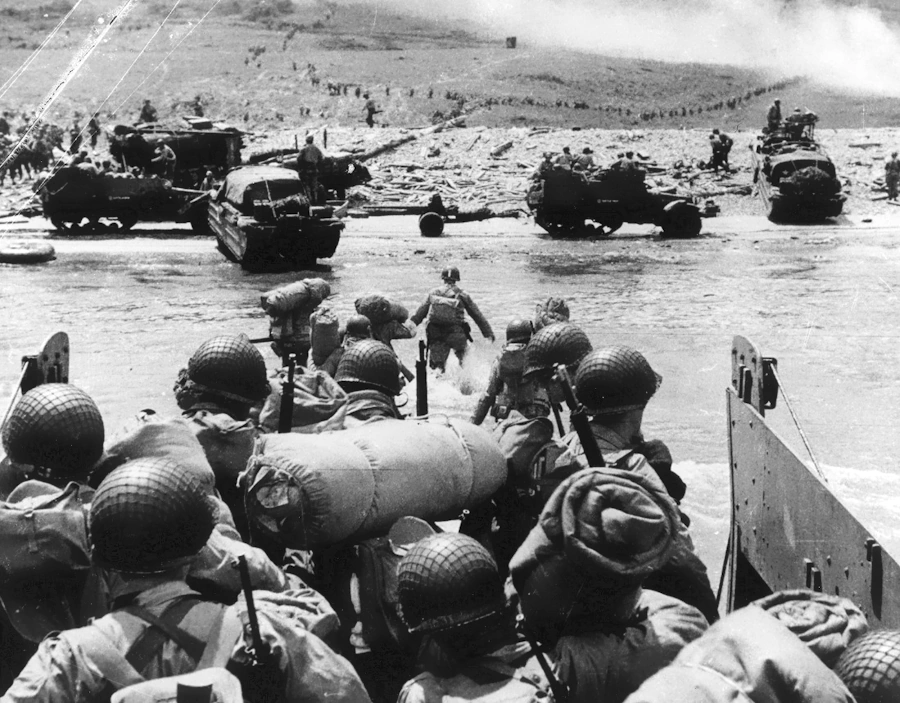
All that was the cold plan of D-Day but it by no means is the story of D-Day. Military history will reconstruct it carefully. Books have already been written about it. But the real story of D-Day will escape the books because it cannot be captured in words. For the real story must be found in the minds of the men who went through it – not one man, not a hundred, but the thousands.
To the men who came ashore at Omaha Beach – the men of the 743, for instance – there was only a secondary place for such military props as phase lines, coordinates, Dog Red or Dog Green or what the unit 500 yards to the left was supposed to do. To those men D-Day was, more than all else, a wild, confused, patternless experience in which they heard thin metallic voices over the radio, of ugly dead and dying, of live men who seemed to move forward as far as they could close to the sea-wall and of how some of them went on without apparent plan or reason. The words are all in the dictionary. Words to describe fear, hope, anger, surprise – all the emotions men have felt in battle. But how can words tell of the noise, of the horror and the tragedy and the heroism, and still make it seem real?
Those who weren’t there can only imagine looking across angry, grey water, a glimpse of flat, white beach, and a green hill which fills the whole horizon. Those who weren’t there can only try to conceive of what it would be like to be a few hundreds of yards away from this beach, steadily approaching, while hundreds of guns fire at you – guns large and small and all deadly and all blurting death and injury straight down into your approach. Add to this the terrifying range of sounds made by the great shells from battleships firing inland, of the whine of high-velocity shells fired from the hill, of the thunder of explosions everywhere, and the rattle and snap of vicious bullets and the whipping sound they make as they strike the water.