


The V-1 Flying Bomb (Buzz Bomb) – Technical, Strategic, and Operational Aspects
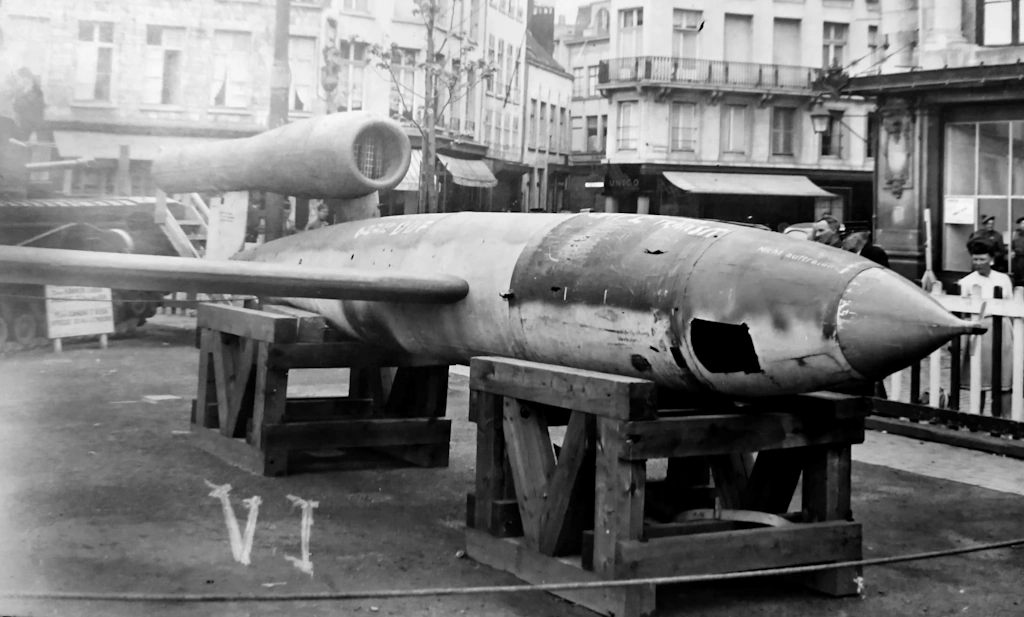
The V-1, officially designated Fieseler Fi 103 by the Luftwaffe, was the world’s first operational cruise missile. Developed by Nazi Germany during the Second World War, it was part of Adolf Hitler’s Vergeltungswaffe (retaliatory weapons) program, conceived to counter Allied bombing of German cities and to instill psychological terror in enemy populations. Between June 1944 and March 1945, more than 10.000 V-1s were launched against England and Belgium, notably London and Antwerp.
1. Design and Propulsion
2. Launch System and Sites
V-1s were launched from fixed ramp systems (approximately 50 meters long) using steam-powered catapults, primarily located in northern <France and the Low Countries. Later in the war, the Germans developed air-launched variants deployable from Heinkel He 111 bombers, extending their operational reach and complicating Allied interception efforts. Launch sites were designed with hardened concrete facilities and a network of camouflage and decoys to evade Allied reconnaissance and bombing campaigns. Despite extensive Allied countermeasures, including Operation Crossbow, many V-1 launchers remained operational until the Allied advance neutralized their range.
3. Strategic Impact and Effectiveness
While the V-1 lacked precision—often missing targets by several kilometers—its primary effect was psychological and logistical. In London alone, over 6000 civilians were killed and more than 18.000 injured due to V-1 strikes. The attacks prompted widespread evacuations, disrupted industrial output, and necessitated the redirection of significant resources to air defense. In Belgium, Antwerp became a key target following its liberation in September 1944. As a vital Allied logistics hub, Antwerp endured intensive V-1 and V-2 bombardment during the winter of 1944–45, threatening supply lines critical to the Ardennes campaign. From a purely military standpoint, the V-1 was cost-effective but strategically limited. Each unit cost less than a conventional bomber mission, and its production could be decentralized. However, its low accuracy and the development of effective countermeasures—including anti-aircraft fire, barrage balloons, and rapid-response fighter patrols (notably the Hawker Tempest and Spitfire XIV)—greatly reduced its long-term effectiveness.
4. Legacy and Technical Influence
The V-1’s technological legacy is significant. As the first successful cruise missile, it laid the groundwork for postwar missile development in both the United StatesSoviet Union. Captured German engineers and prototypes played a direct role in shaping Cold War-era guided missile programs. From a military scientific perspective, the V-1 demonstrated the feasibility of autonomous, long-range weapons, but also exposed the limitations of inertial guidance, simple propulsion systems, and fixed-launch infrastructure. These lessons directly influenced the evolution of cruise missiles into the late 20th century.
References:
Imperial War Museums – V-1
National Air and Space Museum
CommsLink: The V-1: World’s 1st Cruise Missile
Neufeld, M.J. – The Rocket and the Reich
Zaloga, S.J. – V-1 Flying Bomb 1942–52
 The 1st Battalion jumped off early to attack the Chateau des Montys, encountered heavy fire from hostile tanks and infantry, but cleared the town past the cross roads and established a road block while maintaining an active defense of the sector. The 2nd Battalion also defended actively, knocking out a number of German vehicles. The 3rd Battalion, less King Co, which had started out for the Chateau des Montys before daylight, was stopped by a superior enemy force, so it supported the attack of the 1st Battalion and assisted in defending the area.

 The enemy managed to infiltrate west of Trois Ponts in the evening, and Love Co moved into Ster in order to protect the south flank of the Regimental line. Easy Co 120-IR relieved the 3rd Platoon of Able Co, 105-ECB, which had been holding out at Petit Coo, after assisting Task Force L recapture the Aid Station and village of Arret de Coo. Able Co 117-IR, cleaned the remaining enemy out of Stavelot when a robot bomb struck in the
 2nd Battalion area but caused no serious damage. Prisoners of War admitted killing Belgian civilians in cold blood, and Col Johnson requested that photographic evidence be taken of the atrocities. He then cautioned the troops that the foe is not surrendering easily, that no chances should be taken with them since some are dressed in American uniforms, and that gas masks were to be carried at all times.

 On December 23, the 2nd Battalion 120-IR, which was attached to the 117-RCT (Regimental Combat Team), and Love Co 117-IR, jumped off in the early morning hours to clear the woods on the north bank of the Ambleve River. The 1st and 2nd Battalions maintained a vigorous defense of their sectors and engaged in continuous party rolling. Further enemy penetration was held and contained despite fiery efforts by the foe to augment its break through. As the 3rd Battalion was liquidating the opposing force in the woods on the west bank
 of the river, the I&R Platoon reconnoitered the edge of the forest between Stavelot and Roanne, picking up stragglers and probing enemy strength. The enemy still held strongly fortified positions in La Gleize and on the hills south of the town. Elements of the 117-IR and the 3-AD Task Force tenaciously protected their line east and north-east of La Gleize. At 0730, December 24, Task Force Harrison attacked the town from three directions, north, south, and west. By 1030, this enemy strong point was in American hands, along with 300 prisoners, 200 American soldiers recaptured, and large quantities of materiel and supplies were seized.
 King Co 117-IR, was released from attachment with Task Force M and proceeded to Moulin Du Ruy. The 1st and 2nd Battalions continued defending their respective sectors. An enemy patrol struck at George Co, at 1500, December 24, and evidently captured two enlisted men. The 1st Battalion was instructed to mine the bridge to its front and the 2nd Battalion to watch for vehicular traffic in its area moving from west to east. Because of heavy nebelwerfer and direct fire from emplaced tanks the mines could not be laid so the bridge was ordered destroyed. Enemy resistance north of the river was whittled down further and Item Co moved down to the railroad tracks under cover of darkness while Love Co took up a position on the edge of the woods.
By December 25, the Nazi bulge into Belgium was firmly held and the 117-IR had practically wiped out an entire German SS Regiment. Not many prisoners were taken but enemy dead filled the forests, the fields, and the river, in the Regimental Sector alone, twenty-two tanks were knocked out, twelve half tracks, thirty-two trucks, and seven guns of various calibers destroyed, in nine days fighting. The balance of the month was spent in vigorous patrolling and active defense of the corridor. A patrol from the 1st Battalion swam across the Ambleve River, the night of December 29, and returned with three prisoners.