

 NEW YORK
Andrew Cook – Mohawk – Manila
Archie Oakes – Mohawk – Europe
Carroll Patterson – Tonawanda-Seneca – France
Clarence Carnon – Tonawanda-Seneca – At Sea
Collins Moses – Seneca – Germany
Ernest Printup – Tuscarora – Europe
Francis Jock – Mohawk – At Sea
Francis Waterman – Onondaga – Tarawa
Frank Doxtator – Seneca
Harlan Laye – Seneca – Germany
Henry Powless – Onondaga – Tarawa
John Seabrean – Tonawanda-Seneca – Sicily
Kenneth Fatty – Onondaga – France
Kenneth Parker – Seneca
Linas Snow – Seneca – France
Louis Barnes – Mohawk – France
Raymond John – Seneca
Roland Redeye – Seneca
Sylvester Thompson – Mohawk – France
Silas William Chew – Tuscarora – Europe
 NORTH CAROLINA
Adam West Driver – Cherokee – Iwo Jima
Blaine Queen – Cherokee – Germany
Clarence Murphy – Cherokee – USA
Edward Hardin – Cherokee – Pacific
Enos Thompson – Cherokee – Luxembourg
Isaac Ross – Cherokee – Pacific
Jeremiah Toineeta – Cherokee – Germany
Joshua Shell – Cherokee – Okinawa
Mark J. Rattler – Cherokee – Pacific
Richmond Lambert – Cherokee – Germany
Vernon Sneed – Cherokee – Germany
William Taylor Jr – Cherokee – Pacific
 NORTH DAKOTA
Clarence Spotted Wolf – Gros Ventre – Luxembourg
Donald Hosie – Arikara – Holland
Earle Defender – Sioux (Standing Rock) – Italy
Joseph Goudreau – Sioux (Standing Rock) – Germany
Joseph R. Agard – Sioux (Standing Rock) – Marianas
Leonard Red Tomahawk – Sioux (Standing Rock) – Leyte
Louis Calvin Noel – Sioux (Standing Rock) – Belgium
Matthew American Horse – Sioux (Standing Rock) – Germany
Paul Yankton – Sioux (Fort Totten) – France
Philip Lohnes – Sioux (Fort Totten) – New Britain
Wallace J. Demery – Sioux (Standing Rock) – Ireland
William A. Davis – Chippewa – New Guinea
 OKLAHOMA
Andrew Brokeshoulder – Choctaw – Sicily
Aaron Cusher – Choctaw
Aaron Watkins – Choctaw
Andrew Warrior – Shawnee
Ben Trevino Jr – Comanche – Europe
Bennett H. Griffin – Osage – France
Billie Jack – Choctaw – New Guinea
Charles E. Sam – Five Civilized Tribes – Belgium
Charles Edward Harris – Pawnee – France
Charles G. Keighley – Osage – Germany
Charles G. Red Bird – Cheyenne – Pacific
Charles W. Imotichey – Chickasaw – Italy
Clabe C. Mackey – Osage – Germany
Clarence Tinker Jr – Osage – Mediterranean
Cornelius Hardman Jr – Ponca – Luxembourg
Cyrus Packer – Cheyenne – Europe
Dan Madrano Jr – Caddo – Europe
Dan Roebuck – Choctaw – Africa
David Cross Jr – Caddo-Cheyenne – Philippines
Davis Pickens – Choctaw – Sicily
Dennis W. Bluejacket – Shawnee-Cherokee – Europe
Donald Beaver – Caddo – Europe
Edmond Perry – Choctaw
Elmer C. Weinrich – Osage – Germany
Eugene E. Slaughter – Osage – Pacific
Forrest Tabbyyetchy – Comanche – USA
Frank Riddle Jr – Osage – Pacific
George D. Coons – Pawnee – Germany
George Choate Jr – Cheyenne-Arapaho
Gilbert Vidana – Comanche – Europe
Grant Gover – Pawnee – France
Hanson H. Jones – Choctaw
Harold B. Smalley – Osage – Pacific
Harold E. Rogers – Seneca – Europe
Harold L. McKinley – Osage – Philippines
Henry W. Conowoop – Comanche – Luzon
Floyd Primeaux – Ponca
Hershel L. Malone – Chickasaw – England
James L. Douglas – Creek – Philippines
James Paul Fireshaker – Ponca – Okinawa
James Sulphur – Creek – France
Jim N. Chuculate – Five Civilized Tribes – Luxembourg
Joe Guoladdle – Kiowa – Pacific
Johnnie Buckner – Creek – Pacific
Johnnie F. Gokey – Sac and Fox – Luzon
John Carney – Choctaw
John Floyd Wall – Choctaw – Pacific
John Stevens – Choctaw – Europe
John Wallace – Choctaw – Africa
Johnson Harjo – Seminole – France
Joseph G. Bratton – Osage – Pacific
Joseph J. King – Ottawa – Germany
Joseph L. LaSarge – Osage – Italy
Kingsley Allrunner – Cheyenne – USA
Lee Edward Ahcheko – Sac and Fox – Pacific
LeRoy McNoel – Choctaw
Levi Hosetosavit – Comanche – France
Lewis E. Wade – Choctaw – Germany
Lewis Mitchell – Creek – Atlantic
Louis Rivas – Comanche – Europe
Lyndreth Palmer – Kiowa – Europe
Mathson Whiteshield – Cheyenne-Arapaho
Matthew Hawzipta – Kiowa – Germany
Marion Ruling Harris – Sac and Fox – Tinian
Melvin Myers – Comanche – Europe
Milton Otis Ririe – Osage – Panama
Mont Bruce Williams – Caddo – USA
Moses Red Eagle – Osage – Italy
Nathaniel Bitseedy – Kiowa-Apache – USA
Nelson Bearbow – Cheyenne – USA
Osborne L. Blanche – Choctaw – Japan
Orus Baxter Jr – Creek – Germany
Own Mombi – Choctaw – Germany
Paul B. Blanche – Choctaw
Paul K. Stevens – Kickapoo – Europe
Ray Bohanon – Choctaw – Europe
Raymond Brown – Wichita – Europe
Rayson Billy – Choctaw – Sicily
Reuben Mashunkashey – Osage – Luxembourg
Robert E. Warrior – Osage – France
Rudolph McKinley – Osage – France
Sam Fixico – Seminole – Mediterranean
Thomas Chockpoyah – Comanche – Europe
Thomas P. Carter – Sac and Fox
T.P. Hattensty – Choctaw – Anzio
Walter D. McClure – Choctaw
Wayne Beartrack – Cheyenne – USA
Wesley Osage – Cheyenne – Pacific
Whitney Holata – Seminole – England
William Silas Coons – Pawnee – Italy
William Sixkiller Jr – Cherokee – Saipan
Willie Scott – Creek – France
Zack L. Smith – Ponca – Germany
 OREGON
Raymond L. Enouf – Klamath – Pacific
Roscoe Dick – Warm Springs – Philippines
Gilbert Yahtin – Warm Springs – Belgium
Wesley Morrisette – Walla Walla – Italy
 SOUTH DAKOTA
Aaron G. Bettelyoun – Sioux (Pine Ridge) – Holland
Albert Chief Eagle – Sioux (Pine Ridge) – USA
Alexander DuMarce – Sioux (Sisseton) – Biak Island
Art Blue Arm – Sioux (Cheyenne River)
Arthur F. Sanders – Sioux (Sisseton) – France
Charles Under Baggage Jr – Sioux (Pineridge) – France
Charles Swimmer – Sioux (Pine Ridge) – Luzon
Chester Afraid of Bear – Sioux (Pine Ridge) – USA
Chester Maple – Sioux (Pine Ridge) – Pacific
Clement Crazy Thunder – Sioux (Pine Ridge) – Iwo Jima
Daniel L. Quickbear – Sioux (Rosebud) – Africa
Earl J. Dion – Sioux (Rosebud) – Africa
Earl J. Two Bulls – Sioux (Pine Ridge) – Leyte
Elmer A. Feather – Sioux (Sisseton) – Luzon
Fred Colombe – Sioux (Rosebud) – Luzon
Floyd Bear Saves Life – Sioux (Pine Ridge) – France
James L. DeMarsche – Sioux (Rosebud) – Tarawa
James LaPointe Jr – Sioux (Pine Ridge) – Pacific
Francis Leon Killer – Sioux (Pine Ridge) – Germany
George D. LaPlant – Sioux (Cheyenne River)
George Ladeau – Sioux (Pine Ridge) – USA
Guy L. Archambeau – Sioux (Yankton) – USA
Howard Brandon – Sioux (Rosebud) – Iwo Jima
Jacob Herman Jr – Sioux (Pine Ridge) – Holland
Jacob Wood – Sioux (Sisseton) – Europe
James L. Janis – Sioux (Pine Ridge) – Luxembourg
Jesse Cuny – Sioux (Pine Ridge) – Germany
Joe Kitto – Chippewa – Belgium
Joseph Hairychin – Sioux (Standing Rock) – Pacific
Joseph Running Horse – Sioux (Rosebud) – Peleliu
Joseph Supangi – Sioux (Sisseton) – France
Leonard Q. Smith – Sioux (Yankton) – Pacific
Leroy No Neck – Sioux (Pine Ridge) – Holland
Lester Red Boy – Sioux (Pine Ridge) – Pacific
Levi Traversie – Sioux (Cheyenne River)
Lorenzo W. Collins – Sioux (Rosebud) – Germany
Louis LaBelle – Sioux (Sisseton) – France
Louis Raymond Cottier – Sioux (Pine Ridge) – Leyte
Matt Good Shield – Sioux (Pine Ridge) – New Guinea
Norman Portwood – Sioux (Pine Ridge) – English Channel
Norman Redthunder – Sioux (Sisseton) – Germany
Ole J. Johnson – Sioux (Sisseton) – Germany
Pierre Pau Lee – Sioux (Yankton) – USA
Philip G. Atkinson – Sioux (Rosebud) – France
Raymond Lodge Skin – Sioux (Rosebud) – Germany
Reuben E. Redfeather – Sioux (Rosebud) – France
Robert Custer Jordan – Sioux (Rosebud) – Africa
Robert Lee White – Sioux (Sisseton) – USA
Roy A Brandon – Sioux (Rosebud) – Guam
Silas Running Eagle – Sioux (Pine Ridge) – USA
Stanley C. Rogers – Sioux (Rosebud) – Luzon
Stanley Goodbird – Sioux (Sisseton) – Africa
Thomas Crow Necklace – Sioux (Standing Rock) – France
Thomas Waters – Sioux (Pine Ridge) – Luzon
Vincent Fast Horse – Sioux (Pine Ridge) – Pacific
Vincent Village Center – Sioux (Standing Rock) – Belgium
Waldron Frazier – Sioux (Cheyenne River) – USA
Warren C. Bonnin – Sioux (Yankton) – Guam
William Bird Horse – Sioux (Standing Rock) – Europe
William Dempsey Austin – Sioux (Pine Ridge) – Germany
William Flying Horse – Sioux (Standing Rock) – Luzon
William J. Dion – Sioux (Rosebud) – France
William Keoke – Sioux (Sisseton) – Italy
Winfield Loves War – Sioux (Standing Rock) – Europe
 UTAH
UTAH
Ansel G. Wanzitz – Ute – France
Nelson Tonegates – Ute – Germany
 WASHINGTON
Charles Schultz Jr – Lummi – France
Samuel C. Abrahamson – Colville – Manila
Harry J. Cheholtz – Toholah – Philippines
Herman John – Nisqually – Belgium
Jartin James – Snoqualmie – Luzon
John Bobb – Swinomish – Germany
John H. Kittles – Lummi – Italy
Melvin Ross – Muckleshoot – Italy
Norman Simmons – Quinaielt – Okinawa
Richard Wood – Clallam – Germany
Roy Knight – Swinomish – Belgium
 WISCONSIN
Alpheus Decorah – Winnebago
Arnold Tepiew – Menominee – Burma
Donald J. Brisk – Oneida – France
Edmund Cornelius – Oneida – Pacific
George N. Johnson – Winnebago
James C. Ford Jr – Chippewa – Italy
Joseph Graverette – Belgium
Joseph J. White – Winnebago – France
Joseph Komanekin – Menominee – France
Joseph Ninham – Oneida
Joseph Matchoma – Menominee – France
Matthew Johnson – Winnebago – Europe
Marvin Johns – Oneida – France
Melvin Jordan – Oneida – Germany
Milan St. Germaine – Chippewa – France
Richard J. Ackley – Chippewa – Italy
Robert A. Cornelius – Oneida – Germany
Robert Duffy – Chippewa
Thomas Soldier – Menominee – France
 WYOMING
Chester Arthur – Arapaho – Belgium
Claude Goggles – Arapaho – Leyte
George Antelope – Arapaho
John L. Brown – Arapaho
Laverne Wagon – Shoshone
Lee Wadda – Shoshone
Richard Pogue – Shoshone
Sidney Bush – Shoshone
William Trosper Arapaho
 Navajo Code Talkers
by W/T Sgt. Murrey Marder
Marine Corps Combat Correspondent
Through the Solomons, in the Marianas, at Peleliu, Iwo Jima, and almost every island where Marines have stormed ashore in this war, the Japanese have heard a strange language gurgling through the earphones of their radio listening sets – a voice code which defies decoding. To the linguistically keen ear it shows a trace of Asiatic origin, and a lot of what sounds like American double-talk. This strange tongue, one of the most select in the world, is Navajo, embellished with improvised words and phrases for military use. For three years it has served the Marine Corps well for transmitting secret radio and telephone messages in combat.
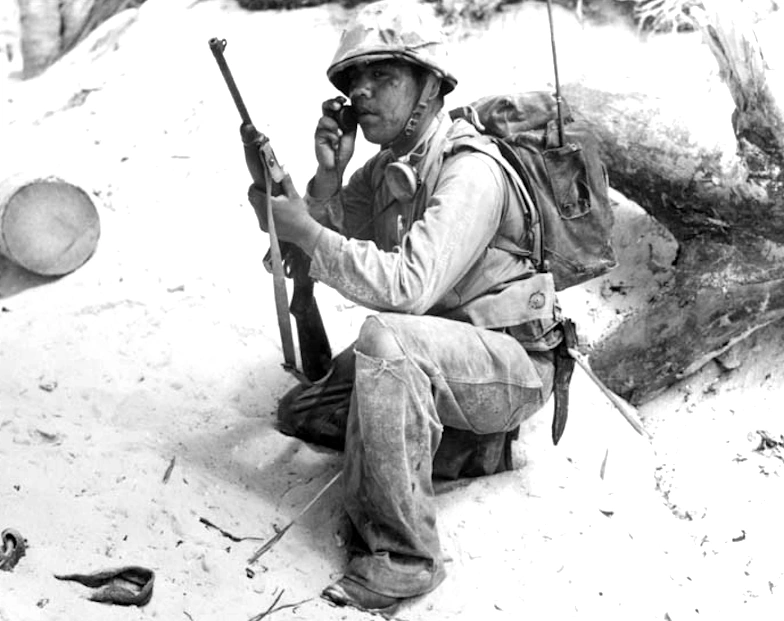
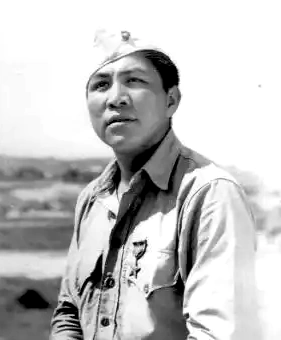 The dark-skinned, black-haired Navajo code talker, huddled over a portable radio or field phone in a regimental, divisional or corps command post, translating a message into Navajo as he reads it to his counterpart on the receiving end miles away, has been a familiar sight in the Pacific battle zone. Permission to disclose the work of these American Indians in marine uniform has just been granted by the Marine Corps. Transmitting messages which the enemy cannot decode is a vital military factor in any engagement, especially where combat units are operating over a wide area in which communications must be maintained by radio.
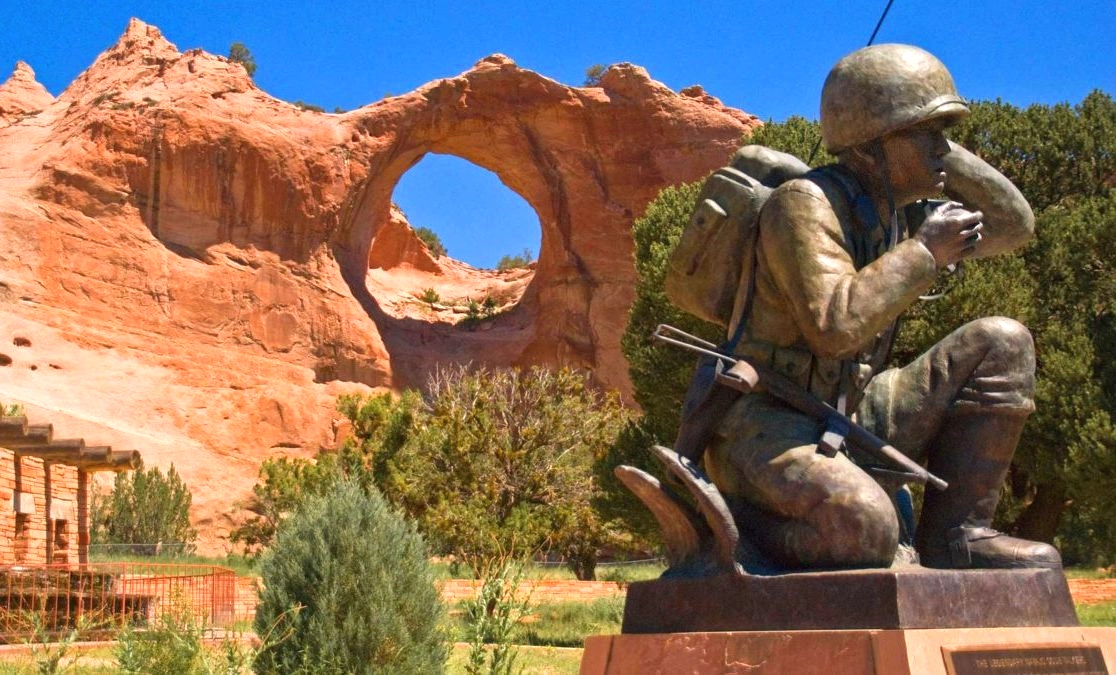
Throughout the history of warfare, military leaders have sought the perfect code – a code which the enemy could not break down, no matter how able his intelligence staff. Most codes are based on the codist’s native language. If the language is a widely-used one, it also will be familiar to the enemy and no matter how good your code may be the enemy eventually can master it. Navajo, however, is one of the world’s ‘hidden‘” languages; it is termed ‘hidden‘, along with other Indian languages, as no alphabet or other symbols of it exist in the original form. There are only about 55.000 Navajos, all concentrated in one region, living on Government reservations and intensely clannish by nature, which has confined the tongue to its native area.
Except for the Navajos themselves, only a handful of Americans speak the language. At the time the Marine Corps adopted Navajo as a voice code it was estimated that not more than 28 other persons, American scientists or missionaries who lived among the Navajos and studied the language for years, could speak Navajo fluently. In recent years, missionaries and the Interior Department’s Bureau of Indian Affairs have worked on the compilation of dictionaries and grammars of the language, based on its phonetics, to reduce it to writing. Even with these available it is said that a fluency can be acquired from prepared texts only by persons who are highly educated in English and who have made a lengthy study of spoken and written Navajo.
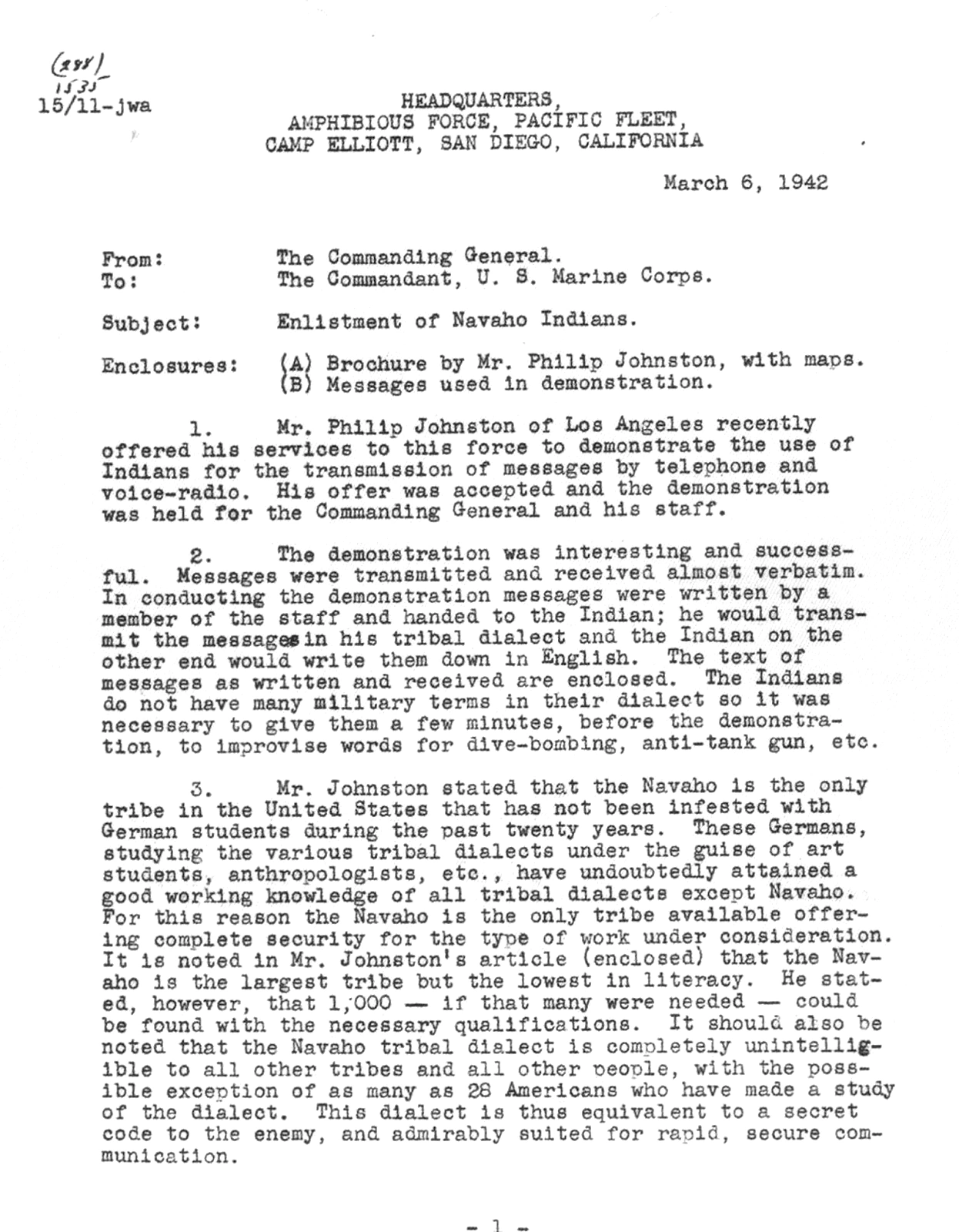 One of the reasons which prompted the Marine Corps to adopt Navajo, in preference to a variety of Indian tongues as used by the AEF in WW 1, was a report that Navajos were the only Indian group in the United States not infested with German students during the 20 years prior to 1941, when the Germans had been studying tribal dialects under the guise of art students, anthropologists, etc. It was learned that German and other foreign diplomats were among the chief customers of the Bureau of Indian Affairs for the purchase of publications dealing with Indian tribes, but it was decided that even if Navajo books were in enemy hands it would be virtually impossible for the enemy to gain a working knowledge of the language from that meager information. In addition, even ability to speak Navajo fluently would not necessarily enable the enemy to decode a military message, for the Navajo dictionary does not list military terms, and words used for ‘jeep’, ’emplacement’, ‘battery’, ‘radar’, ‘antiaircraft’, etc., have been improvised by Navajos in the field. The adoption of code talkers by the Marine Corps stemmed from a request for Navajo communicators by Maj Gen Clayton B. Vogel, then Commanding General, Amphibious Corps, Pacific Fleet. A report submitted with his request said a Navajo enlistment program would have full support of the Tribal Council at Window Rock (Arizona) Navajo Reservation.
Acting on this request the Marine Corps’ Division of Plans and Policies in March 1942 sent Col Wethered Woodworth to make a further report on the subject, and a test was made at the San Diego (California) Marine Base to determine the practicality of Navajos as code talkers. The test revealed that the Navajos who volunteered for the experiment could transmit the messages given, although with some variation at the receiving end resulting from the lack of exact words to transmit specific military terms. For example, ‘Enemy is pressing attack on left flank‘ would come out ‘the enemy is attacking on the left’. Proper schooling in military phraseology, it was believed, could correct this variation, and the following month the Marine Corps authorized an initial enlistment of 30 Navajos to ascertain the value of their services. The enlistment order required that recruits meet full Marine Corps physical requirements and have a sufficient knowledge of English and Navajo to transmit combat messages in Navajo. The recruits were to receive regular Marine training, attend a Navajo school at the Fleet Marine Force Training Center, Camp Elliott (California), and then receive sufficient communications training to enable them to handle their specially qualified talent on the battlefield.
All the recruits spoke the same Navajo basically, but there were certain word variations. In Navajo, the same word spoken with four different inflections has four different meanings. The recruits had to agree on words which had no shades of interpretation, for any variation in an important military messages might be disastrous. As might be expected in any group of youths, they were not equal in education or intelligence. Some of the military terms were very complex to the unschooled; all had to be able to understand them thoroughly in order to translate them into their native language. Some were not easily adaptable to communications work. It was difficult in several instances for non-Navajos to instruct the recruits in Marine Corps activities; a few marine instructors were unable to cope with the typical Indian imperturbability. On the other hand, many of the recruits were well-educated, intelligent and quick to learn. Some had worked for the Bureau of Indian Affairs as clerks, and almost all the Navajos had the highly developed Indian sensory perceptions.
There were some recruits like Pfc Wilsie H. Bitsie, whose father is district supervisor of the Mexican Springs, New Mexico Navajo District. Bitsie became an instructor in the Navajo School at Camp Elliott for a time, and helped work out the much needed military terms. He went on to join the marine Raiders and at New Georgia his Navajo ability helped the Raiders maintain contact with the Army command at Munda while the marines knocked out Japanese outposts in the jungle to the north. Other code talkers went with the Third Marine Division and the Raiders to Bougainville. There some manned distant outposts, maintaining contact in Navajo by radio. It was found best to have close friends work together in teams of two, for they could perfect their code talk by personal contact. The men in their units learned that in addition to their language ability the Navajos also could be good marines. They could do their share of fighting and they made good scouts and messengers.

There had been concern in some quarters that dark-skinned Navajos might be mistaken for Japs. In the latter days of the Guadalcanal action one Army unit did pick up a Navajo communicator on the coastal road and messaged the marine command: ‘We have captured a Jap in marine clothing with marine identification tags‘. A marine officer was startled to find the prisoner was a Navajo, who was only bored by the proceedings.
The code talkers went on into more campaigns, proving their ability, and the Navajo quota in the Marine Corps rose from 30 to 420. At their TBXs they transmitted operational orders which helped us advance from the Solomons to Okinawa. It was found that the Navajos are not necessary at levels lower than battalions. For messages between battalions and companies the extra security is not required and speed is the paramount issue. The III Amphibious Corps reported that the use of the talkers during the Guam and Peleliu operations was considered indispensable for the rapid transmission of classified dispatches. Enciphering and deciphering time would have prevented vital operational information from being dispatched or delivered to staff sections with any degree of speed. At Iwo Jima, Navajos transmitted messages from the beach to division and Corps commands afloat early on D-day, and after the division commands came ashore, from division ashore to Corps afloat. Last April authority was granted to establish a re-training course for Navajos at FMFPac. Under this plan, five code talkers are taken from each division to attend an intensive 21-day course which gives emphasis to plane types, ship types, printing and message writing, and message transmission. These Navajos then return to their divisions to instruct the remaining men. It is emphasized that code talkers work out successfully only where interest is shown by the command and where training continues between operations. As for the Navajos themselves, they probably are not any more enthusiastic about the concentrated schooling than most young marines would be about schooling, for they are amused at being regarded as different from other marines.
On rare occasions, though, they do lapse into some typical Indian gyrations. Ernie Pyle, in one of his last dispatches from Okinawa, described how the First Division’s Navajos had put on a ceremonial dance before leaving for Okinawa. In the ceremony, they asked the gods to sap the strength of the Japanese in the assault. According to a later report, when the First Division met the strong opposition in the south of Okinawa, one marine turned to a Navajo code talker and said, ‘OK, Yazzey, what about your little ceremony? What do you call this?‘ ‘This is different‘, answered the Navajo with a smile. ‘We prayed only for an easy landing‘.
Indians Fought on Iwo Jima
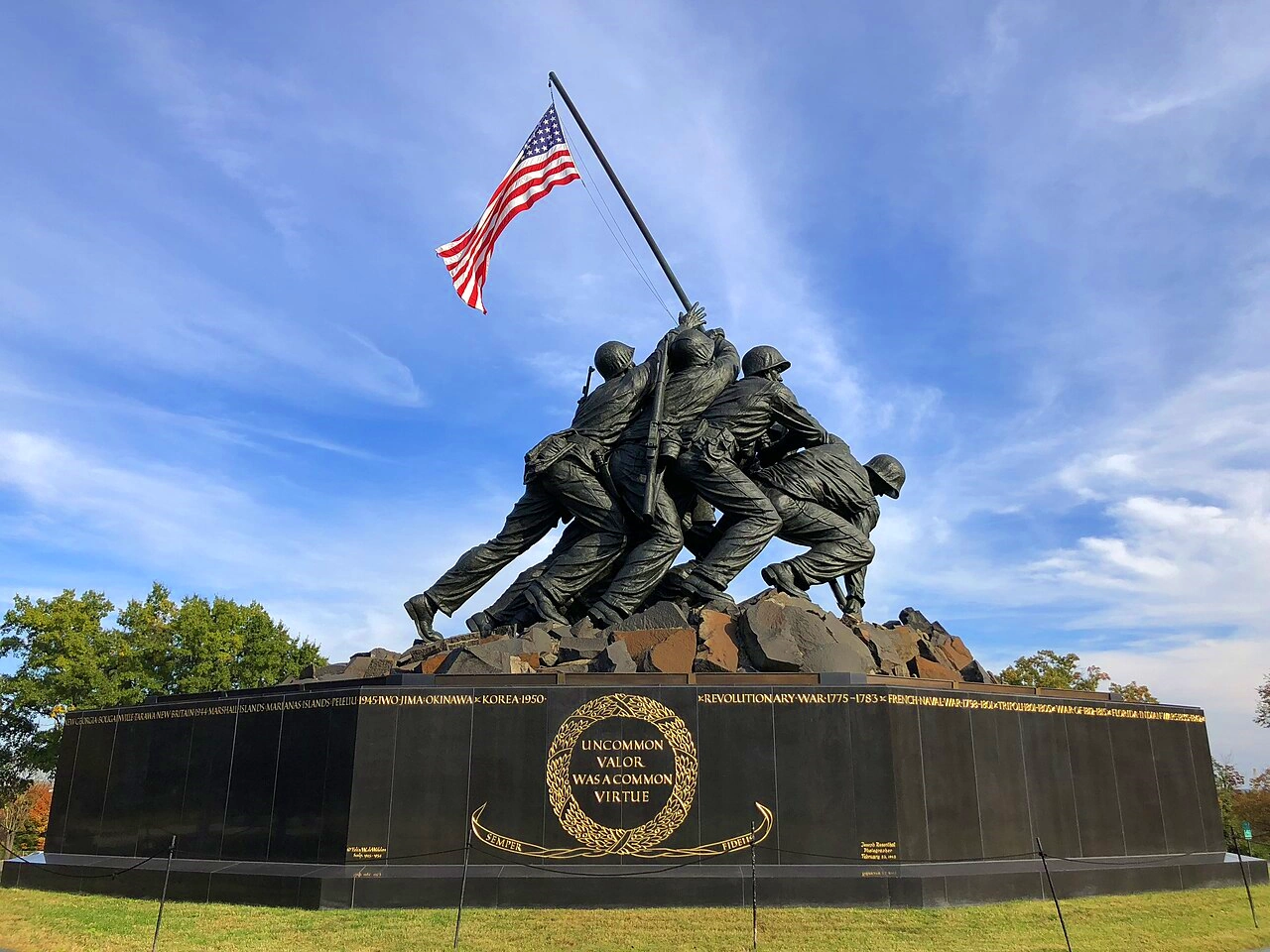
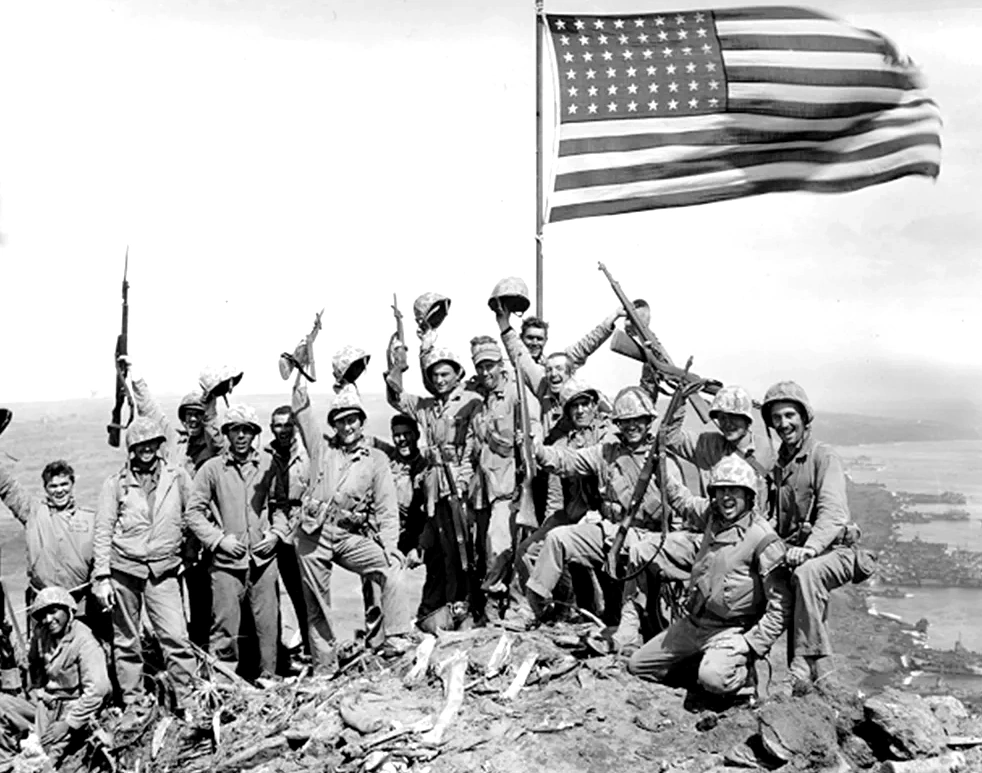
Many Indians participated in the famous action on Iwo Jima. The most celebrated of these if Pfc Ira H. Hayes, a full-blood Pima from Bapchule (Arizona) one of three survivors of the historic incident on Mount Suribachi, when six Marines raised the flag on the summit of the volcano, under heavy enemy fire. He served on Iwo Jima for 36 days and came away unwounded. Previously he had fought at Vella La Vella and Bougainville. Because of the nation-wide attention won by Rosenthal’s dramatic photograph of the flag-raising, symbol and expression of the invincible American spirit, Hayes and his two comrades, Pharmacist’s Mate John Bradley and Pfc Rene A. Gagnon, were brought back to this country to travel extensively in support of the Seventh War Loan. In the photograph on the opposite page, Hayes is pointing out his position in the flag-raising patrol.
On May 1st, more than 1000 Indians of the Pima tribe gathered at Bapchule to pay honor to their fellow tribesman and to celebrate his safe return. A barbecue feast, under a canopy of brush, was followed by an impressive religious ceremony, with prayers led to Protestant and Catholic missionaries and songs by several church choirs. Mrs. Hayes, Ira’s mother, asked two of the girl soloists to sing the hymn, He Will Deliver.
The National Congress of American Indians gave a luncheon in honor of Hayes and his comrades in Chicago on May 19, at which a brief speech by Hayes was broadcast. At this meeting he was made first commander of the American Indian Veterans’ Association. Pharmacist’s Mate Bradley stated in an interview that Hayes was a marked man on the island because of his cool level-headedness and efficiency. He refused to be leader of a platoon, according to Bradley, because as he explained, I’d have to tell other men to go and get killed, and I’d rather do it myself. When he and the two others were ordered home to take part in the War Loan campaign, Hayes was reluctant to leave his fighting comrades, and, after a few weeks in the United States, requested that he be returned to overseas duty, where he felt he would be of greater value to his country.
A second Indian, Louis C. Charlo, Flathead, from Montana, climbed Mount Suribachi with a Marine patrol shortly after the flag was raised on its summit. He was killed in action not long afterward, fighting to keep the Stars and Stripes on the mountain. Louis was the grandson of Chief Charlo of Nez Perce war fame, a leader who maintained his friendship with the white people throughout those trying times.
Among Indians listed as wounded on the island are Pfc Ray Flood, Sioux, from Pine Ridge; Verne Ponzo, Shoshone, Fort Hall; Orville Goss, Sidney Brown Jr and Richard J. Brown, Robert Spahe, Jicarilla Apache; Thomas Chapman Jr, Pawnee, and William M. Fletcher, Cheyenne, from Oklahoma; Joseph R. Johnson, Papago, Arizona; Pfc Glenn Wasson and Pfc Clarence L. Chavez, Paiute, Nevada; and Richard Burson, Ute from Utah. Killed were Pvt Howard Brandon, Rosebud Sioux; Pfc Clement Crazy Thunder, Pine Ridge Sioux, whose photograph appeared in the May-June 1943 issue of Indians at Work; Pfc Adam West Driver, Cherokee, from North Carolina; Pvt Eugene Lewis, Yurok, California; and Paul Kinlahcheeny, Navajo. Leland Chavez, S 1-c, Paiute, Nevada, is reported missing in action. Sgt Warren Sankey, Arapaho, from El Reno (Oklahoma), was one of the crew which first knocked out a Japanese tank on Iwo Jima.
Two Flathead Indian brothers, Daniel and John Moss, Marines from Arlee (Montana), met unexpectedly on Iwo Jima, and both came safely through the fighting. Their father, Henry Moss, served with the Marines in the First World War. One of four survivors of his company is Pvt Clifford Chebahtah, Comanche, of Anadarko (Oklahoma). Pvt Chebahtah was injured on Iwo Jima and was granted a two weeks’ furlough at home. ‘I was lying in a foxhole when I saw our boys raise the flag on the top of the volcanic mountain of Suribachi, and cold shivers ran down my spine‘, he said.