


 Congressional Medal of Honor
Lt Jack C. Montgomery – Cherokee – Oklahoma
Lt Ernest Childers – Creek – Oklahoma
 Silver Star
S/Sgt Francis B. Brave – Sioux – Oklahoma
Lt William Sixkiller Jr – Cherokee – Oklahoma
Pfc Warren Gullickson – Sioux – South Dakota
Pfc James R. Alexander – Lummi – Washington
Cpl Leonard Webber – Shoshone – Idaho
Lt James Sulphur – Creek – Oklahoma
T/4 Rober K. Paul – Blackfeet – Montana
Sgt Knowlton Merritt – Klamath-Modoc – Oregon
Sgt Perry Skenandore – Oneida – Wisconsin
Pfc Ben Quintana – Cochiti Pueblo – New Mexico
Cpl Vincent Village Center – Sioux – South Dakota
T/Sgt Joseph Lawrence – Sioux – South Dakota
Pfc Francis Shaw – Paiute – Nevada
Pfc Philip Kowice – Laguna Pueblo – New Mexico
Lt Jack C. Montgomery – Cherokee – Oklahoma
Sgt Bob Allen – Choctaw – Mississippi
Pvt Blaine Queen – Cherokee – North Carolina
Pvt Eugene Roubideaux – Sioux – South Dakota
Pfc Alonzo Enos – Pima – Arizona
Pfc Albert Wahweotten – Potawatomi – Kansas
Sgt Clifford Etsitty – Navajo – New Mexico
Bert G. Eaglehorse – Sioux – South Dakota
Pfc George W. Walker – Cherokee – North Carolina
Sgt Leo Upshaw – Navajo – New Mexico
Pfc Thurman E. Nanomantube – Iowa-Choctaw – Kansas
Pfc Norris L. Galvez – Papago – Arizona
Pvt Vincent Hunts Horses – Sioux – South Dakota
 Distinguished Flying Cross
Lt William R. Fredenberg – Menominee – Wisconsin
Lt Richard Balenti – Cheyenne-Haida – Oklahoma
S/Sgt Peter N. Jackson – Hoopa – California
S/Sgt Shuman Shaw – Paiute – California
S/Sgt Neil McKinnon – Yurok – California (1 cluster)
S/Sgt Alfred Dalpino – Shoshone – Idaho
T/Sgt Theodore S. Breiner – Sioux – North Dakota
S/Sgt Ernest DuBray – Blackfeet – Montana (3 clusters)
Lt Alfred Houser – Apache – Oklahoma (1 cluster)
S/Sgt Albert Lopez – Delaware – Oklahoma
Lt Edward Tinker – Osage – Oklahoma (2 clusters)
S/Sgt Archie Hawkins – Sioux – South Dakota
S/Sgt Steve Brown – Paiute – Nevada
T/Sgt Harold E. Rogers – Seneca – Oklahoma
S/Sgt Robert C. Kirkaldie – Assiniboine – Montana
 Air Medal
S/Sgt Roger Worlee – Paiute – Nevada (9 clusters)
S/Sgt Shuman Shaw – Paiute – California (3 clusters)
T/Sgt Waldron A. Frazier – Sioux – South Dakota
S/Sgt Cornelius L. Wakolee – Potawatomi – Oklahoma (3 clusters)
S/Sgt Clifton J. Rabideaux – Chippewa – Minnesota (5 clusters)
S/Sgt Peter N. Jackson – Hoopa – California
T/Sgt Oliver Gibbs – Chippewa – Minnesota (3 clusters)
Lt Charles Smith – Bannock – Idaho
S/Sgt Alfred Dalpino – Shoshone – Idaho (12 clusters)
Lt John Cook – Mohawk – New York
T/Sgt Orus Baxter Jr – Creek – Oklahoma
S/Sgt Abe Zuni – Isleta Pueblo – New Mexico (3 clusters)
T/Sgt Forrest J. Gerard – Blackfeet – Montana
S/Sgt Jesse LaBuff – Blackfeet – Montana (2 clusters)
Sgt Floyd Monroe – Blackfeet – Montana (1 cluster)
Lt Kenneth M. Lee – Sioux – South Dakota (1 cluster)
Pfc Albert E. Fairbanks – Chippewa – Minnesota (1 cluster)
S/Sgt Earl M. Thomas – Lummi – Washington (1 cluster)
Sgt Cloyd I. Gooday – Apache – Oklahoma
T/Sgt Kent C. Ware – Kiowa – Oklahoma (2 clusters)
Lt Myers Wahnee – Comanche – Oklahoma (clusters)
S/Sgt Fred B. Larmer – Sioux – South Dakota
Sgt John C. Rustemeyer – Sioux – South Dakota
T/Sgt Cleveland J. Bordeaux – Sioux – South Dakota (4 clusters)
Sgt Lawrence R. Morris – Iowa – Kansas
S/Sgt John Lee Redeagle – Quapaw – Oklahoma
S/Sgt Albert Lopez – Delaware – Oklahoma (1 cluster)
S/Sgt Glenn Black – Quilleute – Washington (4 clusters)
Sgt Joseph Black – Quilleute – Washington
Lt John C. Dirickson – Osage – Oklahoma (1 cluster)
S/Sgt Blaze Savage – Chippewa – Minnesota
S/Sgt Archie Hawkins – Sioux – South Dakota
S/Sgt Steve Brown – Paiute – Nevada
T/Sgt Harold E. Rogers – Seneca – Oklahoma (9 clusters)
Lt Charles E. Harris – Pawnee – Oklahoma (1 cluster)
S-Sgt Robert C. Kirkaldie – Assiniboine – Montana (3 clusters)
Distinguished Flying Cross (British)
Lt Gilmore C. Daniel (RCAF) – Osage – Oklahoma
Distinguished Service Order (British)
Lt Gilmore C. Daniel (RCAF) – Osage – Oklahoma
Soldier’s Medal
Sgt Perry Skenandore – Oneida – Wisconsin
 Bronze Star Medal
Pfc Herbert M. Bremner – Tlingit – Alaska
S/Sgt David E. Kenote – Menominee – Wisconsin
Pfc William A. Davis – Chippewa – North Dakota
Cpl Samuel Powvall – Mission – California
Pfc Bernard Tracy – Navajo – New Mexico
Pfc Otto Hodge – Yurok – California
Cpl Leonard Webber – Shoshone – Idaho
Cpl Jimmy Begay – Navajo – New Mexico
Sgt Louis Provost – Omaha – South Dakota
Pfc Harvey Natchees – Ute – Utah
Pfc Danny B. Marshall – Creek – Oklahoma
T/5 Calvin Daily – Otoe – Oklahoma
Pfc Roy Toledo – Navajo – New Mexico
Walter Key Biye, AOM 2/c – Navajo – Arizona
Pfc Augustine Smith – Paiute-Klamath – Oregon
S/Sgt Walter J. Roberts – Seminole – Oklahoma
Cpl Calvin Flying Bye – Sioux – South Dakota
Cpl Bert Orben Good – Chippewa – Minnesota
T/5 Warren Adams – Blackfeet-Gros Ventre – Montana
Lt Myron W. Anderson – Blackfeet – Montana
Pvt Marion McKeever – Flathead – Montana
Sgt Perry Skenandore – Oneida – Wisconsin
Pfc Joe C. Lewis – Papago – Arizona
Cpl Ramon Juan – Papago – Arizona
T/3 John E. Snyder – Seneca – New York
Pfc John W. Kionut – Caddo – Oklahoma
Sgt Lanert Brown Eyes – Sioux – South Dakota
Cpl Garfield T. Brown – Sioux – South Dakota
Sgt Norman Janis – Sioux – South Dakota
Pfc Carl Broken Rope – Sioux – South Dakota
Donald O’Neal – Arapaho – Wyoming
Sgt Bert H. Jefferson – Lummi – Washington
Pfc Leonard Johnny – Nooksack – Washington
Pfc August L. Smith – Makah-Lummi – Washington
Lt James M. Ware – Osage – Oklahoma
Pvt Lester D. Douglas – Navajo – New Mexico
Nat Becenti – Navajo – New Mexico
Sgt Jose P. Benavidez – Isleta Pueblo – New Mexico
Pfc Harvey Walking Eagle – Sioux – South Dakota
Cpl Jack E. Mattz – Yurok – California
Pvt Houston Stevens – Kickapoo – Oklahoma
Sgt Leo Upshaw – Navajo – New Mexico
Sgt Augustine Chico – Papago – Arizona
Cpl Ralph Andres – Papago – Arizona
Cpl Lyndreth Palmer – Kiowa – Oklahoma
Pvt LeRoy Hamlin – Ute – Colorado
Pvt Vance Broken Rope – Sioux – South Dakota
Pvt Leonard White Bull – Sioux – South Dakota
Pvt Alex Hernandez – Sioux – South Dakota
Pfc Clyde Smith – Hualapai – Arizona
Ceremonial Dances in the Pacific
One of the last stories written by Ernie Pyle before his tragic death on Ie Island was about the Indians of the 1st Marine Division on Okinawa. It is reprinted here by permission of Scripps-Howard Newspapers and United Feature Syndicate, Inc. The ceremonial dances, according to Marine Combat Correspondent Walter Wood, included the Apache Devil Dance, the Eagle Dance, the Hoop Dance, the War Dance, and the Navajo Mountain Chant. Besides the Navajos, Sioux, Comanche, Apache, Pima, Kiowa, Pueblo, and Crow Indians took part in the ceremonies
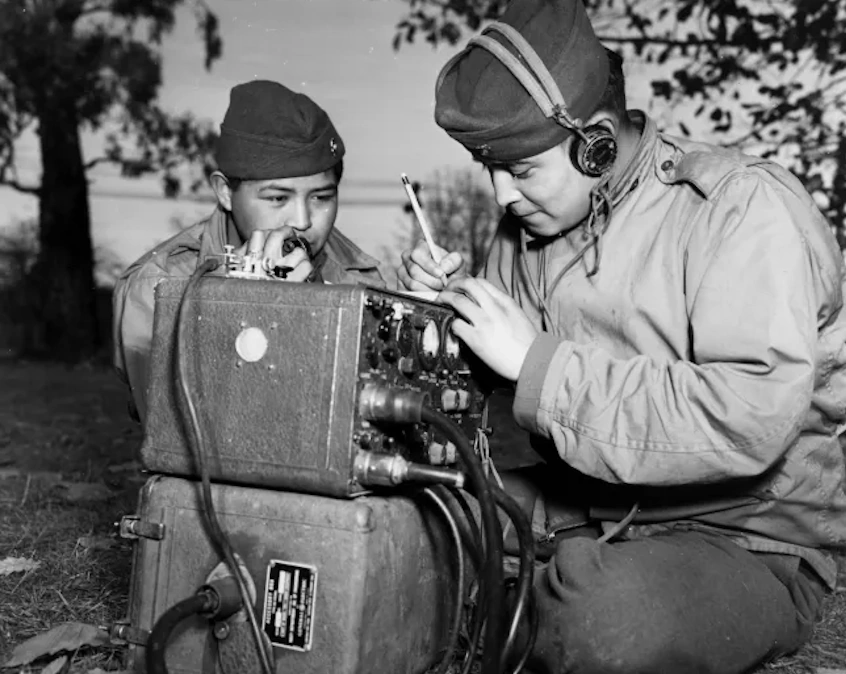
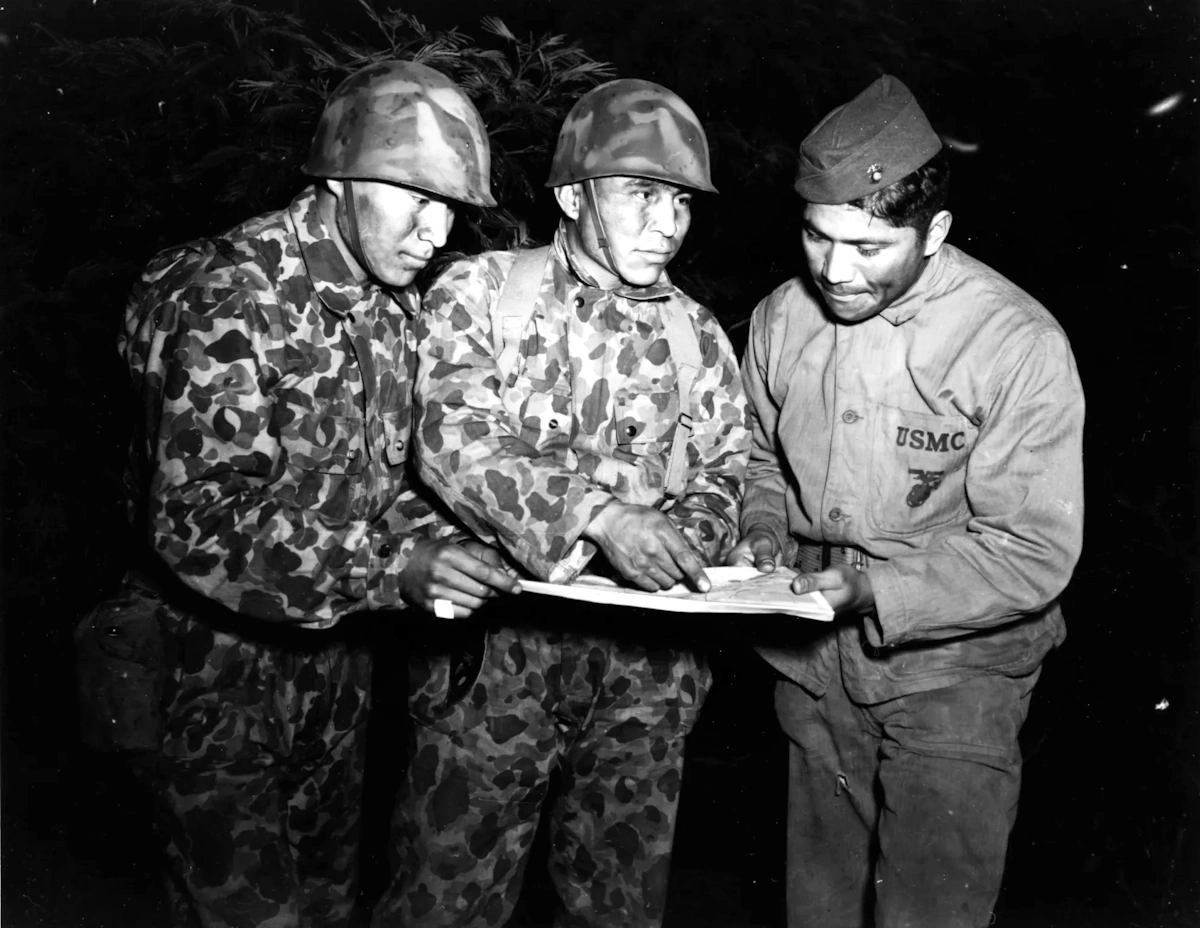
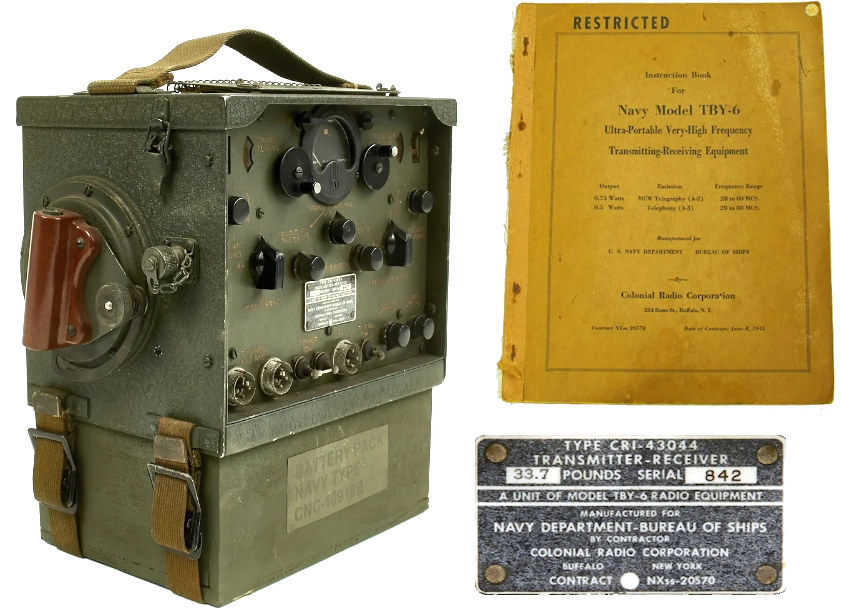
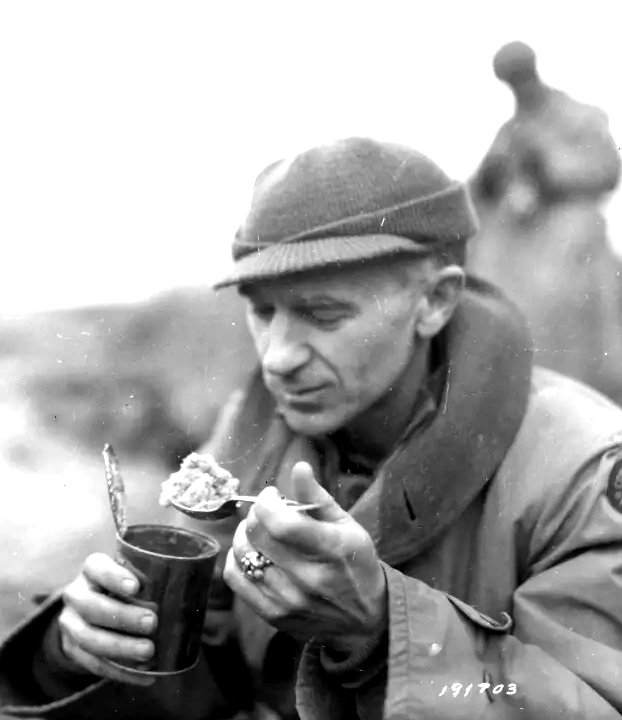 Okinawa – (By Navy Radio) – Back nearly two years ago when I was with Oklahoma’s 45th Division in Sicily and later in Italy, I learned that they had a number of Navajo Indians in communications. When secret orders had to be given over the phone these boys gave them to one another in Navajo. Practically nobody in the world understands Navajo except another Navajo. Well, my regiment of the 1st Division marines has the same thing. There are about eight Indians who do this special work. They are good Marines and are very proud of being so.
There are two brothers among them, both named Joe. Their last names are the ones that are different. I guess that’s a Navajo custom, though I never knew of it before. One brother, Pfc Joe Gatewood, went to the Indian School in Albuquerque. In fact our house is on the very same street, and Joe said it sure was good to see somebody from home. Joe has been out here three years. He is 34 and has five children back home whom he would like to see. He was wounded several months ago and got the Purple Heart. Joe’s brother is Joe Kellwood who has also been out here three years. A couple of the others are Pfc Alex Williams of Winslow (Arizona), and Pvt Oscar Carroll of Fort Defiance (Arizona), which is the capital of the Navajo reservation. Most of the boys are from around Fort Defiance and used to work for the Indian Bureau.
The Indian boys knew before we got to Okinawa that the invasion landing wasn’t going to be very tough. They were the only ones in the convoy who did know it. For one thing they saw signs and for another they used their own influence. Before the convoy left the far south tropical island where the Navajos had been training since the last campaign, the boys put on a ceremonial dance. The Red Cross furnished some colored cloth and paint to stain their faces. They made up the rest of their Indian costumes from chicken feathers, sea shells, coconuts, empty ration cans and rifle cartridges. Then they did their own native ceremonial chants and dances out there under the tropical palm trees with several thousand Marines as a grave audience. In their chant they asked the great gods in the sky to sap the Japanese of their strength for this blitz. They put the finger of weakness on the Japs. And then they ended their ceremonial chant by singing the Marine Corps song in Navajo.
I asked Joe Gatewood if he really felt their dance had something to do with the ease of our landing and he said the boys did believe so and were very serious about it, himself included. ‘I knew nothing was going to happen to us‘, Joe said, ‘for on the way up here there was a rainbow over the convoy and I knew then everything would be all right‘.
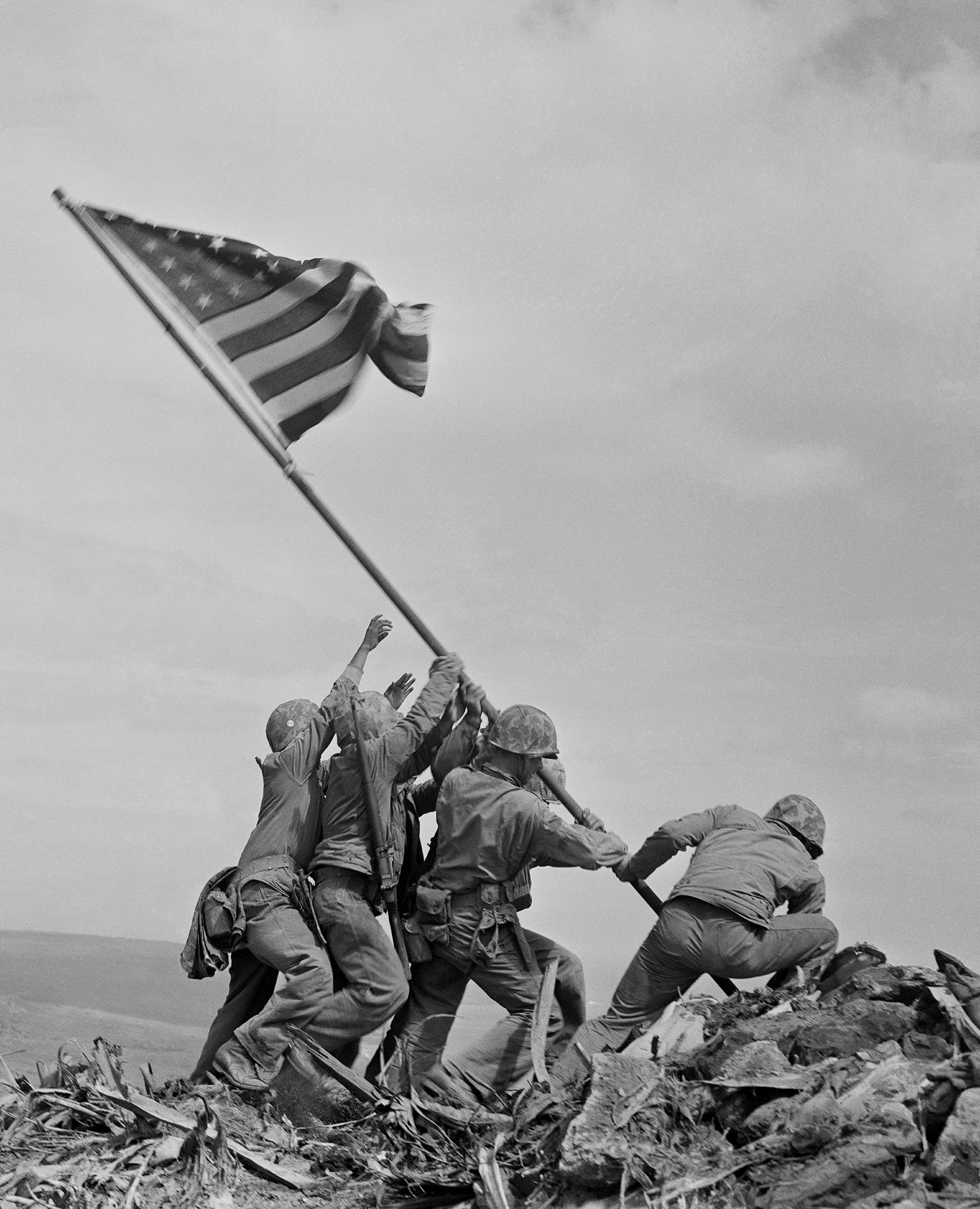
The iconic flag-raising on Mount Suribachi occurred during the Battle of Iwo Jima on February 23, 1945. The six men involved in raising the second, larger flag were: Pfc Ira Hayes (Marine, 5th Marine Division); Pvt Franklin Sousley (Marine, 5th Marine Division); Cpl Harlon Block (Marine, 5th Marine Division); Pfc Harold Schultz (Marine, 5th Marine Division) – identified later as part of the group. Sgt Michael Strank (Marine, 5th Marine Division); Navy Pharmacist’s Mate Second Class John Bradley (Navy Corpsman, 5th Marine Division) – though recent investigations suggest he may not have participated in the second flag-raising.