

 A Choctaw Leads the Guerrillas
In April 1945, after more than three years as a guerrilla leader in the Philippines, Lt Col Edward Ernest McClish came home to Okmulgee (Oklahoma), where his family, who had refused to believe him dead, waited for him. Some of his story has been told in American Guerrilla in the Philippines, by Ira Wolfert, and other details have been added in a report given to the Public Relations Bureau of the War Department by Col McClish. It is an extraordinary tale of accomplishment against great odds.
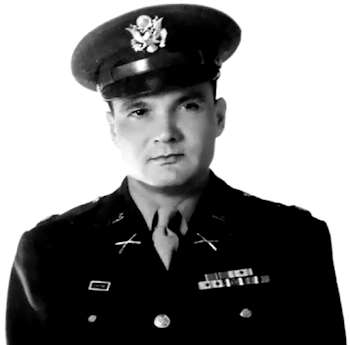 Col McClish, a Choctaw, who graduated from Haskell Institute in 1929 and from Bacone College two years later, was called to active duty in the National Guard in 1940, and early in 1941 he arrived in the Philippines, where he became commander of a company of Philippine Scouts. In August, he went to Panay to mobilize units of the Philippine Army there, and as commander of the 3rd Bn he moved his men to Negros, where they were stationed when the war broke out. Late in December they crossed by boat to Mindanao, and there, all the Moro Bolo Battalions were added to McClish’s command.
The Japanese did not reach Mindanao until April 29, 1942, shortly before the American capitulation on Luzon, and Col McClish’s men fought them for nearly three weeks. When forces on the island finally surrendered, McClish, a casualty in the hospital, some distance from headquarters, was fortunately unable to join his men. Instead of capitulating he began to organize a guerrilla army. By September 1942, he had an organization of more than 300 soldiers, with four machine guns, 150 rifles, and six boxes of ammunition. Some American and Filipino officers had escaped capture and joined the staff. In the early stages of the organization, McClish got word of a Colonel Fertig, of the Army Engineers, who was working along similar lines in the western part of Mindanao, and he managed to reach Fertig by travelling in a small sailboat along the coast. The two men decided to consolidate their commands, and Col Fertig asked McClish to organize the fighting forces in the four eastern provinces of the island as the 110th Division. Organization was at first very difficult. Independent guerrilla bands had sprung up all over the island, some of them composed of robbers and bandits who terrorized the villages. Some were anti-American, says Col McClish. Most of them lacked military training and education. But slowly the work proceeded. The bandits were disarmed and jailed; the friendly natives were trained, and young men qualified to be officers were commissioned. By the spring of 1943, McClish had assembled a full-strength regiment in each of the three provinces, a fourth had been started, and Division headquarters staff had been completed.
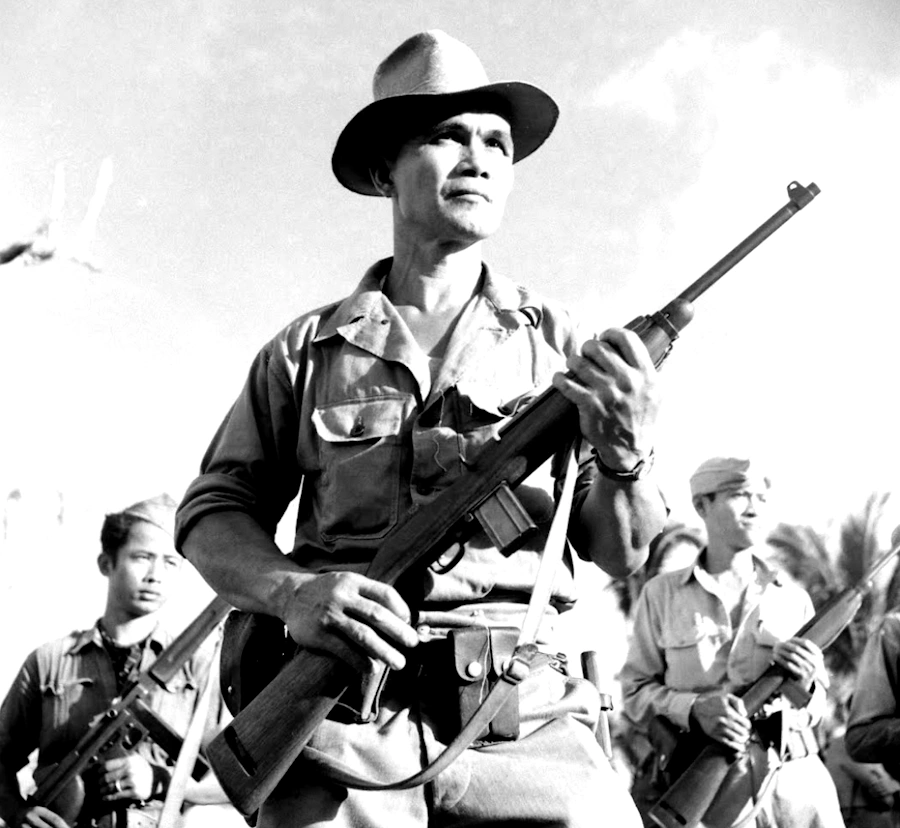
Simultaneously with the military organization, civil governments were set up in each province. Wherever possible, the officials who had held jobs in pre-war days were reappointed, provided that they had not collaborated with the Japanese. Provincial and municipal officials worked hand in hand with the military, and helped greatly to build up the army’s strength. Because of the shortage of food reported by Col McClish, a Food Administrator and a Civil and Judicial Committee were appointed to begin agricultural and industrial rehabilitation. Army projects for the production of food and materials of war were begun throughout the Division area, and all able-bodied men between the ages of 18 and 50 were required to give one day’s work each week to one of these projects. They raised vegetables, pigs, poultry, sugar cane, and other foods. The manufacture of soap, alcohol, and coconut oil was started. Fishing was encouraged. In some of the provinces food production was increased beyond the peacetime level. The civilians realized that they were part of the army, and that only a total effort could defeat the enemy. The public relations office published a newspaper, and headquarters kept in communication with the regiments in each province by radio, by telephone (when wire was available), or by runner. The guerrillas acquired launches and barges which had been kept hidden from the Japanese, and these were operated by home-made alcohol and coconut oil. Seven trucks provided more transport, but it was safer and easier to use the sea than the land. In order to maintain their motor equipment, they ‘obtained‘ a complete machine shop from a Japanese lumbering company in their territory.
From September 15, 1942, to January 1, 1945, while McClish’s work of organization and administration was continuing, his guerrilla forces were fighting the Japanese, and more than 350 encounters -ambushes, raids on patrols and small garrisons, and general engagements- were listed on their records. One hundred and fifteen men were killed and sixty-four wounded. Enemy losses were estimated at more than 3000 killed and six hundred wounded. The guerrillas finally made contact with the American forces in the South Pacific and supplied them with valuable information about the enemy which was extremely helpful when the time for the invasion of the Philippines came at last. They did their part in bringing about the final victory in the Pacific.
An Empty Saddle
‘If I should be killed, I want you to bury me on one of the hills east of the place where my grandparents and brothers and sisters and other relative are buried‘. ‘If you have a memorial service, I want the soldiers to go ahead with the American flag. I want cowboys to follow, all on horseback. I want one of the cowboys to lead one of the wildest of the T over X horses with saddle and bridle on‘. ‘I will be riding that horse‘. Such were the written instructions left by Pvt Clarence Spotted Wolf, full-blood Gros Ventre, with his tribesmen. He was killed December 21, 1944, in Luxembourg.
Pvt Spotted Wolf was born May 18, 1914. He entered the service in January 1942, and a year later was transferred to a tank battalion. He went overseas in August 1944. On January 28, in Elbowoods (North Dakota), the memorial service he had foreseen was held in his honor. It was an impressive ceremony. The Stars and Stripes presided over the winter-bare hills where Clarence Spotted Wolf’s family and friends carried out his wishes. There were soldiers; there were cowboys; and his own saddle had been placed on the T over X horse, which was led in the procession. It is pleasing to fancy the spirits of brave warriors long departed watching benignly from the Happy Hunting Grounds. As for the empty saddle – who knows?
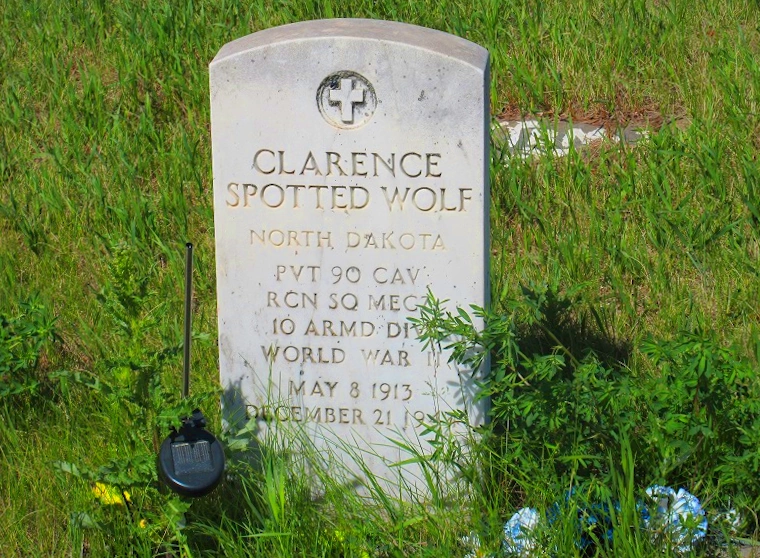
(Above) Tombstone of Pvt Clarence Spotted Wolf, 90th Cavalry Reconnaissance Squadron Mechanized, 10th Armored Division, killed in action in Luxembourg on December 21, 1944, during the Battle of the Bulge. Clarence has been buried at the Memorial Congregational Church Cemetery Raub, McLean County, North Dakota, USA.
 ARIZONA
Adam Harney – Apache (San Carlos) – France
Alfred Ferguson Maricopa – France
Alfred Perkins – Pima – Leyte
Alfred Tsosie – Navajo – Bougainville
Alfonso Zeyouma – Hopi – USA
Alonzo Antone – Papago – Belgium
Allen Honawahoya – Hopi – Pacific
Alton Kidde – Apache (San Carlos) – Pacific
Antonio J. Alvarez – Papago – France
Antony Jose – Pima
Austin Francisco – Papago – Luzon
Clarence Beeson Hopi Germany
Dennis Manuel – Papago – Pacific
Edmund Smith – Navajo – Germany
Edward Harris Papago Okinawa
Elwood King – Navajo – Iwo Jima
Ernest Stanley – Apache (San Carlos) – Luxembourg
Eugene Mansfield – Hopi – USA
Evans Reede – Apache (San Carlos) – New Britain
Felix Ashley – Navajo – Pacific
Frank Banashley – Apache (Fort Apache) – Luzon
Frank Reede – Apache (San Carlos) – Luzon
Fred James – Pima – Pacific
Fred R. Loukai – Navajo – Burma
Fred Washington – Pima
Harold Poncho – Hopi – France
Haskell A. Osife – Pima
Henry Isaac Norris – Papago – England
Joe C. Lewis – Papago – Luzon
Joe Gonzales – Papago – Luzon
Joe Singer – Navajo – Philippines
Joe Terry – Pima
Johnnie Goodluck – Navajo – France
Johnston Peters – Pima – Germany
Joseph Hendricks – Papago – Luzon
Joseph Thomas – Pima
Joshua Morris – Pima
Kayah Gale – Navajo – Pacific
Lawrence Garcia – Papago – Italy
Leander Shelde – Pima
Lonnie Allen – Apache (San Carlos) – Pacific
Norman Puhuquaptewa – Hopi – Luxembourg
Percy Osife – Pima
Phillip Largo – Pima
Ralph Aday – Apache (Fort Apache) – Germany
Raymond T. Carrillo – Papago – Okinawa
Robert E. Allison – Pima
Roy Hoahtewa – Hopi – Philippines
Sam J. Earl – Navajo – Luzon
Silas Lefthand – Navajo – Luzon
Stephen Thomas Carrillo – Papago – Okinawa
Stetson Pahayeoma – Hopi – Leyte
Tom Singer – Navajo – Peleliu
Thomas Altaha – Apache (Fort Apache) – Italy
Thomas Throssell – Papago – USA
Venito M. Condio – Papago – Luzon
Ventura B. – Papago – Italy
Walter Keyannie – Navajo – Luxembourg
Walter Key Biye – Navajo – Pacific
Walter Nelson – Navajo – Luzon
Willacot Anton – Pima
 CALIFORNIA
Arthur Case Jr – Karok
Augustine Quevas – Mission (Santa Ysabel) – Japan
Baron D. Risling – Hoopa – USA
Bob Smith – Mission (Mesa Grande) – Germany
Charles L. Henderson – Hoopa (Mattole)
Eugene Lewis – Yurok – Iwo Jima
Floyd Pilgrim – Klamath
Fred Rodriquez – Mission (Rincon) – Germany
Gene Pablo – Mission (Santa Ysabel) – Pacific
George Estrada – Mission (Mesa Grande) – Saipan
Gilbert Cleland – Mission (Mesa Grande) – Germany
Henry Davis – Hoopa (Weott)
Jack Mattz – Yurok – Holland
James Ladd – Klamath – Italy
Joe Blacktooth – Mission (Pala) – Japan
John Duncan – Hoopa (Wailaki) – Holland
John P. Emeterio – Sacramento – Belgium
Lee M. Angel – Mission (Mesa Grande) – Germany
Leonard W. Mosely – Hoopa – (Eel River)
Melvin Cadoza – Hoopa (Smith River) – Saipan
Merced Norte – Mission (Los Coyotes) – France
Otto Hodge – Yurok – Italy
Philip Peters – Mission (Pauma) – USA
Reginaldo Helms – Mission (Soboba) – Belgium
Romaldo Natt – Yurok – Italy
Steve Levi – Mission (Torres-Martinez) – Saipan
Wilfred Ward – Mission (La Jolla) – Germany
William Besoain – Karok
 COLORADO
Albert Box – Ute – Leyte
Elmer Lewis – Navajo
Wilbur Washington – Ute – Italy
 IDAHO
IDAHO
Adolph Alexie – Coeur D’Alene – Okinawa
Howard Cutler – Shoshone – Atlantic
James Burt – Shoshone – Luzon
James Mosho Jr – Shoshone – Europe
Nelson Ingawanup – Shoshone – Europe
Matthew Honenah – Shoshone – Europe
Stanley George – Shoshone – Europe
 KANSAS
Edgar H. Goslin – Kickapoo – Pacific
Herbert H. DeRoin – Iowa – France
Paul G. Wamego – Potawatomi – Germany
William Lasley – Potawatomi – Italy
 MINNESOTA
Adolph King – Chippewa – France
Clifford John Antell – Chippewa – Pacific
Daniel McKenzie – Chippewa – Holland
Dean Ottershaw – Chippewa – Pacific
Dominic Misquadace – Chippewa
Eddie Brown – Chippewa – Italy
Francis S. Bushman – Chippewa – Manchukuo
George Brunette – Chippewa – USA
George Kelly – Chippewa – France
George Sheehy – Chippewa – Italy
Hubert Williams – Chippewa – Belgium
Jacob Anderson – Chippewa – France
James I. Cook – Chippewa – Luzon
James L. Johnson – Chippewa – France
Jesse J. Tibbetts – Chippewa – English Channel
John S. Mercer – Chippewa – Germany
Joseph Weaver – Chippewa – Belgium
Lewis E. Taylor – Chippewa – Germany
Lyman Tanner – Chippewa – Luzon
Lawrence Carl – Chippewa – Luzon
Martin E. Simons – Chippewa – Pacific
Peter Morgan – Chippewa – France
Ralph Robinson – Chippewa – Germany
Richard Boshey – Chippewa – Belgium
Richard Johnson – Chippewa – Africa
Richard Sailor – Chippewa – France
Robert Belland – Chippewa – Italy
Robert TeJohn – Chippewa – Luzon
Sylvester Charboneau – Chippewa – At Sea
Vincent Zimmerman – Chippewa – Europe
Wesley Eagle – Chippewa – Pacific
William Potter – Chippewa – Italy
 NEW MEXICO
George Vicenti – Apache (Jicarilla) – Romania
Harley Kantenna – Zuni – Italy
Harold White – Navajo – Italy
Harry White – Navajo – Italy
Hilario Armijo – Jemez Pueblo – Germany
Jack Antonio – Acoma Pueblo – Germany
James Romero – Laguna Pueblo
Jay Delawashie – Navajo – Philippines
Jim Tom – Navajo – France
Jimmy Rodriguez – Laguna Pueblo
Jimmie Weahke – Zuni – Italy
Joe Ben – Navajo – Luzon
Joe B. Garcia – Santo Domingo Pueblo – Europe
John C. Nelson – Navajo – Leyte
John Martin – Navajo – Philippines
John Wesley Romero – Laguna Pueblo – Belgium
Jose Chewiwi – Isleta Pueblo – Europe
Jose Cruz Duran – San Felipe Pueblo
Jose C. Tenorio – San Felipe Pueblo – Pacific
Jose E. Lopez – Santa Ana Pueblo
Jose F. Mirabal – Santa Clara Pueblo
Jose R. Lucero – Isleta Pueblo
Jose Romero – Santa Ana Pueblo – Pacific
Kee Y. Chico – Navajo – France
Marce L. Korris – Santo Domingo Pueblo – Okinawa
Mariano Pacheco – Laguna Pueblo – Italy
Martin Aragon – Laguna Pueblo – France
Osborne Sam – Navajo
Pablo Fragua – Jemez Pueblo
Paul Fernando – Laguna Pueblo – Germany
Paul G. Chaves – Acoma Pueblo
Paul Kinlahcheeny – Navajo – Iwo Jima
Raymond Rosetta – Santo Domingo Pueblo
Richard Jamon – Zuni – Luzon
Sam Morgan – Navajo – Iwo Jima
Sidney David – Navajo – Philippines
Silas Yazzie – Navajo – Italy
Ted Bird – Santo Domingo Pueblo – Germany
Vincent Wemytewa – Zuni – Germany
Vicenti Mirabal – Taos Pueblo – Germany
 MISSISSIPPI
Able Sam – Choctaw – Germany
Bob Allen – Choctaw – Solomons
Emmett Jackson – Choctaw – Germany
Gibson T. McMillan – Choctaw – Luzon
John Day Isaac – Choctaw – USA
Raymond Martin – Choctaw – Germany
 MONTANA
Benjamin Chopwood – Assiniboine – Italy
Charles Stewart – Blackfeet – Pacific
Clarence L. Marengo – Flathead – Italy
Daniel L. Pablo – Flathead – Germany
Elmer C. Ladue – Flathead
Elvin Matt – Flathead – Germany
Eugene Horn – Blackfeet – Leyte
Harvey W. Ducharme – Flathead – Germany
Francis Heavyrunner – Blackfeet – France
Fred De Roche – Blackfeet – Belgium
Fredrick Bauer Jr – Sioux – Luzon
Fredrick E. Kasko – Flathead
George B. Magee Jr – Blackfeet – France
Isaac Matt – Flathead – Germany
Joseph Long Knife – Assiniboine – Luzon
Joseph O. Pronovost – Flathead – Pacific
Julian A. Pablo – Flathead – Philippines
Leonard R. Jette – Flathead
Louis C. Charlo – Flathead – Iwo Jima
Melvin Rides at the Door – Blackfeet – Germany
Murphy Gunn – Assiniboine – Pacific
Murry L. Williamson – Blackfeet – Luzon
Oswald A. Felsman – Flathead – France
Pascal Bohn – Flathead – Belgium
Patrick Reevis – Blackfeet – Luzon
Pius Wing – Assiniboine – France
Richard King Jr – Assiniboine – France
Roger K. Paul – Blackfeet – France
Sam Dives Backwards – Cheyenne – Luzon
Warren L. Gardipe – Flathead – Philippines
Wilbur Spang – Cheyenne – USA
William Allison Jr – Blackfeet – Germany
William Pronovost – Flathead
William Wolftail – Blackfeet – France
 NEBRASKA
Thomas H. Harrison – Winnebago – France
 NEVADA
Alex Fragua – Jemez Pueblo – France
Aghe Beligoody – Navajo – France
Alfonso G. Nahkai – Navajo – Palau Islands
Anthony Mitchell – Navajo – France
Arthur F. Jones – Paiute – Africa
Ben Quintana – Cochiti Pueblo – Philippines
Bernard Dolan – Apache (Mescalero) – Belgium
Clarence Hanks – Paiute – Europe
Cypriano Herrera – Tesuque Pueblo – Europe
David Harvey – Navajo – Germany
Earl Ayze – Navajo – France
Edgar Lunasee – Zuni – Philippines
Edward Joe – Washoe – Peleliu
Francis Shaw – Paiute – Africa
Frank Lucero – Laguna Pueblo – Pacific
Henry West Jr – Paiute
Mike Drew – Paiute – Italy
Seymour Arnot – Washoe – Pacific
Scott Green – Paiute
Sidney Jack – Paiute – Europe
Stanley Winnemucca – Paiute
Warren Wilson – Paiute – Pacific