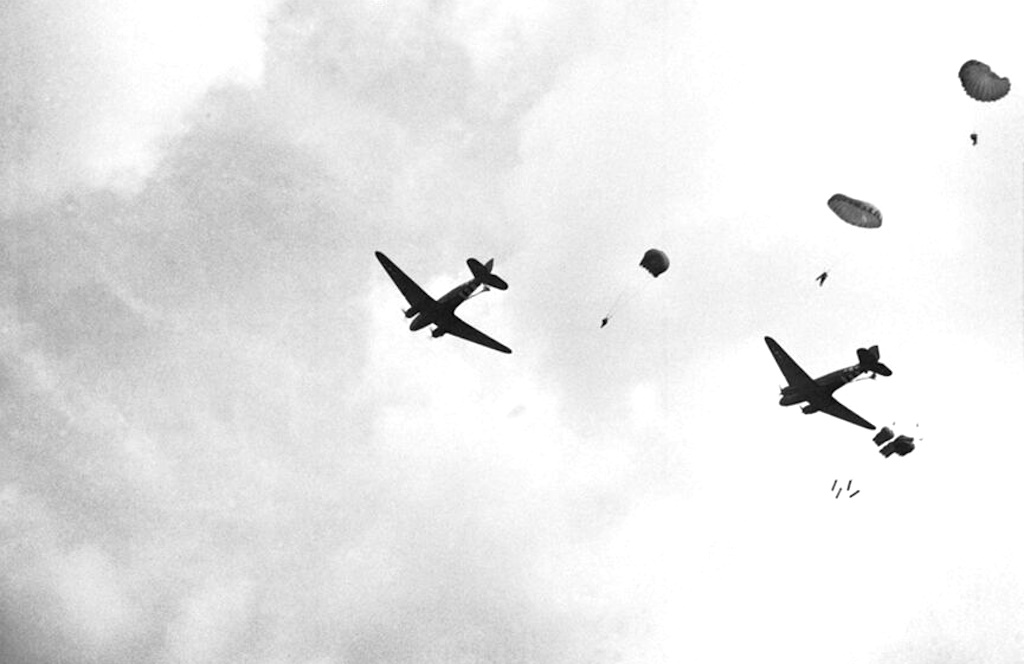


On D-Day, June 6, 1944, during World War II, the US paratroopers of the 101st and 82nd Airborne Divisions used a type of parachute known as the T-5 Troop Carrier Parachute. This parachute was designed specifically for airborne operations and was used by American paratroopers during the Normandy landings. The harnesses of the T-5 Troop Carrier Parachutes used on D-Day were either white or khaki in color. Note that the exact shade of khaki could vary somewhat, but it was generally a light brown or tan color. As for the stock number, during World War II, items like parachutes and other military equipment were assigned a unique identification number known as the Stock Number or Stock Code. The T-5 parachute was assigned a stock number as well. The stock number for the T-5 parachute was AN 6510. This stock number was used to identify the T-5 parachute within military supply and logistics systems. It allowed for proper inventory management, ordering, and distribution of the parachutes to the airborne units. Manufactured by Pioneer Parachute Co., National Toy Co., Irvin Parachute Co., General Textile Mills, etc., the size to the camouflaged canopy had a diameter of approximately 28 feet (8.5 meters) when fully deployed. Being a troop parachute designed for quick and mass jumps the Pack Assembly (complete T-5 with Reserve Parachute) was a static-line parachute, which means it was deployed automatically as the paratrooper exited the aircraft. It had a central vent to assist with stability during descent. It’s important to note that the T-5 parachute was later replaced by the T-5 modified with the addition of a Quick Release Box (T-5A-1) and then the T-7 with the permanent adoption of the Quick Release Box sewn onto the harness during the manufacturing. Later, post-war, came the T-10 parachute. It’s worth noting: T-5 for North Africa, Pacific, Normandy, and Southern France (82-AB, 101-AB, 503-PIR, and 509-PIB); Holland, T-5 82-A/B, T-5A-1, and T-7 101-A/B; Belgium and Germany, T-7, 17-A/B (T-5 and T-5A-1 obsolete and replaced by T-7)
They were not so fortunate with their equipment, however, of the major items dropped, consisting of one radio SCR-264, two SCR-609s, two switchboards, and a supply of wire, four rocket launchers with ammunition, and one 50 caliber M-2 BMGs with ammunition, no a single item was recovered from the water. The jump masters each had one SCR-536 to aid them in assembly. These were wet and useless and were thrown away. Lt Shockley succeeded in ‘rolling up his stick’ and assembling his men on the edge of the railroad embankment running north-south through the marsh. Capt Whitley lost seven enlisted men who drifted to the river’s west bank, joined a small force of paratroopers from the 507-PIR, and engaged as infantry for the next thirty hours. Through the use of runners, Lt Shockley established contact with Capt Whitley, and by 0430 H the four officers and twenty-five enlisted men were assembled on the railroad embankment, contemplating their situation. About this time, Col Roy Lindquist, CO of the 508-PIR, came down the railroad track while proceeding south with a force of approximately sixty officers and men. Since Col Lindquist’s interests lay on the west side of the river, he intended to cross the causeway at La Fière. Capt Whitley, the senior officer of the artillery detachment recalling that part of his mission was to reconnoiter the bridge at La Fière, formed a third platoon and joined Lindquist and his force.
The fighting that developed around the bridge at La Fière when they arrived a short time later proved so interesting to the artillerymen that their mission was completely forgotten until Gen Ridgway, the Division Commander, arrived upon the scene at approximately 0930 H, and recognizing Lt Shockley ordered him to disengage his artillerymen and proceed to the artillery CP which had been established by Col March in the vicinity of Ste-Mère-Eglise. The order was complied with, without incident, and the detachment closed in the CP at noon. Nothing material as far as the artillery effort was concerned had been accomplished by this detachment. The two howitzer sections with the 3/505-PIR had encountered pretty much the same conditions en route but did drop on their designated DZ. Their bundles, however, became scattered on the drop, and they were able to assemble only one howitzer when it became time to move on to Ste-Mère-Eglise. Man-handling a 1270-pound howitzer, and the ammunition therefor, through the hedgerow country of Normandy, enemy or no enemy, is a mean job in itself; consequently, most of the efforts of this force was expended in getting from one place to another. In support of the 3/5058-PIR, their efforts were negligible, but this howitzer was to play an important role later in the day. By noon, the exhausted gun crews and their howitzer were at the artillery CP.
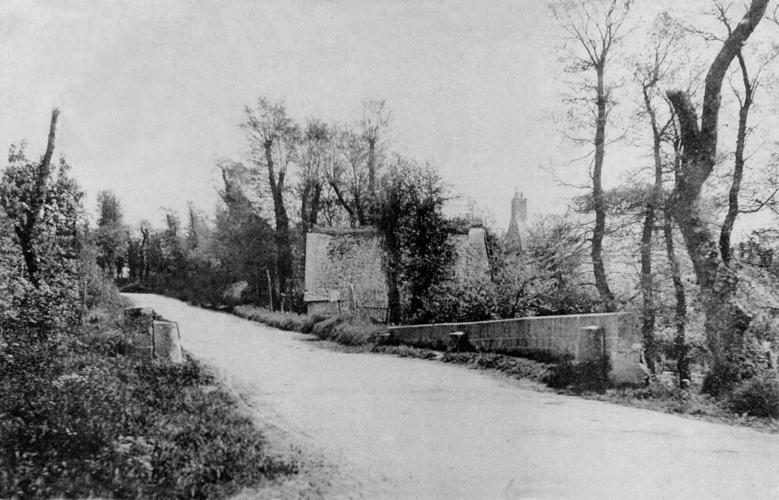
THE ADVANCE GLIDER ELEMENT
As we recall from the breakdown of aircraft the artillery was allotted only one CG-4A glider in the command and anti-tank serial of Force B. This load was formed at the Ramsbury departure field and consisted of Col March, the artillery Commander, Maj Frederick J. Silvey, S-3 of the 319-GFAB, and Capt Robert J. Manning, Communications Officer of the 320-GFAB. The remainder of the load, to a total of thirteen officers and men, consisted of survey personnel and their equipment. The glider became airborne at 0130 H on D-Day, marshaled, and flew the same route that the parachutists had flown shortly before. The formation, as were all the other glider formations, was a pair of pairs echeloned to the right forming four plane flights. It may be well to explain this formation, just to illustrate the increased length of the sky trains when gliders are involved. The tow ropes are 300 feet in length. In the formation just mentioned, the two planes on the left dress on each other and establish the guide; the two planes on the right dress on each other, and the gliders on their left, thereby occupying approximately the same distance space as a flight of nine planes alone. Upon approaching land, the glider pilots noted that the fog was still there and that heavy anti-aircraft weapons were searching the sky. Here, however, the air train was in a favorable position. It was too low to be affected by the heavy weapons, and the poor visibility rendered the small arms fire comparatively ineffective.
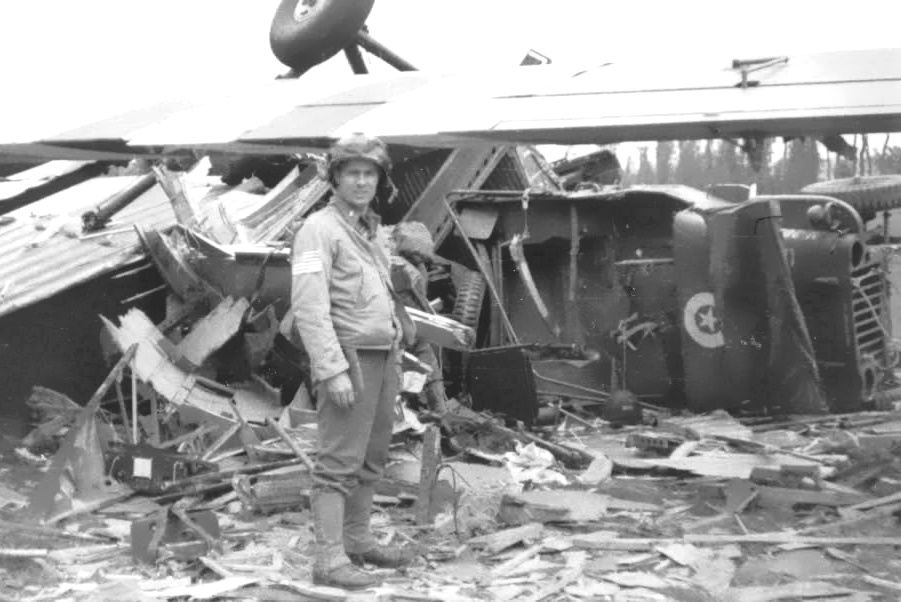
Since it was now almost four hours that the planes had been flying this lane, the enemy had analyzed the situation and reacted accordingly. The directional navigation of the tug ships was perfect. The Eureka station on DZ O was functioning perfectly. As the ships approached the DZ, the fog banks began to open. The occupants of the glider could now clearly see the tug ship ahead. The crew chief of the tug ship was signaling them to cut loose. This signal was transmitted by means of an Aldis lamp operated by the crew chief from a position in the observation bubble of the C-47. The glider cut loose, and immediately it seemed as if the entire sky was full of gliders going in all directions. To avoid a mishap in the air, the pilot brought it down hard and crash-landed on the outskirts of b>Ste-Mère-Eglise at 0407 H just slightly beyond the DZ. Due to the danger in the air, he had not been able to make his 180-degree turn. In smashing through a stone embankment, the glider was demolished, and members of the party were injured to the extent that they could not be moved. Leaving two members of the detachment to take care of the injured, Col March, with his considerably reduced party, proceeded toward the center of the town, where Col Edward Krause and his 3/505-PIR engaged in mopping up the town, noting that Ste-Mère-Eglise, for the time being at least, was secure, the party proceeded west toward the preplanned CP location. While reconnoitering the preplanned area, the party was met by Gen Ridgway, who advised Col March that the Division CP was approximately 1000 yards west of the preplanned area. The Division CP dictated that the artillery CP be near, so, at 0500 H the artillery CP opened approximately 1400 yards west of Ste-Mère-Eglise.
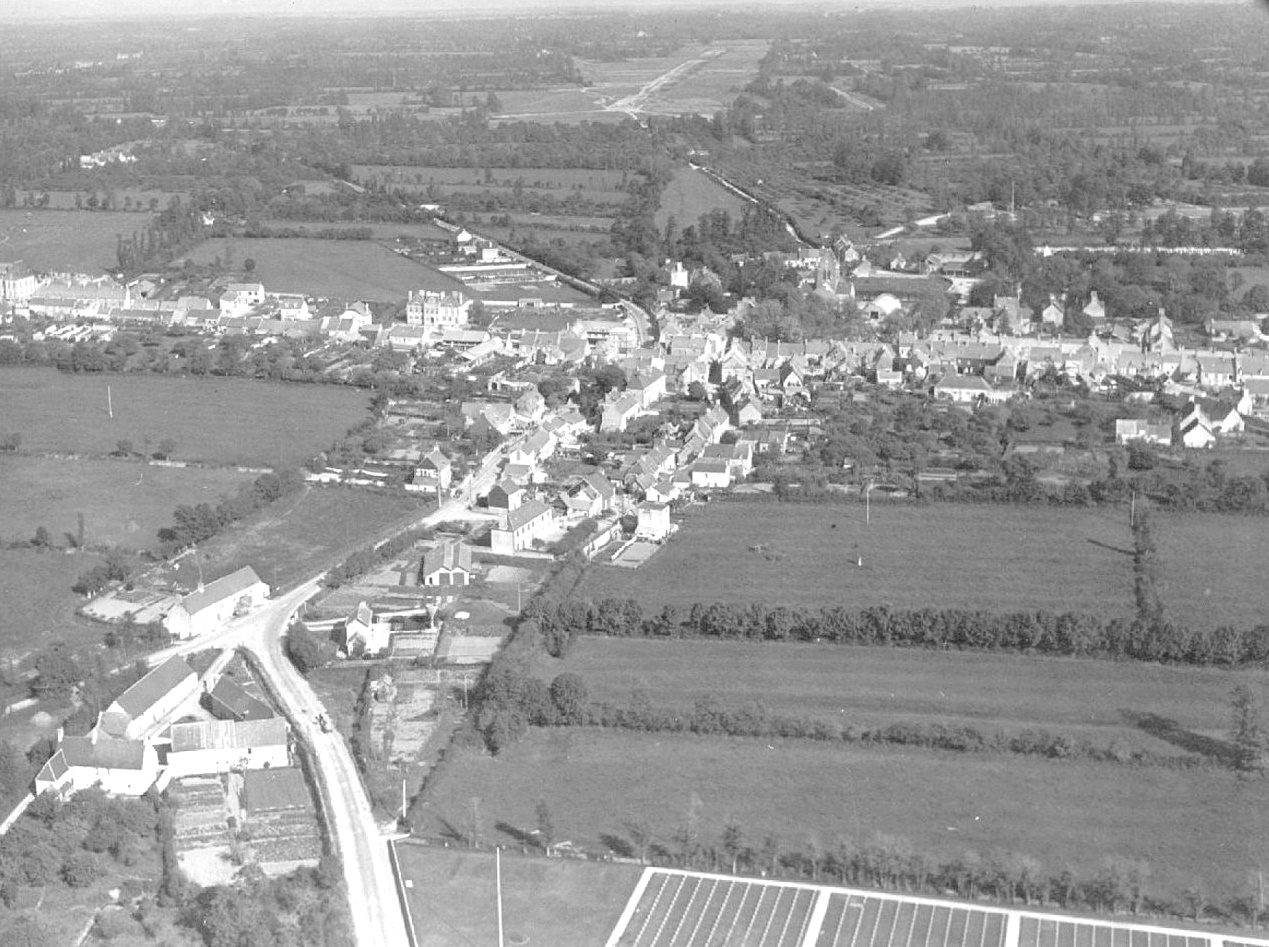

The reconnaissance detachment which Col March expected to find here was nowhere around, and if we will recall, it was engaged at this time in fighting as infantry at La Fière. The situation was so obscure, and the survey parties so depleted that nothing could be done in that direction. No transportation was available, and isolated firing was heard from all directions. About all the command group could do was wait for developments. At noon, when the reconnaissance element joined the CP group, a portion of the enemy’s plan of action was becoming apparent. Pressure, just north of the CP was building up. It was mandatory that the enemy threat be repulsed in that it would cut the lifeline between the elements of the Division in the vicinity of Ste-Mère-Eglise, and those to the west at La Fière. Gen Ridgway realized that if the situation went from bad to worse he would have to go on the defensive, and Ste-Mère-Eglise and vicinity would be the ground he must occupy. Consequently, all efforts were directed toward the repulsion of this attack. The enemy probed throughout the afternoon but sought to dislodge the defenders by fire rather than by aggressive action. The lone 75-MM pack howitzer from the 456-PFAB had a field day in neutralizing enemy automatic weapons by direct fire. The cannoneers would cautiously probe a small opening through the hedgerow, fire several fast rounds, and displace. In the meantime, observers would pick up another machine gun opening up on the now vacant position, thus providing the howitzer with its next target. Airborne artillerymen call this sniping and enjoy the sport tremendously so long as the enemy is not sufficiently aggressive to overrun the position.
During the afternoon’s action, however, Col March was able to organize an improvised staff. Of immediate concern was the lack of equipment. He appointed Lt Shockley S-4 and provided him with a one-quarter-ton truck and trailer, borrowed from Division Headquarters. The S-4, with a few enlisted men, was able to salvage considerable wire communication equipment from the crashed gliders and the para bundles which had not been picked up by the jumpers. The idea was infectious, and by evening the Division supply situation had been saved to some extent. Col March could see by this time that the artillery battalions would not be able to occupy their preselected position areas, not even the alternate area, and consequently, he and his recently appointed 5-3, Capt Whitley, reconnoitered new position areas, Their circulation was limited to the 2000 yards between Ste-Mère-Eglise and La Fière, and they were on foot, so they decided to place the 320-GFAB just east of the CP and approximately halfway to Ste-Mère-Eglise, and the 319-GFAB a few hundred yards south of the CP. Sgt Smith, the newly appointed Communications Chief, was able to establish wire communications to both areas without difficulty.

The newly appointed S-2, Lt Sullivan, could get nowhere with his survey due to the lack of personnel but managed to get the howitzer after the fight around the CP, register from one position area prior to darkness, and stake out a limited position area survey. The fruits of his labors, however, were never utilized, nor was survey ever to be employed during the remainder of the campaign. During the course of the afternoon the battalion parties, augmented by personnel from the Headquarters Battery, were readied to receive the incoming glider men, brief the commanders on the situation, and guide them to their position areas.