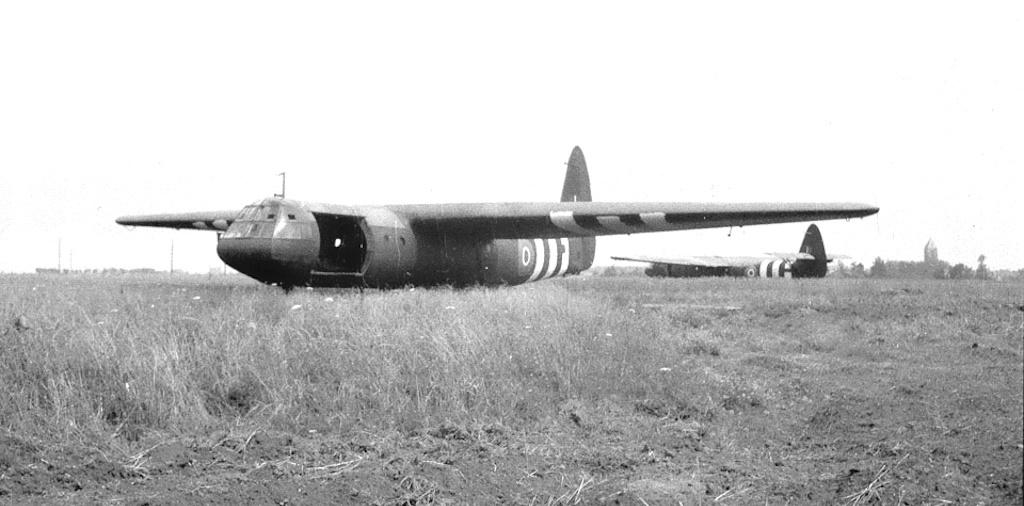
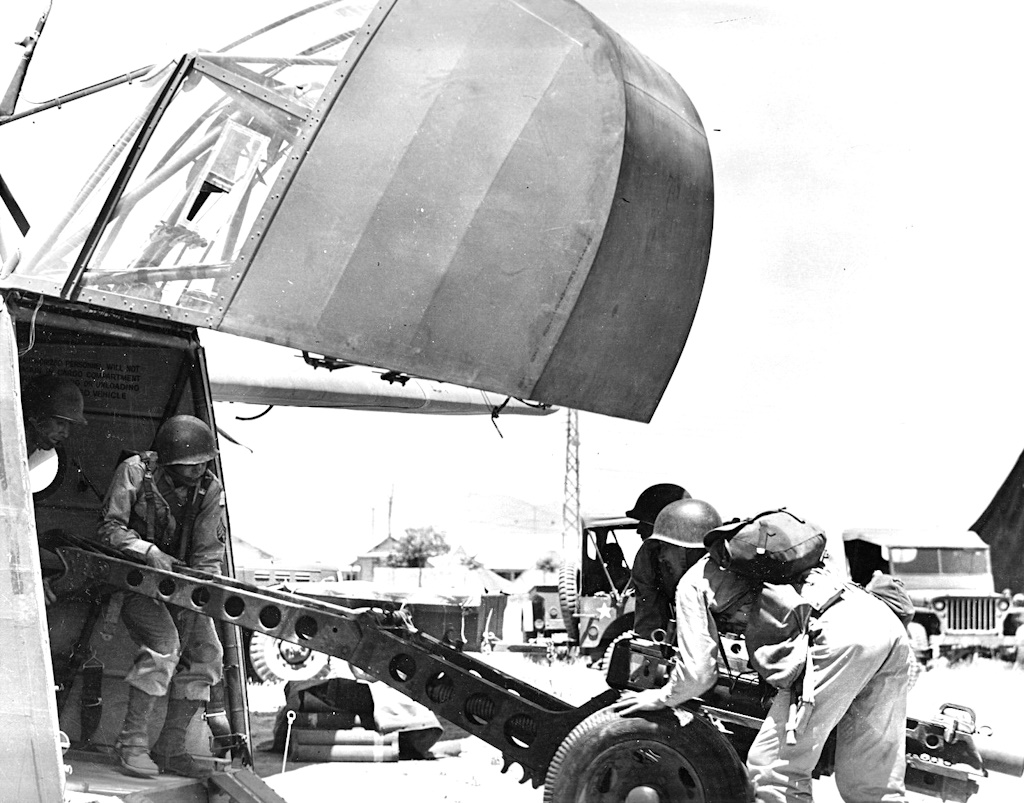
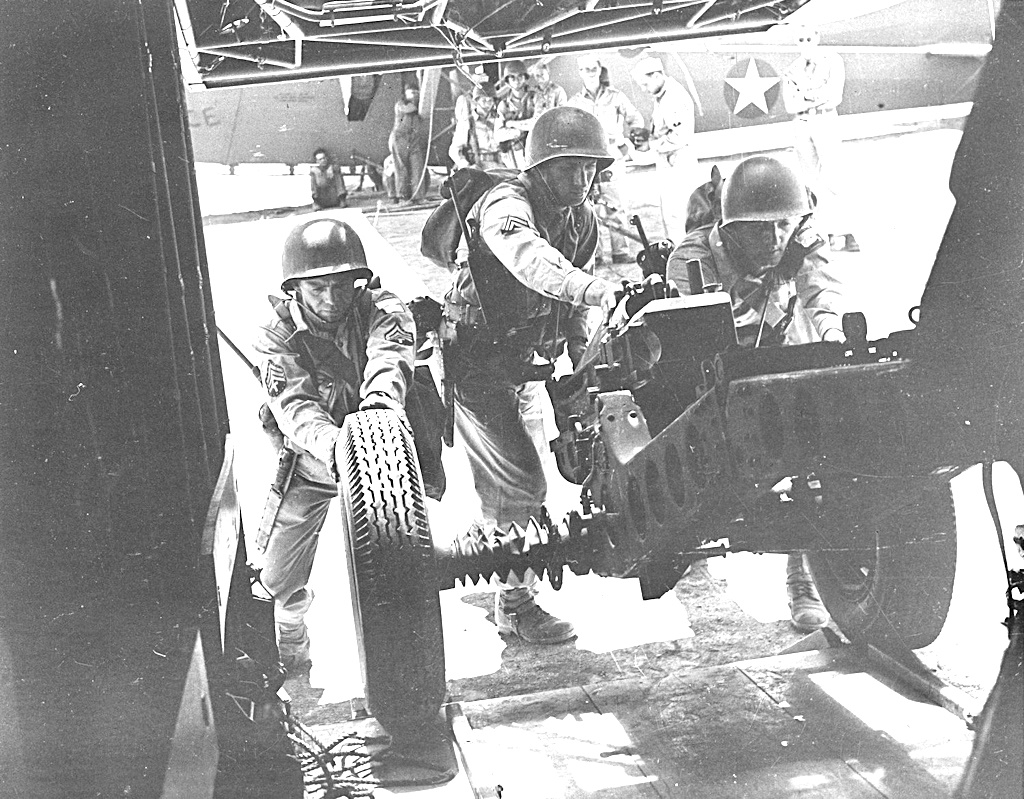
The time required for unloading was unduly long. To facilitate unloading, numerous experiments were conducted, the most promising of which was the placing of powder charges in the tail section, with the view of blowing off the tail upon landing and seeking egress through the rear. Some troops might have actually used this method, but most abandoned it as being too dangerous to both men and equipment. Of gravest concern to the gliders was the fact that our pilots had had very little experience in flying this craft, and also that the nose wheel frequently broke through the floor upon landing, and ripped its way through the entire craft. Training through April and May was at a terrific pace. Much attention was given to the balancing of loads to provide for the proper distribution of weapons to provide security for each load. Recognition signals were worked out. Assembly aids and various plans for assembly were worked out and rehearsed, and toward the latter part of May, the division was ready.
The 52nd Troop Carrier Wing and the 534th Troop Carrier Wing of IX Troop Carrier Command were designated to furnish our transportation. The number of aircraft to be utilized by the 82-A/B alone included 378 C-47s to take in the parachute lift on the night of June 5/6, 240 Airspeed Horsas, and 188 Waco CG-4As gliders to land on D-Day and D+1 (including the necessary C-47s to single tow these gliders) and the additional use of 191 C-47s for resupply on D+1. The air echelon of the Division was organized into two forces: Force 4 (Paratroopers), and Force B (Gliders). The land-tail element was known as Force C. The Troop Carrier plan was to fly Force A and one serial of Force B (50 Gliders) into Normandy by the western route; that is, to fly around the Cherbourg Peninsula and approach from the west, and the rest of Force E, the eastern route, or overhead of the seaborne forces. On May 27, when Force C was already en route to its marshalling areas, the 82-A/B received its mission to land by parachute and glider, before and after the dawn of D-Day astride the Merderet River, capture Ste-Mère-Eglise, destroy the Douve River crossings at Beuzeville-La-Bastille and Etienville, protect the northwest flank of the Corps, and be prepared to advance to the west on Corps order. The mission of the Division Artillery was to support the Division and be prepared to deliver fires beyond the northwest boundary of the Division zone. Accordingly, final drop and landing zones were selected and assigned, areas of responsibility established, and tentative artillery position areas designated.

DIVISION ARTILLERY SITUATION
Gen Maxwell D. Taylor left the Division artillery on February 21 to assume command of the 1101-A/B, thereby leaving the commend to the Executive Officer, Col Francis A. March, who. is frequently referred to as the dean of airborne artillerymen. The artillery, discounting the battalion with the 504-PIR in Italy, now consisted of a Headquarters and Headquarters Battery, two glider battalions, the 319th armed with twelve 75-MM Pack Howitzers, the 320th armed with twelve 105-MM M-3 Howitzers, and the 456th Parachute Field Artillery Battalion armed as the 319th. All battalions were organized into one Headquarters Battery and three firing batteries of four howitzers each. A most welcome addition to the artillery family at this time was a replacement packet of officers who were sorely needed. In addition to filling vacancies, the artillery was now able to provide forward observer parties down to lettered infantry company level, which was not authorized by T&0 but had been dictated by experience, inasmuch as ninety-five percent of our firing had been done by forward observer methods. The artillery shared the same training problems as the Division. The 456th was busy reorganizing because only the equivalent of one battery of Sicilian veterans was now with us. The 319th and 320th concentrated on the Horse glider. This meant a complete re-computation and readjustment of unit loads. The plans which had gradually been perfected over the past two years were no longer applicable because of the increased capacity and other peculiarities of the Airspeed Horsa Glider. Also, until the glider assignments were actually made, no unit knew what proportion of Horsas to CG-4A it would have for the operation; consequently all plans had to be extremely flexible. By May, Headquarters and Headquarters Battery alone had twenty-four complete loading plans on paper to fit itself into almost any combination of planes and gliders. Artillery ranges were non-existent in England. There were some ranges in Wales, but the demand was so great that Division Artillery was allotted only a very few days in which to engage in service practice. This was totally inadequate and must certainly have left a question in the Artillery Commander’s mind as to the ability of his officers to conduct fire, and the ability of the men to service the pieces. By improvising and using all available training aids, this was overcome to the best of everyone’s ability. Considerable time was spent on training for night assembly by using the compass, flashlights, pyrotechnics, and radios. Unfortunately, glider landings after darkness were considered too dangerous for actual rehearsal, consequently, this phase of the training was simulated by using trucks.
82-A/B ARTILLERY PLAN OF ACTION
The artillery plan was influenced by our experience in Sicily. There, the parachute artillery had been committed with the infantry as integral parts of Regimental Combat Teams (RCT). Due to the scattered drop patterns, however, and the limited mobility of the artillery once it reached the ground, it possibly did more to hamper the infantry than to help it. In addition, because of its heavy equipment, artillery requires considerably more aircraft than infantry. This is always a limiting factor in its employment. It was believed that since there was insufficient aircraft to accommodate both the parachute and glider artillery, a commitment of the glider artillery would provide for better initial ground organization, mobility, and employment in mass; consequently, the glider battalions were designated. In the parachute echelon or Force A, the artillery was limited largely to reconnaissance, liaison, and forward observer parties. The plan was to commit the Headquarters and Headquarters Battery and the two glider battalions in Force B under Division Artillery control and bring the 456th Parachute Field Artillery Battalion in with the land-tail element, or Force C. Therefore, this battalion is eliminated from the airborne phase of the operation. The artillery was initially limited to two planes in Force A, but Col William Ekman, CO of the 505-PIR, made available two planes from his lift to accommodate two howitzer sections for initial employment in an AT role at the important communication center of Ste-Mère-Eglise. This mission was assigned to two sections from the 456-PFAB, who were to drop on DZ O with the 3/505-PIR and support that battalion in the vicinity of Ste-Mère-Eglise. The two planes assigned to the artillery were to drop the reconnaissance parties on DZ N with the 508-PIR. Their mission was to become acquainted with the situation, reconnoiter crossings over the Merderet River, establish a CP, select reference points, and establish communications with the pre-selected battalion position areas. This completed the artillery loads in Force A, with the exception of liaison and forward observer personnel mixed in with the infantry of all three parachute regiments.
In the first glider serial of Force B, which was to fly the western route and make a predawn D-Day landing on DZ O the artillery was allotted one CG-4A. This was to be occupied by Col March and reconnaissance and survey personnel from the two glider battalions. Other elements of the Headquarters and Headquarters Battery plus the 319-GFAB and 320-GFAB were to commence their landings at 2300 H on D-Day on LZ W and proceed to their predesignated position areas. The 319-GFAB upon landing was to be in direct support of the 508-PIR, and the 320-GFAB in direct support of the 507-PIR. Contingent zones were assigned to cover all the Regimental zones of action. The airborne echelon of the Division Artillery closed in its departure fields on May 31 and proceeded to accomplish its final briefing. The enlisted men and junior officers had received no previous briefing on the target, Maps, and escape kits were issued, and all final preparations were made. D-Day, after one day’s postponement, was announced as to be June 6, 1944. The troops were trained to a fine peak and morale was excellent.
PARACHUTE ELEMENT IN ACTION
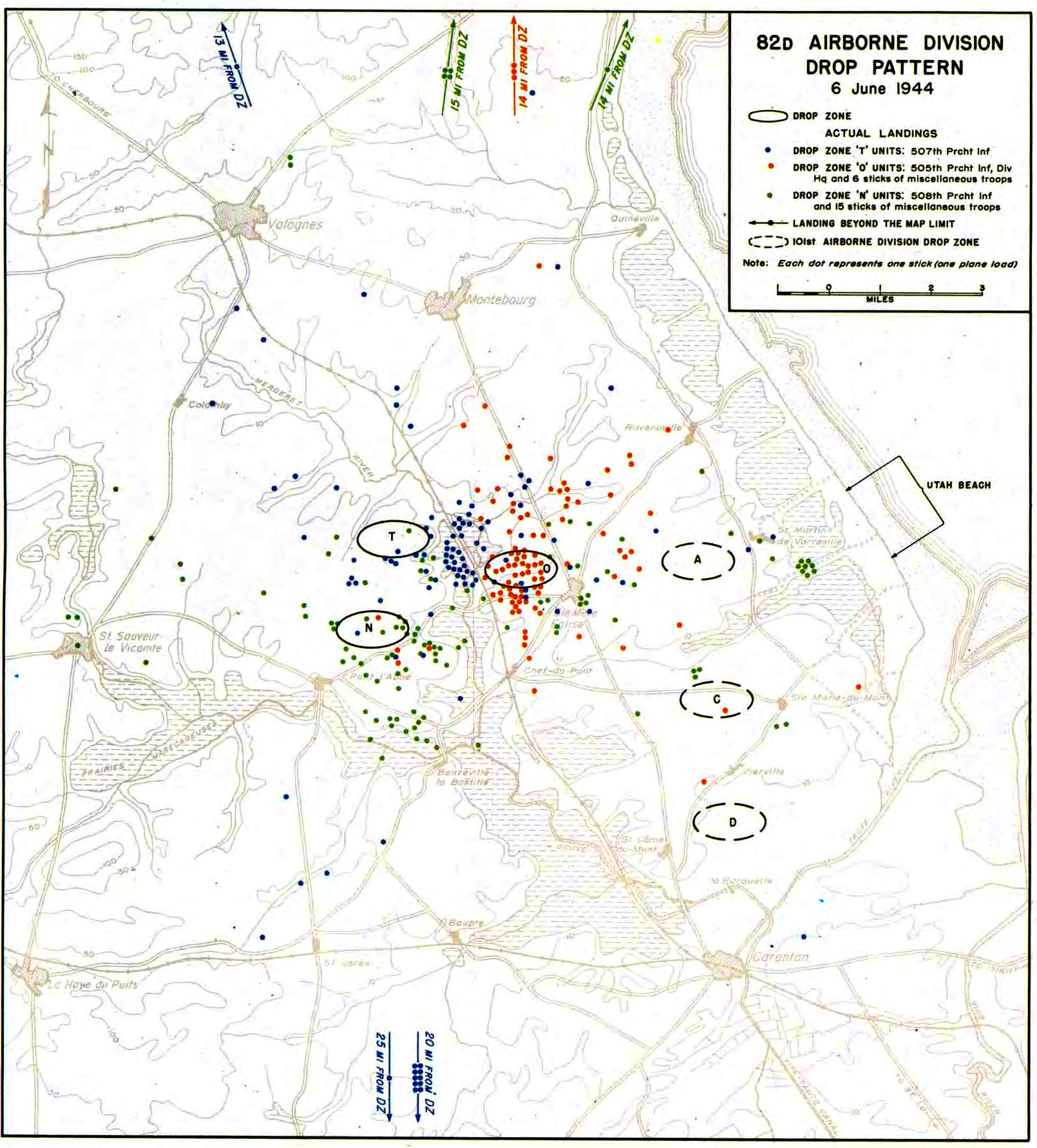
The reconnaissance party of Headquarters and Headquarters Battery, consisting of four officers and 38 enlisted men, loaded into its two C-47s and became airborne at approximately 2330 H on June 5. The night was generally clear and moonlit. After marshalling, the jump masters of the two planes, Capt Edward E. Whitley and Lt Thomas E. Shockley, were able to stand in the door and observe the visual navigational aids below. The planes were flying in a column of V of Vs. In this formation, three planes form a V, and three of these Vs form a flight of nine planes, The flights in turn are in columns to complete a serial which usually averages from four to six flights. Their flight over the water was at 500 feet for tactical reasons, and uneventful until the twenty-minute warning was given by the pilots. At this time considerable flak was encountered from the Channel Islands of Guernsey, Alderney, and Stark, west of the Cherbourg Peninsula, but fortunately it was short, which was according to plan, and assure the jumpers that the planes were on course. The only cause for apprehension was that surely the enemy on the Peninsula was alert and waiting. As the planes went into their climb up to 1500 feet, upon approaching land another enemy of airborne operations appeared in the form of dense clouds. The jump masters could hardly see the wing tips from their positions in the doors. Though this gave a certain feeling of security to the airborne personnel as far as the ground fire was concerned, experience had taught them that it opens up flight formations and makes for a more dispersed landing pattern. Occasional breaks in the clouds indicated that the formation was opening up, and over each jump master there came a feeling of loneliness. Although this ground fog had accurately been predicted by our intelligence reports, it had been overlooked in the briefing and came as a surprise to the personnel occupying the planes. During the breaks in the fog banks, the ships were subjected to scattered small arms fire, which became more severe as they approached DZ N.
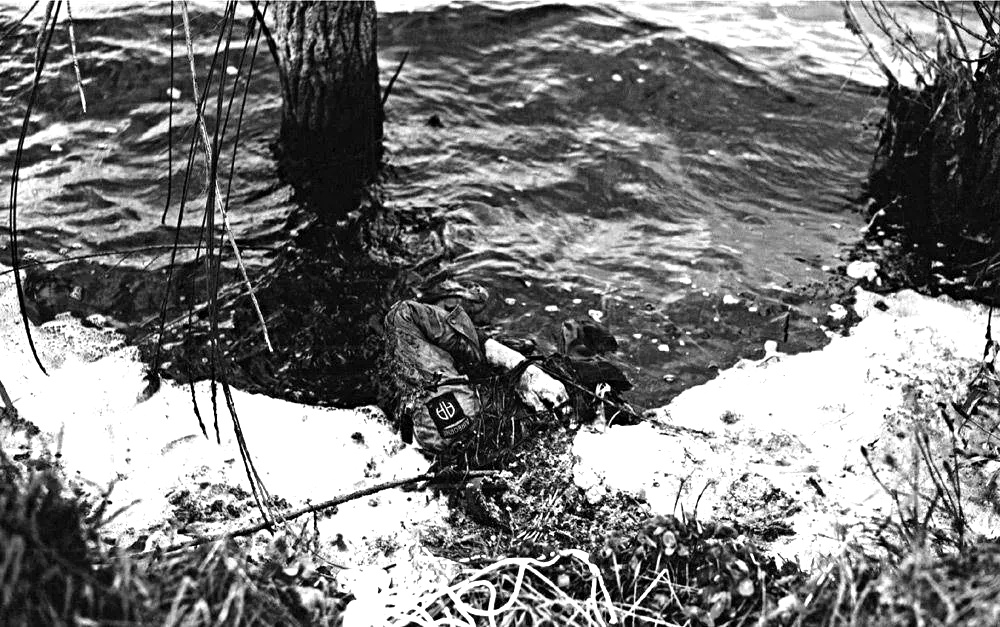
The planes were now flying at approximately 700 feet, and according to the time element they should have been over the DZ. The jump masters expected to see lights marking the DZ, but could see none even though it was now fairly clear. The planes were engaging in evasive action, and there was nothing to do except wait for the green light, which was the signal to jump. The signal was given at 0814 H and the troopers bailed out. The two ships which had been flying wing to wing were no longer together in the formation, but later events proved that they were only 400 yards apart. Nevertheless, both loads landed in the inundated Merderet River bottom, approximately one-half-mile north of La Fière, thereby missing their DZ by approximately one and one-half miles. The marsh was deceptive. What appeared to be only marsh grass from just a few feet away actually was marsh grass, but it was growing in from two to six feet of water. Comparatively ineffective enemy fire was sweeping the area, but the principal threat to immediate survival was the water, The ground wind was sufficient to pull the paratroopers into a prone position, quick release harness had not been adopted yet (T-7 Pack Assembly), and the most expeditious means of getting out of the parachute was to cut the harness. By the stronger helping the weaker and a wonderful spirit of cooperation, the artillerymen were able to extract themselves without casualties due to drowning. The Division suffered thirty-six known casualties due to drowning that night.