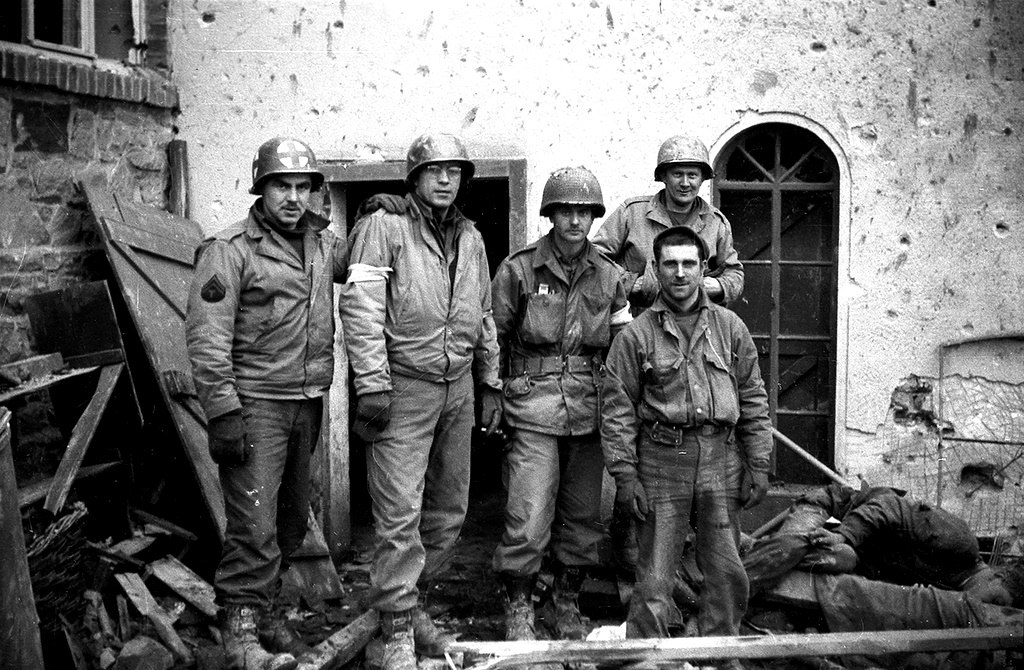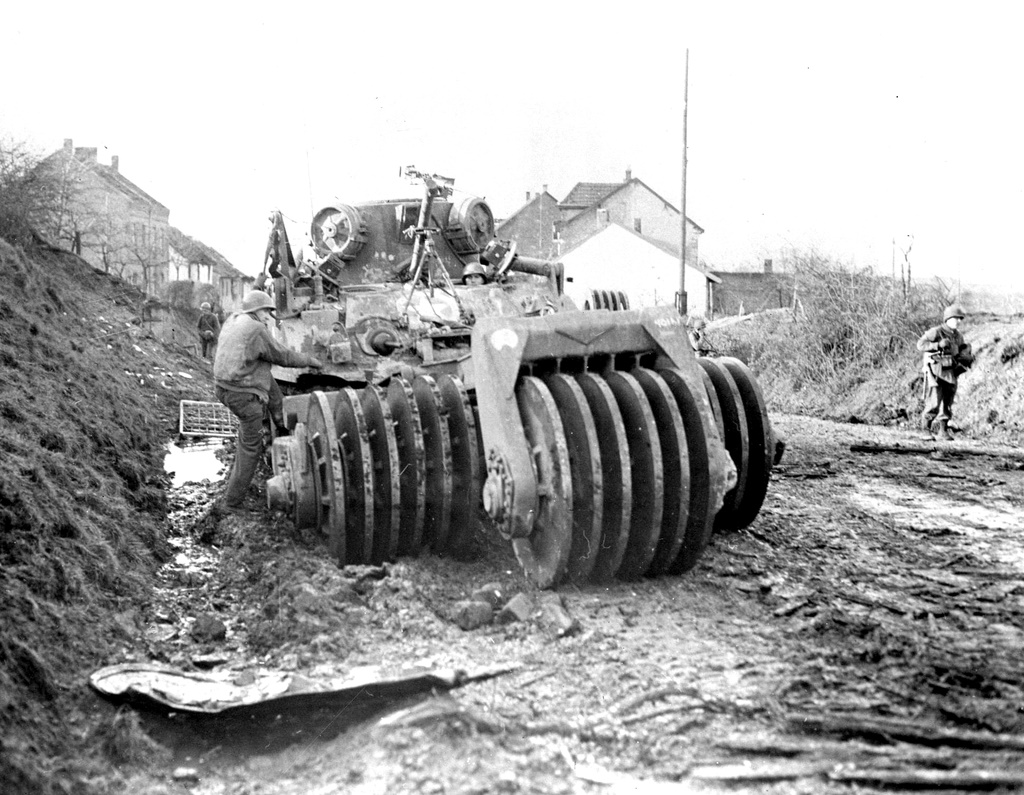
At about 0300 hours, the King Company positions on the high ground overlooking Jungersdorf were heavily counter-attacked. One of the 3/26 TDs was knocked out and another was threatened before the counter-attack was repelled. During this action, one of the Battalion 57-MM AT guns knocked out a Mark IV tank. Later in the morning about 1000 hours, the enemy counter-attacked Jungersdorf. Now we had observation and the enemy was caught in the open and given the treatment. His forces, unsuccessful in taking Jungersdorf withdrew toward Langerwehe where the 18-IR was attacking. Friendly artillery took the backtracking enemy force under fire and caused extremely heavy casualties. Later in the day, as friendly aircraft hovered over our lines, the enemy dropped red smoke on Jungersdorf in an attempt to get the US Air Corps to bomb the 3/26, however, the trick was detected in time to prevent the bombing.
Now that Jungersdorf had been taken plans were made for sending the 2/26 east to seize the town of Merode. The 1st Recon Company and the Recon platoon of the 734-TB were attached to the regiment to hold positions between the 1/26 and the 3/26. The 2/26 was then ordered to attack east along the unimproved road to clear the woods (500-600) yards and take and hold the town of Merode. The remainder of the regiment was to hold its present line. Except for the 3/26 positions on the north (facing north) the line was well inside the forest on high ground with little if any observation of the Roer River valley to the east.
At 1000 hours on November 29, after artillery preparation, the 2/26 jumped off with Easy and Fox Companies, each reinforced with a Heavy Machine gun platoon. From the outset, the attacking troops received heavy artillery and mortar fire as they plodded through the last enemy defenses in the forest. Again they hit a well-dug-in enemy behind a mesh of wire and mines. Of the estimated 350 personnel in the assault approximately 130 were casualties before the two companies emerged from the forest into the open overlooking Merode. Moving out for the assault on the town, Lt John D. Hamilton, Company Commander of Fox Company called for the tanks and TDs to be employed in the clearing of the town. The companies proceeded with their assault on the town and seized that portion along the road east into town. Fox Company moved up and held the edge of the woods facing Merode. Meantime, the tanks had been dispatched and appeared on the outer edge of the woods where they drew considerable fire. Two of these tanks proceeded to join the companies and helped in clearing the remainder of the town.
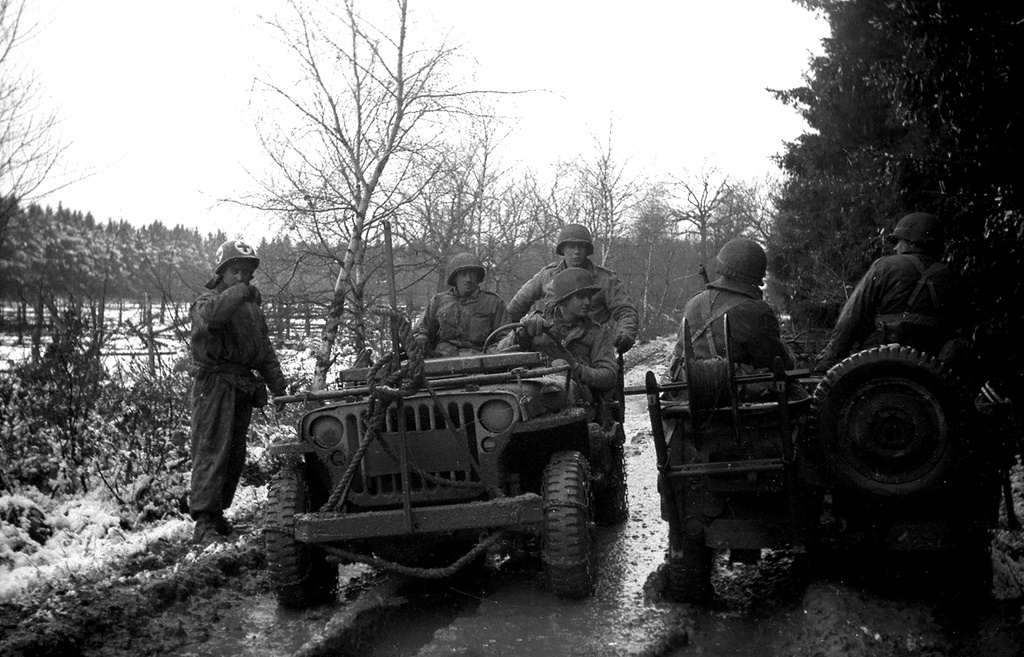
However, Merode, a small town, is joined with its larger neighbor Schlich so that it is difficult to tell where one ends and the other begins. Easy and Fox Companies took all that they could hold and the enemy held the rest strongly. The defense consisted mainly of holding the houses along the two roads of Merode. While the companies organized their positions the enemy in Schlich took Merode under fire with their tanks and assault guns and kept all of the buildings and the two tanks covered. During the day the two tanks left the troops in Merode and made an attempt to return to the forest. On their way, west of the town on the only road back, one of the tanks bogged down in the mud and turned over and the other was hit by an enemy shell. They now blocked the road so that it could no longer be used to reinforce the troops in town. About this time, it was noted that communications to the town were particularly bad, Lt Hamilton did have intermittent contact with his SCR 300 until approximately 2800 hours, thereafter no contact whatsoever was made except by one runner. That night, a coordinated German infantry and tank attack on Easy and Fox Companies systematically proceeded to wipe out or capture the group in Merode. The gallant fighters had no defense except their small arms against the tanks and infantry moving in. The fighting lasted throughout the night. At daybreak, George Company could observe enemy tanks firing directly into the Easy and Fox Companies buildings. German tanks drove their guns into windows and blasted the insides of buildings then the infantry moved in to mop up. Finally, on November 30, the Germans recaptured Merode. Throughout the siege, patrols were sent from Battalion to the companies in Merode but none ever reached the town.
One patrol consisted of twelve bazooka teams to make up for the lack of armor in the defense of the town but it never reached Easy and Fox Companies. The enemy had apparently first cut off the town from the forest by setting up a line west of Merode. Any movement toward the town drew immediate and intense small arms, mortar, and artillery fire. The platoon of engineers and tank recovery tried to clear the road several times but were unable to remove the obstacles under the terrific fire. During the night in question, several illuminating shell fire missions were fired in an attempt to catch enemy reinforcement in the open. At the time Merode was counter-attacked the regiment had no reserve. It is estimated that a Company had an effective strength of approximately 50 men employed in the line holding the edge of the forest west of Merode. Division at first alerted a battalion of the 16-IR then ordered the 18-IR to relieve elements of the 3/26 in Jungersdorf on November 30. It was the evening before the battalion became available and that was too late. Strong patrols were unable to make any progress toward the town.
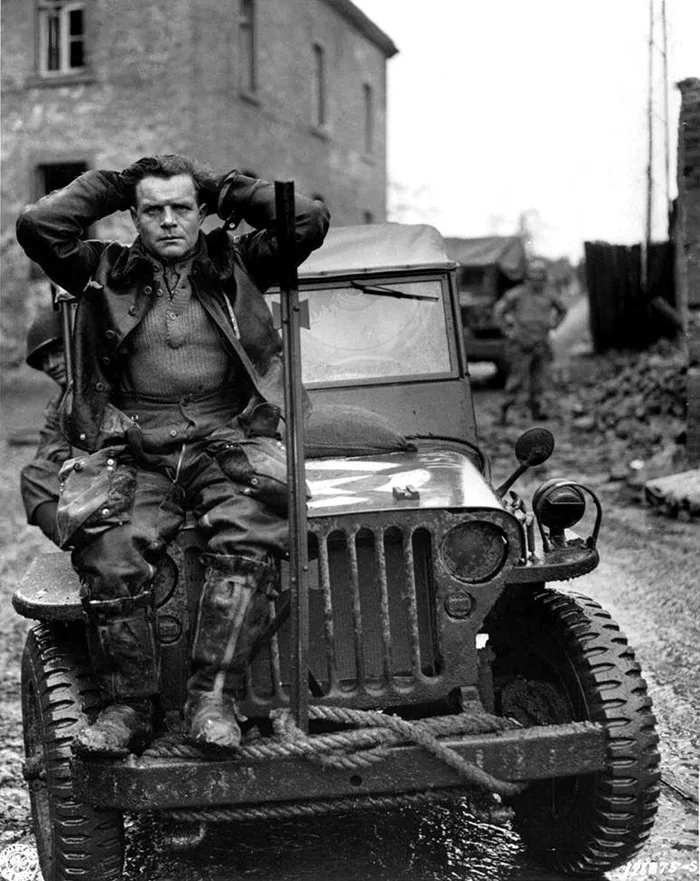
In fact, the enemy was beginning to feel aggressive, he had regained the initiative in Merode and apparently decided to continue. During the day he launched an attack on the 1st Recon Company positions just north and west of Merode which was broken up by our mass of artillery and mortars. On December 1, the two companies were given a loss. Four 2/26 men who had been taken prisoners escaped and returned to our lines confirming the fact that there were no longer any friendly troops in Merode. The regimental front required all available troops – any major move might so weaken the line as to make it vulnerable in the event of enemy attack and so for that reason, the 1st Battalion and 3rd Battalion were ordered to hold what they had and to clear the woods in their respective areas. The 1st Battalion was to clear the area south of the Merode road and the 3d Battalion, the area southeast of Jungersdorf. The 3rd Battalion cleared its area during the day while the 1st Battalion ran into heavy fighting and cleared little, George Company pulled back on line with the 1st Battalion and held its position north of the road. For the next three days, only the 1st Battalion moved, sweeping its assigned area against heavy resistance. The enemy captured by the 1st Battalion during this action told of the enemy’s recent reinforcement to the 1st Battalion front. On December 4, the division notified the regiment that elements of the 9-ID would relieve the 26-IR on December 5. During the afternoon of December 4, reconnaissance parties from the 9-ID arrived to plan the relief and gather information about their new area. On December 5, the regiment was relieved and moved to a rear bivouac area in the vicinity of Henri-Chapelle in Belgium for rest and rehabilitation.