


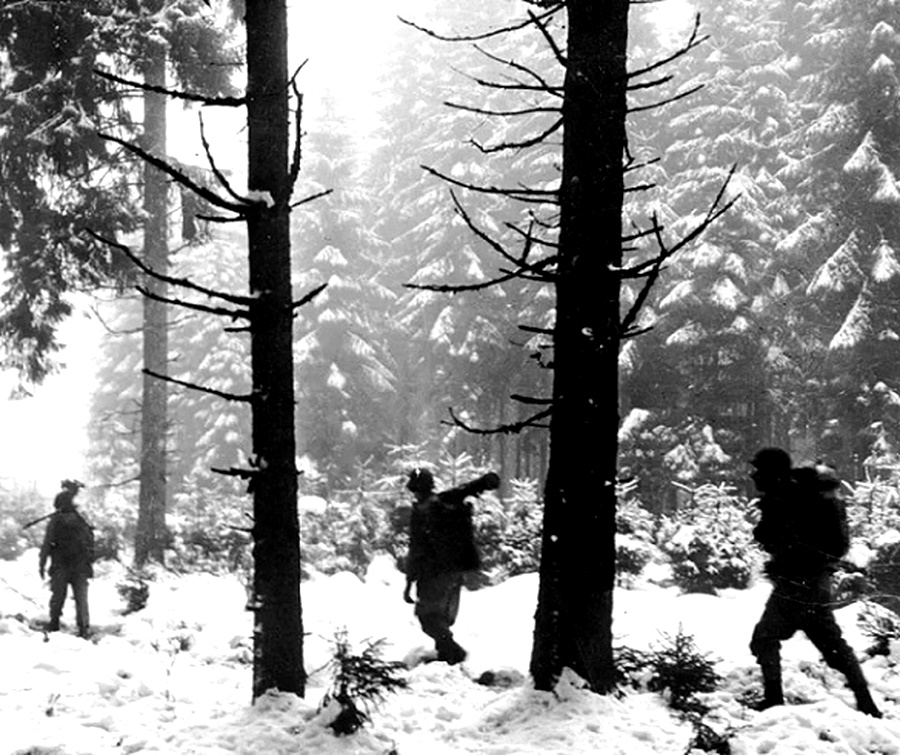
At 1400, the battalion resumed the attack. In moving through the woods west of Dairomont, a sharp encounter was made by Able Co with a strong German patrol. Approximately ten Germans were captured and six were killed. The battalion continued to move in column and Able Co emerged from the woods advancing toward Dairomont but was stopped by heavy small arms and artillery fire from the vicinity of the town. It was approximately 1630, about one hour before darkness and the battalion commander felt that it would be extremely difficult and costly to attempt a direct attack to seize Dairomont during daylight. It was then decided to bypass the town, move around it during the night, and attack the town from the east at daylight with one company while occupying the battalion objective with the other two. The battalion was then disposed along the woods facing Dairomont awaiting darkness.
Periodic mortar and artillery fire continued to fall on the battalion positions. During this period the Battalion S-3, Maj Herman, an Artillery Forward Observer, whose name is not presently known, with Charlie Co, and the Executive Officer of Charlie Co, Lt Serio, became casualties. The battalion commander called the company commanders together and with the aid of a flashlight and a shelter half, briefed them on the movement for the night. The battalion was to move in a column of companies, in the order, Charlie, Baker, and Able, cross country, seize Dairomont with Able Co and the High Ground west of Rochelinvall with Baker Co and Charlie Co on the left, at daylight on January 5.
THE NIGHT ATTACK OF JANUARY 5
At about 2000, the battalion moved out in a column of companies, and because of the heavy underbrush and forest, the companies were in single file. The march was slow and tortuous with halts every few minutes to keep the battalion intact. The weather cleared during the night of January 4/5 and by midnight a full moon was out, which combined with the snow made the night almost brilliant. The temperature went down to slightly below zero which added to the discomfort of the men. At approximately 0300, the battalion was halted parallel to the Dairomont – Petit Halleux road about one thousand yards southeast of Dairomont. A patrol was dispatched to the road to report any Germans discovered. They quickly returned and reported a German column of about battalion strength halted along the road. Another patrol was dispatched to the front and they quickly returned with the report that they had encountered Germans in position about one hundred yards to the front. The strength of this position was estimated to be in excess of one platoon. Sgt Spletzer, the Battalion Rigger Sergeant, was a skilled interpreter and he led each patrol. In each case, when the patrol was challenged, Sgt Spletzer answered in German and evidently satisfied the Germans because there was no firing.
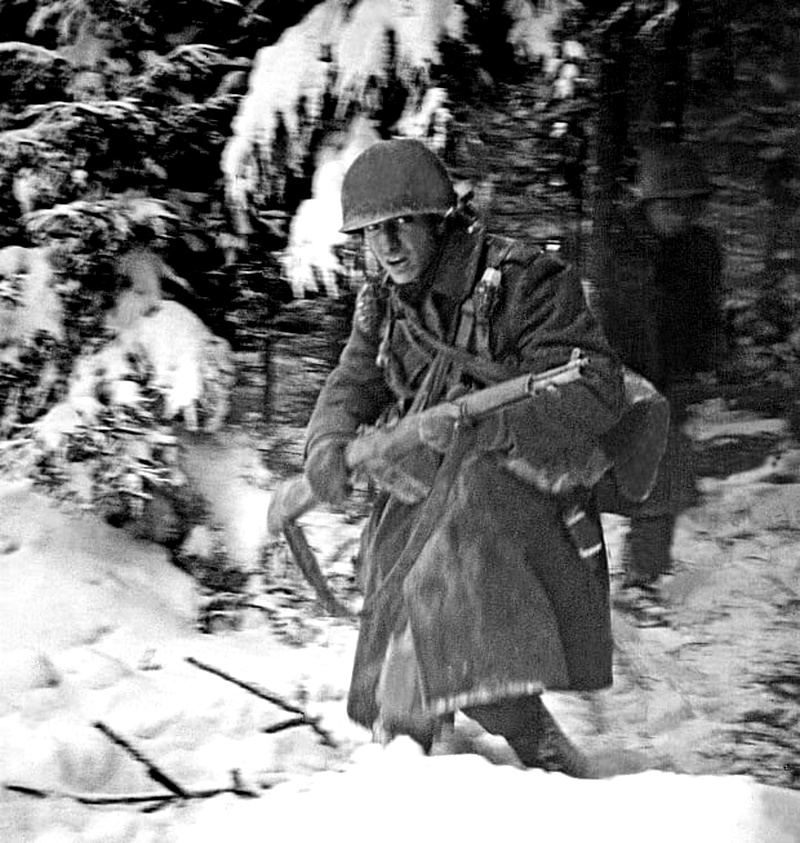
The battalion commander then decided to turn the column around strike the road and attack east astride the road with Baker Co and Charlie Co while Able Co seized Dairomont. This turnaround was accomplished with difficulty as most of the men had fallen asleep and it was extremely difficult to awaken them. By now the cold weather was taking its toll of casualties. Those men who had made the mistake of falling asleep were literally frozen. In two cases the men had to be forcibly exercised for over an hour before it was possible to evacuate them. The boots and socks of the majority were frozen when they were awakened. Prom this time on to the end of the period described the non-battle casualties increased. These casualties were primarily frozen feet and respiratory diseases.
By about 0400, the turnaround had been completed and by about 0430 the head of the battalion was at the edge of the woods, south of the highway and east of Dairomont. The companies halted and for the next two hours reconnaissance in preparation for the attack was made. Patrols fixed the position of the German column halted along the highway and it was discovered that Dairomont was still occupied. Shortly prior to daylight, the three rifle companies moved to attack positions and at daylight, the attack began. During the night the Battalion Command Post, the 81-MM Mortar Platoon, and the Headquarters Company Command Post had displaced forward to St Jacques. Radio communication during the night had been excellent and as a result, the 81-MM mortar platoon was in a position to support the attack. Able Co captured Dairomont with only a few shots being fired. It suffered no casualties, one or two Germans were killed, and about thirty were captured. Baker and Charlie Cos faced a little different situation in their attack east along the road. The head of the German column was encountered about five hundred yards inside the woods and a brisk fight developed. The German column retreated quickly toward Rochelinval leaving only a strong rear guard behind. This rear guard was slowly driven in and by 1200, the high ground designated as the objective had been captured. With the capture of the objective Baker and Charlie Cos were ordered to organize a defense on their present positions and to contact the 1/517 on their left and the 504-PIR on their right.

At about 0900, the regimental commander had visited the battalion. He informed the battalion commander that the 1st and 2d Battalions had occupied the High Ground west of the Salm River in their zones during the previous night. The battalion commander was instructed to prepare his objective for defense when captured and that he did not know how long we would remain on the defense but to make plans for the continuation of the attack. The afternoon of January 5, was spent organizing the positions for defense. The squad rolls were brought up and issued out to the men, ammunition was replenished, mail was given out, and a full ration of 10 in 1 {Ten in One) was issued to the men. The battalion situation as of 1500 was as follows: (Map G) Baker-551 and Charlie-551, each with one section of machine guns attached, were in position on the high ground west of Rochelinval, Able-551 was in battalion reserve in an area behind Baker-551, the Battalion Command Post as indicated on Map G, and the 81-MM mortar platoon, in position just east of Dairomont. At approximately 1500, the Headquarters Company Commander was ordered to blow the bridge over the Salm River just south of Rochelinvall sometime during the night of January 5/6. It was hoped that by accomplishing this the Germans in the vicinity of Rochelinval would be unable to reinforce their positions in front of the battalion with additional armor from east of the river. Lt Parrin was ordered to constitute a reconnaissance party from the demolition section of five or six men and be ready to accompany the company commander on reconnaissance at about 1800.

At about 1600, the Regimental S-2, Lt Kyler, visited the battalion position. He and Lt Farrin conferred on the bridge job and apparently decided to make an early reconnaissance on their own. These two officers without other support and without notifying the commanders concerned started off. They advanced to a position about two hundred yards in front of Baker Co where they were ambushed by a small German patrol. In the resulting melee Lt Farrin was killed and the Regimental S-2 escaped to the rear. This took place at about 1630. The regimental S-2 reported to the Headquarters Company Commander of the action and upon a report to the battalion commander it was decided not to blow or attempt to demolish the bridge during the night. This decision was made in light of the experience of the two officers and a patrol report from Baker Co that had just come in. The patrol reported Germans dug in in strength along the high ground southwest of Rochelinval and around the town itself. It was decided that to be successful a large combat patrol would have to be sent out to seize the bridge while it was being prepared for demolition and that this being the case it was not worthwhile. This estimate was borne out in later operations. The Germans did not attempt to bring armor across the river. The reason was that they had better firing positions for it on the east side.
THE DEFENSIVE OPERATIONS OF JANUARY 6
The night of January 5/6 was relatively quiet, the only action being patrol activity engaged in by both sides. During the night the battalion had ordered patrols out from both front-line companies to determine the extent of the German position and attempt to estimate the strength of the Germans in position in the vicinity of Rochelinval. On the morning of January 6, the Battalion S-2, Capt Hartman, estimated the German strength to be approximately 500 and to consist of elements of the 9.SS-Panzer-Division (Hohenstaufen). At approximately 0900, a German counter-attack in an estimated company strength supported by mortars, nebelwerfer, and some artillery struck Baker C. The Company, however, was aware that the attack was coming, as a local security outpost reported it, and heavy artillery and mortar barrages were placed on the advancing Germans. The counter-attack was broken up before it reached Baker Co’s lines and the Germans withdrew. Considerable nebelwerfer fire continued to fall on the positions of the two front-line companies during the remainder of the morning.
Aside from a direct hit on the battalion message center at about 1200 by a nebelwerfer salvo, which destroyed considerable Christmas mail and packages, the day was relatively quiet. At about 1400, the battalion was detached from the 517-PIR and attached to the 504-PIR. The battalion was to remain in place, its zone was not changed except that the battalion left boundary became the regimental left boundary.

PREPARATION FOR AND THE ATTACK OF JANUARY 7
At approximately 1500, January 6, the battalion commander was called to the Regimental Command Post and told that the regiment would attack at 0830 January 7 to drive the Germans east of the Salm River and capture the towns of Rochelinval and Grand Halleux. The regiment would attack with two battalions abreast, the 551-PIB and the 1/504-PIR, with the 551-PIB on the left with the mission of seizing Rochelinval. One platoon of light tanks from the 740-TB would be attached to the 551-PIB effective 0200 January 7. Upon his return from the Regimental Command Post, about 1630, the battalion commander called the company commanders together and gave his attack order. It was briefly as follows: the battalion would attack with two companies abreast, Able and Baker Cos, Able on the left. With the objective of Rochelinval to Able Co and the high ground southwest of Rochelinval and the railroad to Baker Co, (Map H). Each assault company would have one section of machine guns attached and a mortar forward observer would be furnished to each assault company. Charlie Co would be in reserve and assemble in the vicinity of the Company Command Post after passage by Able Co, Charlie Co also would support the attack of Able Co with a section of machine guns and be prepared to reduce the roadblock between their positions and Rochelinval.
The tank platoon would be in reserve and assemble in the vicinity of the Battalion Command Post. The 81-MM mortar platoon would support the attack from its present position with a five-minute preparation of Rochelinval with the priority of its fires going to Able Co. During the night of January 6/7, intensive patrolling was carried out by both Companies Able and Baker reconnoitering routes and approached to their objectives. The patrols in all cases were reconnaissance patrols and had no fights with the Germans during the night.

To completely understand the forthcoming action it will be necessary to review the casualties suffered by the battalion up to date. The battalion had suffered approximately 400 casualties since January 3, approximately 200 of which were killed, wounded, or missing, (ten men were listed as missing up to this date) another 200 were non-battle casualties, Trench foot, frostbite, and respiratory disease. The Rifle Companies with the exception of Able Co had an effective strength of approximately 50 men and officers. Able Co had an effective strength of approximately 30 men and officers. The Headquarters Company had an effective strength of approximately 60 men and officers. During the night of January 6/7, two replacement officers were assigned to the battalion and delivered to the Battalion Command Post at about 2300. They were promptly reassigned to Able Co. Both were casualties by noon of the following day. One was killed and the other wounded.
ATTACK OF JANUARY 7
At exactly 0830, Able and Baker Cos crossed the line of departure, which was the line of contact, on their attack east toward the Salm River. Each was met with a heavy column of artillery, mortar, nebelwerfer, and small arms fire, (Map G). Baker Co, however, made rapid progress in its zone and by 1000 had captured the high ground assigned as one of its objectives. Baker Co had experienced some casualties and had killed or captured about forty Germans. The battalion commander ordered Baker Co to continue its attack and clear its zone down to the west bank of the Salm River. In the zone of Able Co, the situation was considerably different. The company had been met with considerable German fire when it crossed the line of departure and as the company advanced the fire increased. When the company cleared the trees and began its advance across the open ground in front of Rochelinval the fire became murderous. The Company Commander, Lt Booth, and one of the newly assigned replacement officers were both killed as the company advanced across the open ground. The advance continued however until the lead elements reached a position about one hundred yards west of the town where they were stopped completely and finally. Radio communication with the battalion was out, but the mortar forward observer was still alive and operating his radio, unfortunately, he was separated from the two remaining company officers (a Rifle Platoon Leader, Lt Durkee, and the Machine Gun Platoon Leader, Lt McNair) and could not reach them. This mortar observer directed considerable accurate mortar fire upon the German position and about 1100, called for a smoke mission to cover the withdrawal of the remnants of the company.
At the Battalion Observation Post confusion was king. The observation post was in the immediate vicinity of a machine gun section of Charlie Co, supporting the attack, and considerable German mortar fire was falling in the area. The battalion commander was aware of the situation of Baker Co but was very much unaware of the situation of Able Co. He was certain that Able Co had been halted by German fire because he could observe the intensity of it, but being that he had no communication with the company commander, and was unaware until about 1100, that he had been killed, he was reluctant to arbitrarily order fire into the area or to commit the reserve company. Some German positions within the buildings were picked up and the battalion commander ordered the light tank platoon to come forward and take them under fire. This they did, the tank fire was very effective and assisted considerably the withdrawal of Able Co. The battalion commander was killed as Able Co began to withdraw. The mortar fire that had been falling upon the Battalion Observation Post all morning was very effective.
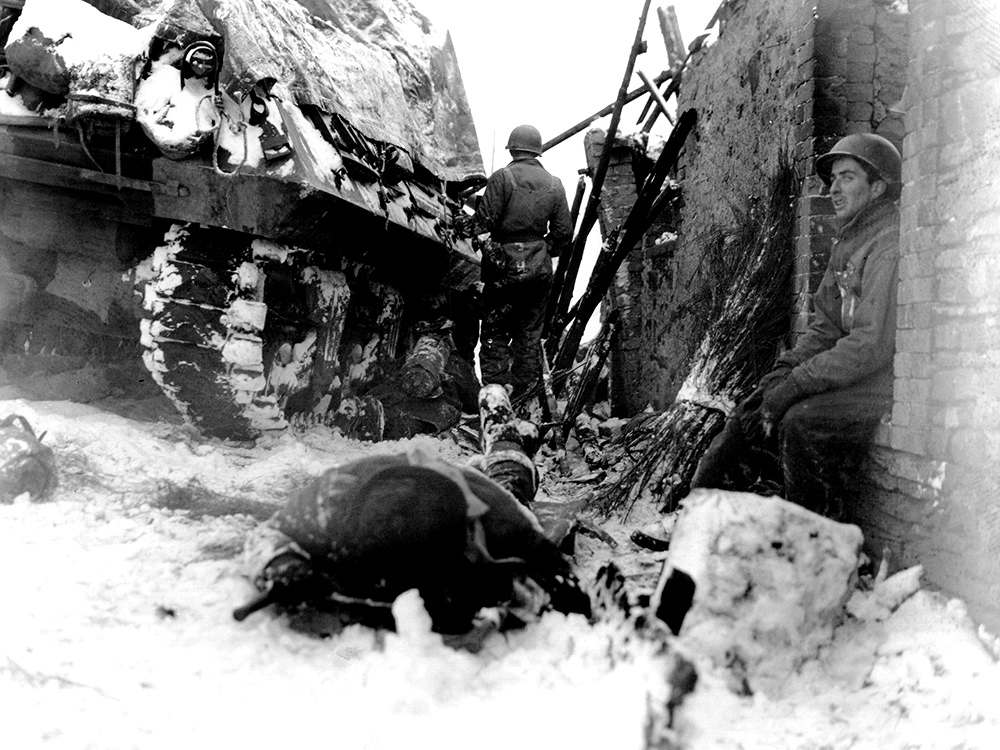
The Battalion Executive Officer, Maj Holms, was immediately notified. He arrived shortly from the command post, took a quick look at the situation, ordered the tank platoon attached to Charlie Co, and ordered the company to attack Rochelinval from the northwest and southwest with two groups simultaneously, utilizing at least one tank with each group. The company commander was ordered to move his company into attack positions immediately and to notify him, Maj Holms, when ready to attack. The mortar platoon was ordered to place continuous fire in as heavy a rate as possible until Charlie Co was ready to assault the German positions. The mortar platoon fired approximately seven hundred and fifty rounds into and in the vicinity of Rochelinval in support of the attack. At approximately 1300, Charlie Co with the tank platoon attached attacked the town. As the company neared the town the mortar fires lifted and the town was taken with very little fighting. Charlie Co captured over two hundred and fifty Germans inside the town. A count of the German dead in that vicinity totaled over 100. At approximately 1430, Charlie Co had control of the west bank of the Salm River in its zone and the entire battalion was closed in on its objective.
SUMMARY
In summation, it may be said that this battalion accomplished every mission given it. The men fought valiantly and at critical times demonstrated their superiority over the Germans. The battalion had suffered 475 casualties in officers and men during the period January 3-8. The fact that a large percent of the non-battle casualties were needless can be laid to a number of causes. First, it was not anticipated that the men would be without their rolls for a period of three days, second equipment to be carried was sacrificed for the sake of speed, and last, the unit commanders were inexperienced in combating trench foot.
This archive was written with the help of the following personnel:
Col. W. G. Joerg, CO 551-PIB (in that time)
Capt W. G. Irwin, S-3, 2/517-PIR
Capt M. A. Dalton
Capt J. E. Evans, CO Baker-551
Capt T. A. Quinn, CO Charlie-551
Capt E. W. Hartman
Capt Halleck
Lt Booth
Lt Hyler, Regimental S-2
Lt McNair
Lt J. M. Hill
End
