MOVEMENT TO THE LINE OF DEPARTURE AND FINAL PREPARATIONS FOR THE ATTACK
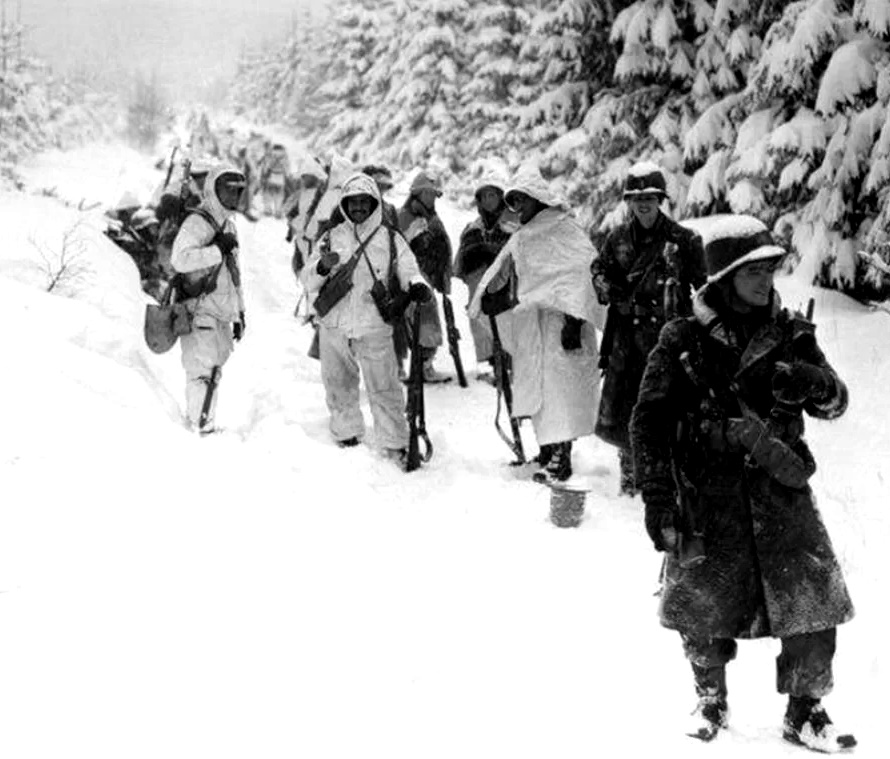
At 0430 January 3, the battalion moved out of its rear assembly area and began its march to the forward assembly area in the following order of march: (1) Battalion Command Group; (2) Able Co; (3) Charlie Co; (4) Baker Co; (5) Anti-tank and Demolition Platoon {-); (6) Battalion Command Post; (7) Headquarters Company Command Post. The march was to be a move generally southeast on the road toward Basse Bodeux for approximately three thousand yards than the northeast cross country for another one thousand yards into the forward assembly area. The road was covered with a thick coating of ice making the going rather slippery, particularly so for the heavily laden soldiers. A gap quickly began to form between the battalion command group and the leading rifle company. The battalion commander was not worried about this as he intended to stop at the turnoff, and he didn’t believe the column could get lost following the only road in the vicinity. However, the leading rifle company commander had not found the forward assembly area the day before and the assistant S-3 had made his reconnaissance of the wrong area. Consequently, the non-commissioned officer, who had been oriented by the assistant S-3 the day previously, led the company and the column to the wrong turnoff. The company turned northeast off the road onto a trail approximately one thousand yards short of the correct turnoff.
Upon reaching the correct turnoff the battalion commander discovered that the column was not following the command group at all. He dispatched an officer back to find the column and bring them to the correct turnoff. The column was found and brought back to the correct route and forward to the turnoff, but it was already 0730 before the head of the battalion moved off of the road toward the final assembly area. There were still one thousand yards to go and it was mostly cross country and the marching was slowed considerably by the snow. The final assembly area was reached at 0815, and the companies quickly deployed, made their final checks, and moved toward the line of departure at 0845.

THE ATTACK ON JANUARY 3
At 0915, Able and Charlie Cos crossed the line of departure, after having received some artillery fire on their approach to the Line of Departure. On the right, Charlie Co advanced rapidly toward its objective crossing the open space and entering the woods before it became engaged with the enemy, see Map D. Once in the woods, stiff resistance was encountered. Germans in well-dug-in positions about two hundred yards inside the woods opened fire and brought down considerable large caliber mortar fire on Charlie-517. The company deployed and overran the first few German positions capturing about ten Germans. The German mortar fire increased in density, accuracy, and in effectiveness due to the tree burst, and the company was momentarily stopped.
On the left, Able Co was met with intense artillery and small arms fire the moment it crossed the line of departure. Most of the small arms fire was coming from the zone of the 2/517 on their left. Tanks were observed in the vicinity of Mont de Fosse and their fire was added to the weight of the German fires directed at this company. By moving aggressively the company advanced in spite of this fire to a position about one hundred yards from the woods where it was stopped by fire from its front, (Map D). At this time, the company was being hit by extremely accurate fires from its left flank, from the vicinity of Mont de Fosse, and fire from its front, from the edge of the woods. The company had suffered about twenty casualties including the company commander and one platoon leader. Meanwhile, in the zone of Charlie Co, Capt Quinn, the Company Commander, had committed his support platoon and had slowly advanced toward his initial objective. The German mortar fires increased, but by 1100, Charlie Co had captured its initial objective and was preparing to continue the attack southwest down the ridge toward Fosse, and to seize the road running from Fosse to St Jacques. Contact between Able Co and Charlie Co had been lost at about 1130 and had not been re-established. Every effort to send patrols toward Able Co’s zone was blocked by Germans in positions along the creek running northeast through the battalion zone.
The Battalion Commander, Lt Col Wood G. Joerg, ordered Baker Co, the reserve company, to displace forward to an area north of objective TWO and be prepared to attack and seize St Jacques from objective TWO. Able Co, by employing artillery on the Germans in the vicinity of Mont de Fosse, (this fire had to be cleared with the 2/517) and mortars on the Germans to their front, had managed to advance into the woods. Within the woods, this advance was slow and bitterly contested every foot of the way. The company executive officer, who had taken over the company when the company commander had been wounded, Lt Booth, had committed his support platoon just prior to entering the woods. The company advanced with three platoons abreast with their right flank generally along the creek. This slow advance continued until the company reached the near edge of objective ONE. There the company halted momentarily and attempted to assault the German positions.
After a sharp hand-to-hand engagement, the company was thrown back and quickly counter-attacked. This counter-attack came at about 1300 and was supported by two tanks. After more severe fighting the company was forced back to the edge of the woods. There it dug in and remained for the balance of the day.

Contact between Able-551 and the 2/517 on its left had never been made and with Charlie-551 on its right had never been regained. The company commander had, although, been in contact with the battalion commander by radio all day long. Able-551 had suffered approximately fifty casualties during the day due mainly to the lack of contact with the 2/517 on their left. Even after being driven back from their objective they continued to receive fire from the vicinity of Mont de Fosse until darkness. Two small counter-attacks from the left were also repulsed during the late afternoon.
At approximately 1300, the battalion commander notified the regimental commander of his situation and his plan to commit the reserve company. The regimental commander concurred with this decision and notified the battalion commander that he would do something to take the pressure off his left flank. In the zone of the 2/517, a very bitterly contested fight for the town of Trois Ponts was shaping up. The entire battalion had been stopped immediately in front of the Line of Departure by a tremendous fire from the vicinity of Trois Ponts and Mont de Fosse, and the high ground between the two towns, consequently a gap of about two thousand yards existed between the 517-PIR and Able-551.
Shortly after notifying the regimental commander of his intention to commit Baker-551 the battalion commander heard heavy firing from the vicinity of objective ONE. Upon contacting Able-551’s Commander, he was informed that they were commencing the assault on objective ONE. In the hope that Able-551 would be successful Baker-551 was ordered to hold their attack on St Jacques. Shortly thereafter the battalion commander was notified by Able-551 that they were being driven back by a strong counter-attack. Baker-551 was then ordered to execute the attack as planned except the objective would be objective ONE, the Line of Departure would be the creek running northeast, and the time of attack would be 1400. This attack would be in conjunction with a continuation of the attack by Charlie-551.
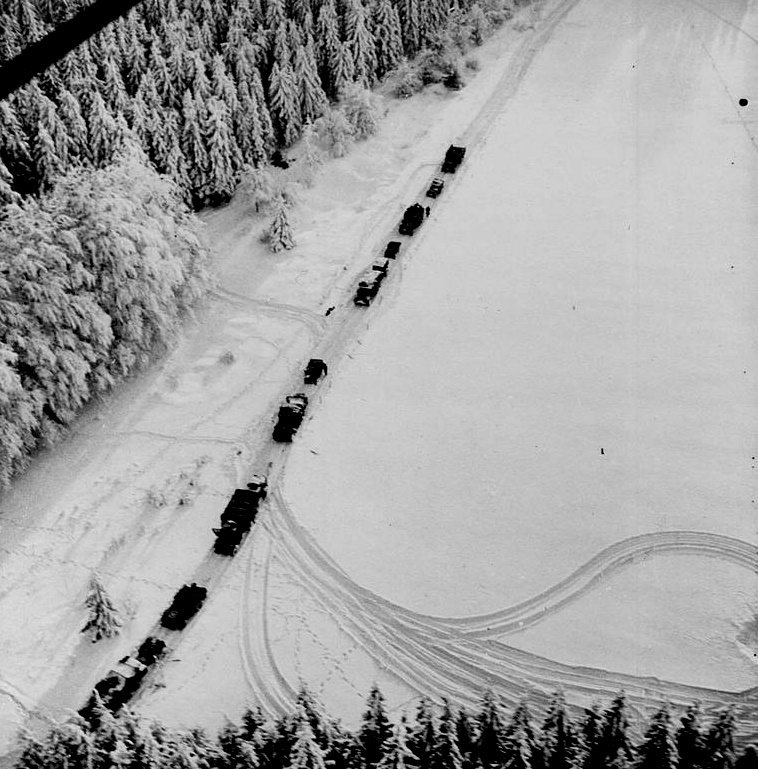
At 1400, Baker and Charlie-551 launched their attack after a short mortar preparation on their respective objectives. The battalion commander and his command group accompanied by Charlie Co. Baker-551 advanced slowly after crossing their Line of Departure against surprisingly light resistance and by 1600, had occupied objective ONE. Charlie-551 however, in its advance down the ridge toward Fosse, was subjected to intense and extremely accurate heavy mortar fire. The caliber was estimated at the time to be from the German-Russian 12-CM heavy mortar (120-MM). In spite of this fire, the company advanced slowly clearing German positions to their front, and by 1700, were in a position overlooking the road between Fosse and St Jacques. Here the company was forced to dig in on a terrace of the ridge and it underwent one of the heaviest mortar and artillery barrages, which lasted about thirty minutes, of its experience. At approximately 1800, the Battalion Command Post displaced forward to a position on objective TWO. The mortar platoon was ordered to displace forward to a position just southwest of objective TWO and the three rifle companies were in approximately the same position they had been in at 1700. At this time the battalion commander received a message from the regimental commander outlining the plan of action for the night of January 3/4. To complicate things snow began to fall at about 1830.

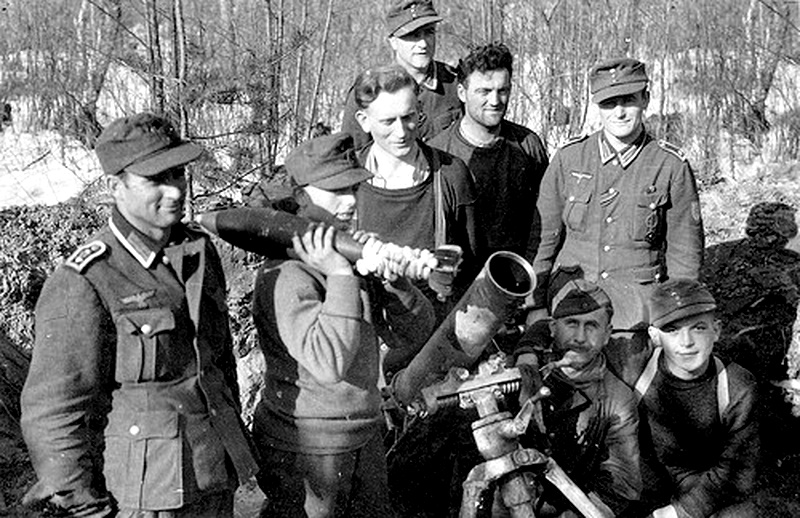
The 120-MM French Brandt Model 35 mortar was used in limited quantities during the Battle of France in the early stages of World War Two. The weapon was exported en masse to the USSR and other nations before France’s capitulation in 1940. The Soviet PM-38 120-MM mortar, was captured in large quantities during Operation Barbarossa and the entire war in the East and pressed into service by the Germans and other Axis nations before the introduction of similar nationally produced 12-CM heavy mortar designs. In German use, the captured Soviet mortar was given the designation 12-CM Granatwerfer 42 and became a real beast on the battlefront due to its large caliber and the length of its range. The GrW 42 was basically the usual three-part construction made up of one circular base plate like the previous Soviet design, the tube itself, and the supporting bi-pod. Because of the greater weight of the weapon, (280 Kg – 620 pounds) a two-wheeled axle was utilized, enabling the mortar to be towed into action. The axle could then be quickly removed before firing. A total of 5.3 million rounds of ammunition were produced for the weapons during World War Two.

THE NIGHT ATTACK OF JANUARY 3-5
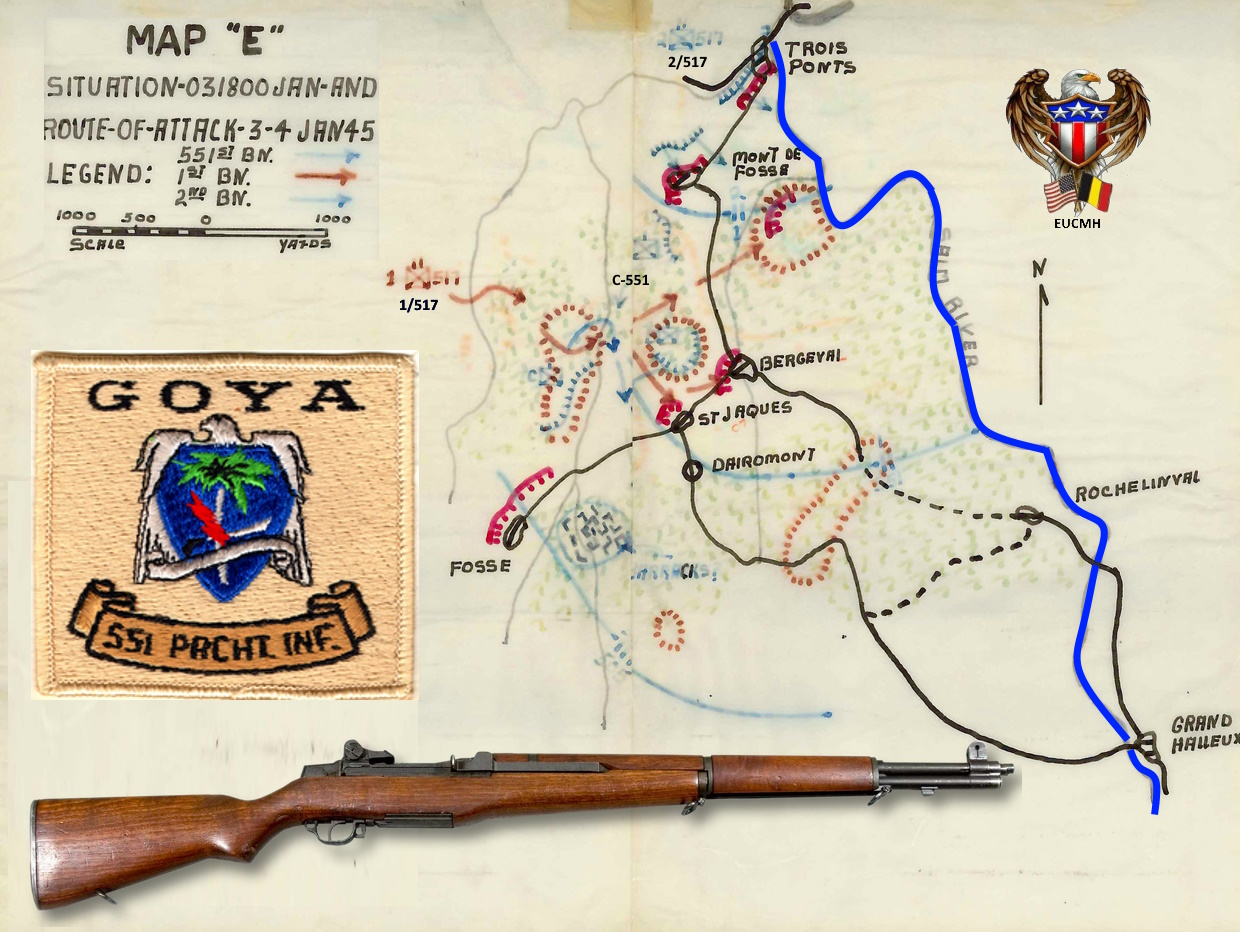
The regimental commander had ordered the 1/517 to move through the zone of the 551, attack east capture St Jacques – Bergeval – Mont de Fosse and the Hight Ground south of Mont de Fosse, and establish and maintain contact with the 551 on their right and the 2/517 on their left. The regimental commander on division order instructed the 551 to execute an attack to the south and capture a barracks area that was thought to exist (Map E). The 551 was also to maintain contact with the 505 on its right. The battalion commander planned to attack in a column of companies in order Baker, Charlie, and Able. As it was dark and he was anxious to begin the move with as little confusion as possible he decided the attachments would remain as they were during the day. The mortar platoon would remain in its present position, the Battalion Command Post would remain on objective TWO, and the Command Group would follow Baker Co.
At approximately 2200 on January 3, the 1/517 had cleared our zone and launched their attack. By daylight, they had captured the objectives assigned to them. At approximately 2230, after the 1/517 cleared our zone, the battalion commander ordered the movement to begin. Contact with the enemy was broken and the companies moved out. Snow fell most of the night making visibility almost an impossibility. The movement was slow and halting but at about 0230 on January 4, the battalion was in position for the attack. The battalion commander, because of the snow and darkness, ordered a patrol out to reconnoiter the approaches to the objective. The patrol quickly returned and reported that they had found no barracks or Germans. The battalion commander then made a personal reconnaissance accompanied by two company commanders and they found the same situation to exist, no barracks and no Germans. Due to the possibility of being lost and the fact that radio contact with the Regimental Command Post was out, the battalion commander decided to remain in position until daylight.
At daylight, the battalion commander found the supposed barracks to be nothing more than a series of fire breaks in the forest in which were stored giant stacks of logs. This fact was immediately dispatched to the regimental commander. In the meantime, the battalion was disposed of as indicated on (Map E). Tile companies were ordered to bring up a one-quarter-ton truck each with rations and ammunition. The men were issued one K ration (a full ration) and in certain protected areas fires were permitted. The battalion command received a message from the regimental commander indicating a change in plans and ordering the battalion commander to meet him in the Battalion Command Post at 1000.

THE ATTACK OF JANUARY 4
(Map F) At 1000 on January 4, the battalion commander met the regimental commander in the Battalion Command Post and was ordered to resume the attack at 1400. Attack east, seize Dairomont and the High Ground west of Rochelinval and be prepared to continue the attack on order to the Salm River. The division command had committed the 504-PIR on the right of the 551-PIB with the mission of seizing the high ground west of Petit Halleux. The enemy situation in our zone, at that time, was extremely vague. Dairomont was known to be occupied by the Germans but it was not known at what strength. For this reason, the battalion commander decided to move in a column of companies, in the order Able, Charlie, and Baker, attack Dairomont from the northwest, continue east along the Dairomont – Petit Halleux highway and occupy the assigned objective.