





 At 2320, a Troop B patrol reported that they had recovered the two vehicles abandoned by the 955-FAB observation outpost at (K930211) earlier in the day; no personnel were found in the locality. Unusual enemy use of pyrotechnics and searchlights continued throughout the night. 0000 on Dec 17, found the Squadron literally holding its breath. Warn by the strain of the days fighting, nevertheless, all personnel were fully alert and still possessed a good reserve, mental and physical, for what might come. The most remarkable feature of the entire day had been the negligible 2 casualties received. Over 200 enemy dead were reported, by actual count, on the fronts of Troops B, C, and Fox Co. Troop E had fired 1105 rounds of 75-MM howitzer ammunition for a total of 23 of the 73 missions in direct support of the Squadron. All of the Squadron positions were intact and strengthened by reinforcements. The balance of the night, until 0300, was marked only by a repetition of the previous nights, pyrotechnics, and searchlight activity. Numerous planes passed over the sector and there was the usual enemy harassing artillery fire. At 0125, Lt Krupnick and his engineers completed a minefield on the road at (K942207) in front of Troop B. The CO of the 3/395-IR reported that the enemy appeared to be infiltrated and digging in on the flanks of his outposts.
On Dec 18 at 0300, a terrific enemy artillery and rocket barrage fell on the Monschau and Höfen areas and wire communication with the 393-IR. Contact was maintained by radio through an observation post on the Höfen Hill, manned by Sgt Joseph Poll of Troop C. Shortly after 0330, enemy planes circled over Monschau and dropped a number of flares. Troop C called for artillery on suspected movement along the Snake Road. Heavy enemy mortar and artillery fire fell on the Mützenich Hill and Troop C reported receiving small arms fire from the draw immediately west of Menzerath (K948189) at 0440. At 0445, the enemy attacked the 395-IR in Höfen, capturing one outpost. This was followed by a report that there had been penetration in the infantry lines at (K951170) but that the gap had been sealed. Troop A reported, also at 0440, that Lt Warren McCray, Pvt William Dube, and Pvt Robert Wynn had been killed while laying AT mines in front of the troop sector.
At 0515, the 395-IR again with the aid of mortar illuminating shells, reported enemy to their front. Sgt Poll picked up the enemy at (K953173). The 99-ID was adjusted on the targets presented through this observation post. The remaining hours of darkness passed without unusual incident. With the first light at 0746, Troop B outposts fired on a small German patrol to their front without results; and at 0814, Troop C placed artillery on an enemy squad at (K948196). At 0830, the Squadron Commander left for headquarters of the 47-IR. At 0850, enemy artillery and rocket concentrations again fell on the area, and groups of Germans were observed in the vicinity of the pillboxes to the east of Höfen. The 395-IR line on the Höfen Hill came under heavy small arms fire and, at 0938, reported a penetration in that town. Ten enemy tanks struck on the 395 lines. The 2nd Platoon of Fox Co began to receive some action as a result of this attack on the Squadron’s right and captured one German in the draw to their front. The Troop C observation post on the Höfen Hill became a vitally important contact and relay point for liaison with the 395 as telephone communications with that unit went out. Sgt Poll, in command of this position, maintained a constant and invaluable flow of reports to the Squadron HQs via his radio and telephone, keeping the command post informed as to the infantry situation at all times.
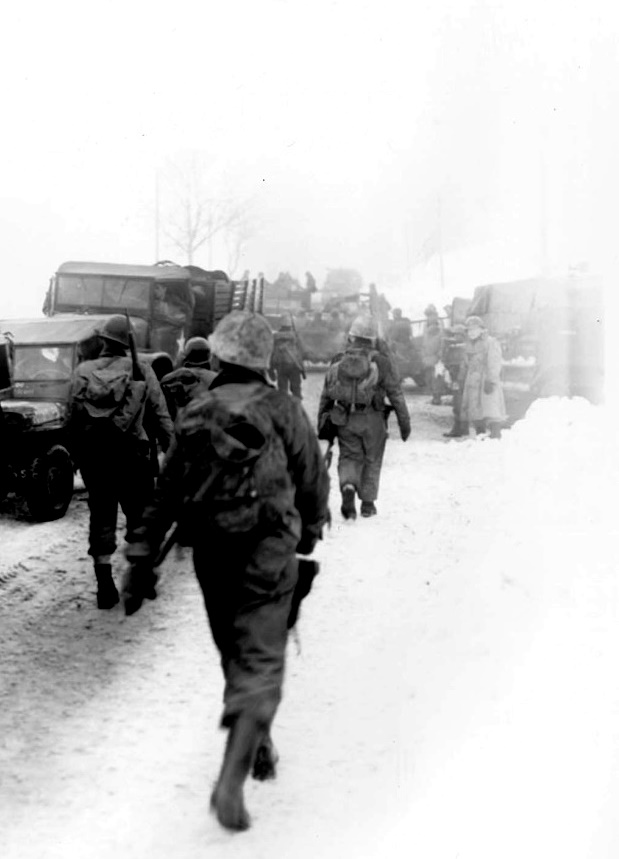
At about 1000, the infantry squad in position to Sgt Poll’s immediate right was taken out to be used in a counter-attack role elsewhere. Realizing that his small observation post was, in effect, the right flank of the Squadron, Sgt Poll, directing his small forces, calling for and adjusting artillery fire, and himself firing a light machine gun; successfully repulsed a frontal assault on his position. For this gallant action which played an important part in the defense of Höfen, Sgt Poll has been recommended for the Distinguished Conduct Medal (British) and appointed acting platoon sergeant. At 1030, the 395 reported enemy penetration to (K948173), almost to Kalterherberg, and at 1110, the 406-FAG reported a concentration of an unknown number of enemy tanks at this same location. Troop B took 4 POWs at 1117, who were driven out of a haystack in front of the 1st Platoon. All stated they were members of a recon patrol and were turned over to the 47-IR. Later, the Troop brought in 6 wounded POWs from the vicinity of StillBusch, who had been left on the ground as a result of the previous night’s action. At 1345, Troop C observed two high-ranking enemy officers, one in the Panzer uniform and the other in a field gray-green, observing with field glasses and a map from a pillbox in front of Imgenbroich. These German officers appeared to be interested in the approaches to Monschau.
 Enemy actions for the period Dec 16-18 in the area held by the 38-CRS indicate that all elements of the 751.IR and the 1./732.Regiment of the 326.VGD was employed in a full-scale defensive effort to gain control of the Monschau area and with the mission to dominate the Monschau – Eupen road. On Dec 18, the enemy made a frontal attack in battalion strength on Monschau, employing both battalion and regimental support weapons. The attack was preceded by a series of TOT concentrations which lasted from 0525 to 0600. At 0615, the companies attacked simultaneously from (K94197) and (K950180). All three efforts were successfully repulsed. It is interesting to note that the enemy did not commit reserves in the furtherance of the attack.
Another attack was launched at 0745 from Menzerath Hill (K949185). This was also repulsed and the enemy confined his actions to heavy harassing interdicting fires and strong patrolling for the remainder of the day. German paratroops from combat team von der Heydte were dropped behind the Squadron line during the night. From 0400 Dec 18, it was evident that the enemy was endeavoring to mass troops at strategic points in preparation for a major effort. At 0650 the attack was made with a combat team composed of 4 battalions; 3 battalions of the 751.Regiment and 1 battalion of the 752.Regiment. The 3rd battalion of the 751.regiment was held in a reserve position in the vicinity of (K957205). Simultaneously, paratroopers became active behind the Squadron lines, and a minor attack was repulsed at (K935229) at 0800. The main attack developed into a frontal effort against Monschau, as on the previous day, and an envelopment to the north in an attempt to out the Monschau – Eupen road from the Mutzenich Hill. POWs from all companies of the 1.Battalion and the 2.battalion of the 751.regiment were taken in the area in front of Mützenich Hill from the Snake Road to the north. This fact plus the observation of the defenders of the line indicates that the entire 751.Regiment was committed to the attack on the Mützenich Hill and the Monschau – Eupen road. The assembly for this attack took place in the draw out of Mützenich prior to daylight. At dawn, the attack jumped off south towards the hairpin turn (K941199) and west on the hill itself. The southern attack, which was coordinated with an attack in company strength west down the Snake Road was repulsed by 0800, but the attack on the Mützenich Hill succeeded in penetrating the B Troop line before it was counter-attacked and driven back. The attack was definitely stopped by 1300 after all reserves had been committed.

At 1700, the enemy made another approach in strength down the road leading due west from Imgenbroich, which was broken up by the fire of the 186-FAB before it could be developed into another attack. The enemy then tried twice more during the night of Dec 17-18 to break through. At 2200 approximately, two companies were observed massing in the area (K945202) and (K945196). These groups were dispersed by heavy artillery concentrations and small arms fire. At 2230, another enemy concentration of approximately 100 troops was observed and broken up. At 0300, Dec 18, heavy artillery and rocket barrages were placed on the Höfen and Monschau areas. This was followed by an attack at daylight in an attempt to flank the Monschau positions from Höfen Hill. After some penetration, this attack was repulsed late into the day. The 326.VGD, after three attempts on successive days, had failed to accomplish its mission. Heavy enemy shelling continued to fall on the Squadron positions and, at 1615, enemy infantry commenced to build up in the River Ravine at (K947181).
The 2nd Platoon, Fox Co, heard whistle signals and reported much movement. All available artillery was put on the target and the enemy withdrew. Shortly before 2400, a Troop B outpost at (K942198), manned by a squad of attached engineers, heard the noise of movement approaching down the draw from Stillbusch (945202). Their position was heavily wired in and all approaches were covered by trip flares, so they alerted their gun crews and waited. Within a matter of minutes, one of the flares was set off, revealing an enemy patrol and machine gun crew. All weapons were directed at the target thus exposed before the Germans could fire a shot. The element of surprise was complete; four of the enemy were killed, one of whom was an officer, and six wounded; two more were captured unharmed. The latter stated that it had been a fourteen-man patrol, led by an officer sent out by the 751.Regiment. Their mission was to reconnoiter to the Konzen Railroad Station to determine whether the Monschau-Eupen road was mined at this point. Mine detectors found among the equipment dropped by the enemy confirmed this point. This action served to make it clear that the use of trip flares is more profitable that the use of booby traps in an alert defense.
 On Dec 19 at 1130, Troop A, with its attached Item Co, 121-IR (8-ID) and the platoon of light tanks from Fox Co, 102-CRS, was detached from the control of this Squadron and, remaining in position, was attached to the 3/121-IR. Thus, Able Co of the 47-AIB became the left (north) unit of the Squadron. The platoon leaders and NCOs of Troop B reconnoitered proposed new areas to be occupied by their units on the following day. The troop now had attached 1 platoon of medium tanks from Charlie Co 10-TB, positioned in the vicinity of (931205) and (931208); 1 section of M-10s from Charlie Co 893-TDB, in the vicinity of (933197); and 1 platoon plus 2 squads of Able Co 146-ECB; thickening the MLR positions.

When Troop C was relieved of its positions in the 500 yards of trenches on the Monschau Hill by Able Co of the 1/47-AIB, they began the arduous task of moving equipment down the steep hillside and prepared for a night movement to assume a portion of the Squadron front between Troop B and Able Co 47-AIB. Troop E fired 218 rounds of ammunition during the period on observed point targets and unobserved harassing missions. Fox Co less the 1st and 3rd Platoons, was relieved of its mission in the defense of Monschau by the 1/47-AIB and proceeded at 2105 to the Monschau Railroad Station in the basement of which the command post was set up. The 2nd Platoon remained in reserve in that position. The 1st Platoon continued to defend in the vicinity of the blown-out bridge (941196) and at the hairpin turn (941199), while the 3rd Platoon remained at (934201). Both platoons were in support of Troop B. The CO and his HQs of Charlie Co 10-TB operated from the Fox Co CP. At dusk, the Squadron command post moved to Mützenich (920199) and the HQs of the 1/47-AIB, occupied the previous location in the Monschau Post Office.
On Dec 20, beginning with the movement of Troop C at 0200, the following reliefs and changes in the position of the platoons were affected, 1st Platoon of Troop C relieved the 1st Platoon of Troop B. The 1st Platoon of Troop B relieved the 2nd Platoon of Able Co (47-AIB). The 2nd Platoon of Able Co (47-AIB) relieved the 3rd Platoon of Troop B and the 2nd Platoon of Troop C relieved the 3rd Platoon of Able Co (47-AIB). The Squadron Medical Detachment moved out of Monschau to Mützenich, where another infirmary was set up at (910188). The Squadron (less Troop A) with Able Co (47-AIB) attached, was then disposed along a 4000-yard front, from the right (south) to the left (north); Troop B supported by two light tank platoons, a section of self-propelled tank destroyers and a medium tank platoon; Troop C; then Able 47-AIB, in direct contact on its left with Troop A attached to 121-IR (8-ID). Troop B had all three of its recon platoons committed to the MLR with its attachments in support. Troop C and Able 47-AIB each had a platoon in dug-in supporting positions behind the two platoons on the line. The 57-MM AT guns of Able Co were placed and sandbagged covering the road net and terrain approaches from the north. The unit CPs were located as follows, Able 47-AIB at (935231); C Troop at (928208); Fox Co at (936194); B Troop (no change) at (932201), and E Troop (no change) at (908187).
The Squadron again moved 100 yards to (920198) and a German 170-MM shell went through the house just vacated. Troop B and Fox Co coordinated fire plans and physical contacts with Able 47-AIB in Monschau on their right. Daylight security patrols were dispatched by each line unit. These were followed by all-night patrols working far in front of the listening posts. All elements, including the Squadron command post group, took added measures of security against German paratroopers still known to be at large in the rear areas.
During the period Dec 21-31, the 38-CRS continued to improve by digging in, sandbagging, and building overhead cover against shelling and the winter elements. The placing of many bands of concertina barbed wire with pickets and fixing of warning trip flares were emphasized. By the end of the month, each position was encircled with at least 3 bands and the entire front was protected by at least 6 bands. A total of 3500 rolls of wire was used between Dec 20 and 31. The ever-present snow covering the ground somewhat hampered operations, restricting movement to darkness and fog and forcing the men in most of the outlying positions to remain under concealment and to refrain from making tracks or spoil. White snowsuits were provided and worn by patrols by day and night. The camouflage of vehicles and emplacements was effectively accomplished by the use of any available white cloth.

 The enemy, of course, was confronted with the same difficulties and offered our artillery forward observers many lucrative targets. On Dec 21, Able 146-ECB was relieved of attachment to the Squadron, on Dec 24, the Squadron was attached to the 60-IR (9-ID) and on Dec 25 and 27, respectively, Charlie 10-TB and the TDs of the 893-TDB reverted to control of their parent units. With their leaving, the reserve platoon of Fox Co and two platoons of Item 2/60-IR took up positions in support of Troop B. Item Co was reinforced with elements of the 57-MM AT Company. Officer liaison was maintained with the HQs of the 102-CG and the 60-IR and an armored car were assigned to the 2/60-IR, in case of telephone failure. Capt Wilson reported as liaison officer from the 60-FAB and Capt Haseltine was relieved as liaison from the 62-AFAB and replaced by Lt Cerutti. Lt Davis reported from the 186-FAB. Early in the morning of Dec 21, Pfc Ashwell, on an armored car outpost at the Squadron CP, challenged and captured four Germans paratroopers. Troop A remained detached for the period.

 On Dec 21, the 3/121-RCT (8-ID), was relieved by the 3/311-RCT (78-ID), and Troop A, remaining in position, became attached to the latter. Thus, Troop A was with the XIX Corps in the 9-A while the Squadron remained under V Corps in the 1-A. Also on Dec 21, Lt Sacammano and six men, all former members of the Squadron, returned from hospital and were assigned to Troop A. The troop suffered a great less on the same day when a large caliber enemy shell made a direct hit on the CP killing T/5 Baxter and Pvt Wheeler, causing the evacuation from wounds of T/4 Diana, Cpl Scirole, T/5 Howe, T/5 Walters, Pfc Trucker, Pfc Lucijansky, Pvt Dyer and Pvt Wickliff. Pfc Meyer, Maj Rousek’s driver, died of wounds and the Squadron Executive Officer narrowly escaped injury. Other members of the troop and attached units suffered minor wounds and returned to duty after medical treatment.
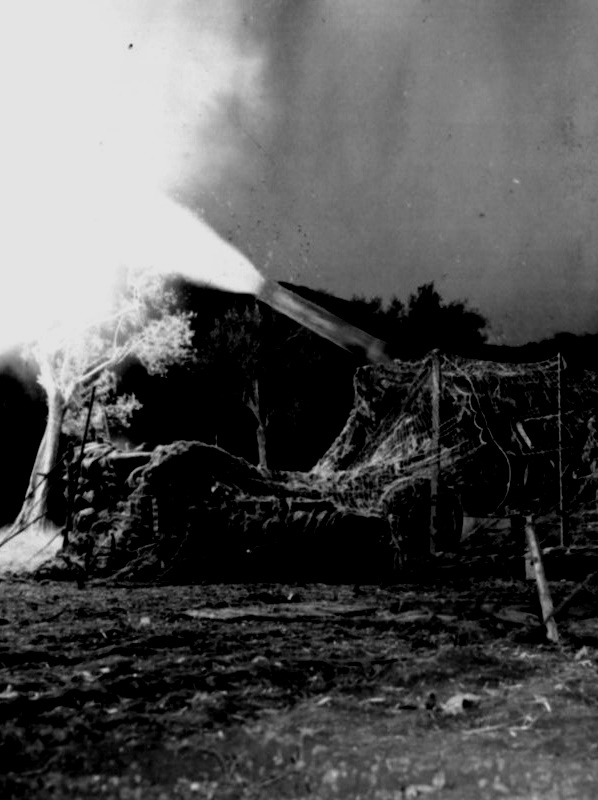
 Able 47-AIB dispatched radio-equipped patrols each night which traveled along the company front, east of the railroad, and set up successive listening posts, returning at first light. Under the cover of darkness on Christmas night, one 57-MM gun from the AT Platoon was manhandled into a barn at (939221) and well concealed by daylight. This gun, within 50 yards of the 2nd Platoon forward positions on the MLR commanded an excellent 90° field of fire. The other two guns were emplaced covering the road covering the roads at (940235) and (935229). Nightly recon and security patrols were operated by Troop B with enemy contacts and little to report. Several points were investigated, such as the vicinity of (945208); a trench reported at (947209) which proved to be a drainage ditch; and a pillbox at (952208). On the night of Dec 28, T/5 Buchman and Pvt Cherneck provided the point for an infantry patrol from the 60-IR and set up an ambush at (946208) where a four-man German patrol was surprised. After a short firefight they killed one and brought in three prisoners.
During the period, Troop B captured 14 POWs. From a civilian report on Dec 22, the Riot Squad of HQs Platoon – Cpl Fitzpatrick, T/5 Wearmouth, and Pfc Willaba, assisted by Sgt Belcher and two men from the 2nd Platoon captured four paratroopers. They surrendered and searched for a house and barn (932199). Finding nothing they threw in four hand grenades and fired their small arms, whereupon the Germans came out from under the hay. On the same day Pvt Grossi, while stringing wire between the 1st and 2nd Platoons saw 8 German Paratroopers. He fired his carbine at them and they all surrendered to him.
On Dec 22, two more paratroopers were captured by T/5 McCauley’s outpost as they tried to return through the lines to the Germans. Troop C continued to send out all-night security patrols without enemy contact. Pfc Benham of the 2nd Platoon captured four paratroopers attempting to pass through the lines to the east. Coincidently, Pfc Benham was wounded by long-range, harassing machine-gun fire. The six assault guns of Troop E fired 1915 rounds of ammunition during the period. The troop maintained three observation posts, #1 at (936220) and #2 at (930208), both of which were manned 24 hours a day. #3 was manned only during daylight and was used as an excellent observation post for the squadron staff and others who had reason to inspect the terrain to the front.
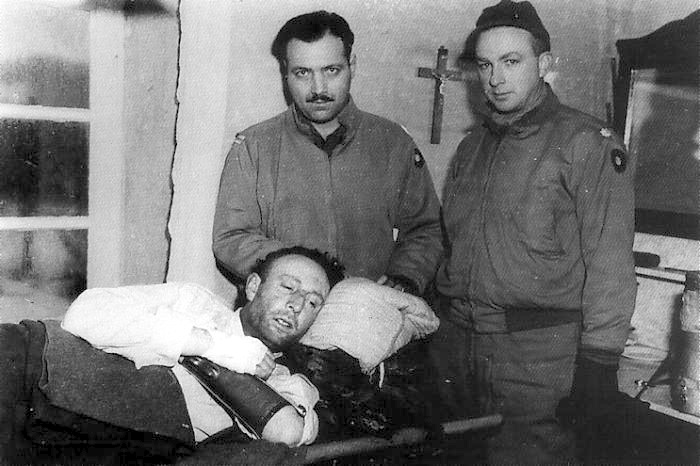
During the month, Troop E fired 8199 rounds of ammunition, which amounted to a 60.2-ton projectile weight. A detail under Sgts Guidry and Oliver captured three more German paratroopers. The light tanks of Fox Co occupied supporting positions behind Troop B with the 3rd Plat. in reserve. On Dec 27, that Plat. was also committed to filling the vacancy left by the medium tanks of the 10-TB which had reverted to the V Corps control. Five more paratroopers were captured on Dec 26. S/Sgt Wright returned from the hospital after a wound received in September at Manderfeld. The attached 3rd Platoon of Able, Co 112-ECB laid minefields at (941207) and (940212) and checked the road at (94352238). The Platoon continued to assist the troops in wire laying and setting trip flares as well as maintaining the road net.
 The Squadron Medical Detachment continued to maintain its infirmary, caring for the sick in quarters and conducting daily sick call. During the month of Dec, a total of 39 Battle Casualties and 40 Non-Battle Casualties from the Squadron were processed through the aid station. The battle casualties consisted of 5 KIA, 34 WIA, and one battle injury. The Rear Echelon continued to supply and service the Squadron from Eupen. A truck head was established at the Troop B rear command post at Mützenich (910196) and placed in charge of S/Sgt Gang from S-4. All supplies were distributed from this point in small vehicles. The rear echelon bivouac escaped damage on several occasions when Eupen was subjected to shelling and bombing. A number of enemy planes were knocked down by an efficient AAA crew 300 yards away. In conjunction with the V Corps defense system, Capt Marvel HQs, and Service Troop Commander, was placed in charge of the area in the vicinity of his bivouac and conducted a bantam-armored car night patrol.
December – General
On the night of Dec 21, the Squadron Commander accompanied by Maj Rousek and Capt Meyer visited Troop A at the Konzen Railroad Station and surrounded by the atmosphere of the typical front-line CP presented the decoration of the Silver Star for gallantry in action to the Troop Commander, Capt Buenzle, Lt Tully, and Pfc Glinski. The party then proceeded to the command post of the 2nd Platoon of Troop C along the MLR and there presented the same award to Lt O’Brien. Troop kitchens fed B rations with the exception of isolated platoons which used 10-in-1 menus prepared by attached cooks. However, on Christmas Day all personnel were served a full-course turkey dinner. The closing of the old year marked the 111th consecutive day that the Squadron had been in direct contact with the enemy along the Siegfried Line. On New Year’s Eve of 1943 the entire Squadron had been engaged in an ambitious practice firing schedule at the Southampton Range on Dartmoor, England.
