Battle of the Bulge (Shouth)

 In the early morning of December 16, a German counter-attack in strength lunged westward out of the Siegfried Line, spearheaded by top-notch armored columns, covered by hundreds of new, and hitherto hidden aircraft. Not since Avranches (France) had the enemy endeavored to mount a counteroffensive of the proportion of that which now rolled across the frozen hills of Luxembourg and Belgium. Feldmarschall Gerd von Rundstedt offensive in the Ardennes hit the American US First Army in a thinly held sector, extending roughly from the Belgian twins-town of Krinkelt-Rocherath to the south of Echternach in the Grand Duchy of Luxembourg.
In three days, enemy spearheads, overrunning American lines, had penetrated into the area between Bastogne (Belgium) and St Vith (Belgium). Some elements swept further west to bypass Marche-en-Famenne (Belgium) and reach the Meuse River. By December 19, the shoulders of the Bulge were becoming more stabilized, and enemy thrusts were being contained without further loss, in the Krinkelt, Rocherath, Elsenborn area on the North Shoulder, and in the Echternach Area on the south.


The 101st Airborne Division temporarily under the command of Gen Anthony McAuliffe (the CG of the 101st A/B, Gen Maxwell D. Taylor being in Washington for a meeting), with portions of the 9th Armored Division and the 10th Armored Division were making their historic stand at Bastogne against constant enemy pressure which had surrounded the town.
 This is briefly the situation into which Gen Patton’s Third Army was soon to play a leading and spectacular role, and in which the 26th Infantry Division was to meet its heaviest engagements with the enemy. As plans were hurriedly formulated in Supreme Headquarters, the part of the Third Army would play in reducing the German penetration in the First Army sector became known.

Gen Patton’s offensive, along the German Border approaching the Siegfried Line, was to be suspended; the present line held with a minimum of troops and the main effort of the Third Army to be directed in a smashing blow against von Rundstedt south flank. The units most immediately available to the Army Commander were the III Corps Headquarters in Metz, the 4th Armored Division, the 26th Infantry Division, and the 80th Infantry Division, none of which were at this time actively engaged. On December 19, the III Corps was ordered to employ these divisions in launching an attack on December 22 against the enemy’s south flank.

 On December 20, the III Corps moved its Headquarters from Metz to Arlon (Belgium). The 4-AD and the 26-ID began assembling in the area in preparation for the attack. With road priority directed to the armor, elements of the 4-AD became the first Third Army combat units to arrive on the new scene of battle, but only a few hours behind, elements of the 26-ID closed in the concentration area. Although the 26-ID had followed closely the developments of the Ardennes offensive, the order directing the entire division to move to Luxembourg was received with a suddenness, which allowed only ten hours until elements must begin the movement to the north. Orders were received by the Division Chief of Staff on the night of December 19 to start moving the following morning.

 By midnight, on December 20, the entire division had moved from Metz (France) to the assembly areas in the vicinity of Eischen (Luxembourg). On December 21, the 4-AD had completely assembled in its area near Arlon and the 80-ID had assembled north east of Luxembourg City. The III Corps then directed these 3 divisions to attack at 0600 on December 22.
The 4-AD was to advance up the Arlon-Bastogne Highway, with the 26-ID in the center of the Corps zone, and the 80-ID on the right. At no time prior to the attack was the division able to secure any substantial amount of information concerning the location of the enemy, or other details related to the situation. The infantrymen who remained concealed in the Luxembourg Forests during the day and night of December 21, making last-minute preparations, were, of necessity, to begin the attack the following morning in which they must seek out and find the enemy. They were to move north aggressively, engage the flank of the German Salient pushing west. Ahead, in their path stretched the hills, woods, streams, cold and frozen ground, covered now with a raw mist, and shortly to be covered by snow. And somewhere, the enemy.
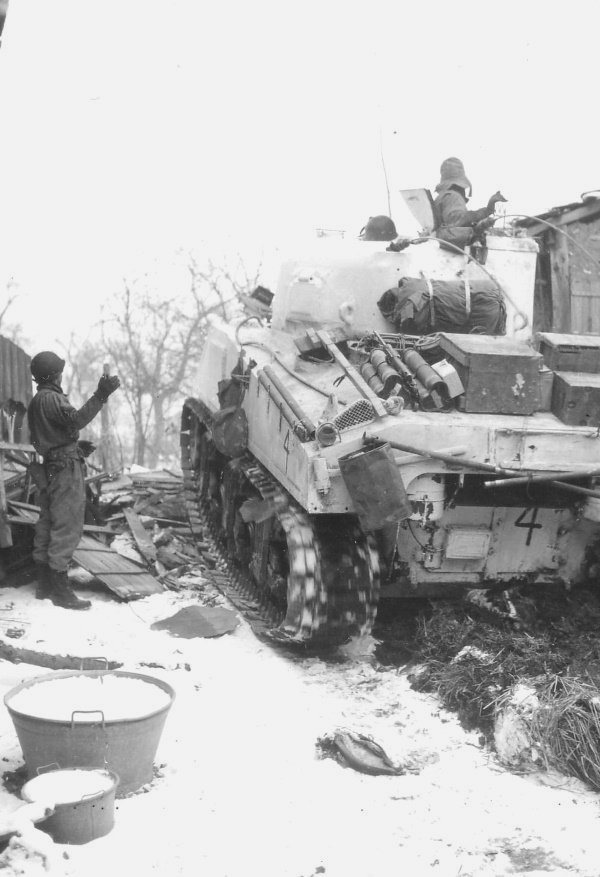
At 0600 on the morning of Dec 22, with the countryside still wrapped in a chilling mist, the 26-ID began the attack with two regiments abreast, the 328-IR on the left, the 104-IR on the right. In a column of battalions, on foot, because the possible point of meeting the enemy was unknown, the infantrymen of the two regiments walked approximately 16 miles before contacting the German columns moving west.
 The first contact with the enemy on December 22 was met by the 26th Cavalry Reconnaissance Troop which had been sent out in advance of the infantry to screen and probe across the division front. The 1st Platoon of the Troop had advanced north to Ell and then to Rambrouch without sighting the enemy. Just outside of Rambrouch the platoon, now approximately 16 miles north of Arlon and Eischen, went into concealment along the side of the road. From this position, the cavalrymen, firing from their armored cars, were able to ambush two enemy vehicles carrying personnel and one motorcycle bearing a German colonel. Soon enemy infantry began to arrive in larger numbers, followed by tanks and AT guns. The Recon Platoon, heavily outnumbered, fought a stubborn delaying action, withdrew to the town of Rambrouch in which they resisted for two hours the savage attacks of the enemy. Other elements of the Troop had contacted the enemy at Rodt-Les-Ell. The 328-IR struck the flank of the enemy when the 1st Battalion encountered self-propelled guns on a hill in the vicinity of Rindschleiden. The I&R Platoon of the 104-IR found the enemy in the vicinity of Grosbous. During the afternoon of December 22, the enemy became aware of the threat that was pushing into his left flank.
In the zone of the 4-AD, CCA advanced up the Arlon-Bastogne Highway as far as Martelange. On the right of the Corps zone, the 80-ID encountered stiff resistance from the 352.Volksgrenadier-Division at Merzig and Ettelbruck. Later in the day, the enemy had sufficiently recovered from the surprise of this flank attack, to launch a counter-attack south of Grosbous, forcing our troops to withdraw one mile. On the second day of the attack, the terrain became an increasing obstacle to operations. In the area north of Grosbous, toward Eschdorf and the Sure River, the ground was broken into a series of deep gorges and high wooded ridges. During the day, in which the enemy resisted vigorously, the 104-IR captured Grosbous and pushed on to Dellen and Buschrodt. King Co, 328-IR, occupied Wahl on the morning of December 23, and the 2/104 became part of a combat team known as Task Force Hamilton. This Task Force was organized to fill the need for a quick, powerful, mobile armor-infantry team, consisting of the 2/328-IR motorized, Charlie Co (less one platoon) of the 735-TB, one Platoon, Able Co, 818-TDB, one Section Battery C, 390-AAA Battalion, one Section Able Co, 101-ECB.
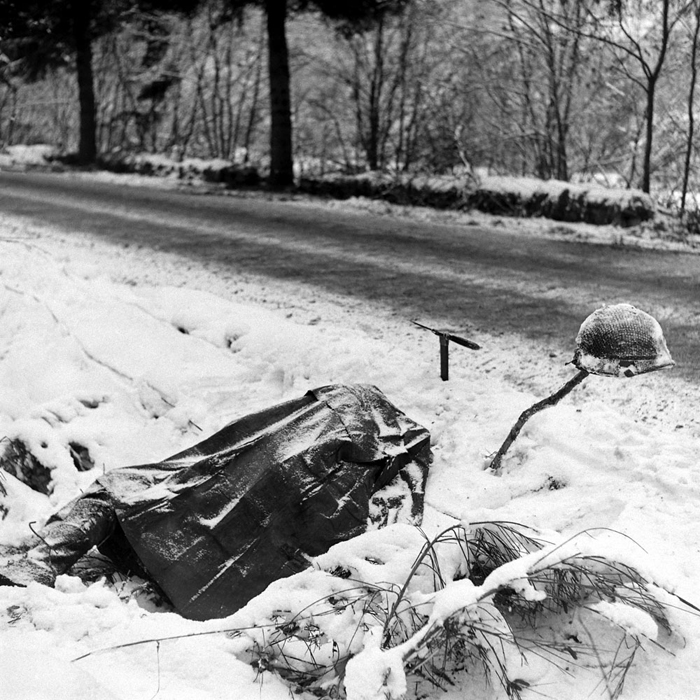
Late in the day on December 23, the 2/101 was taken from reserve with the mission of securing Rambrouch on the division left flank which had been in German hands since the withdrawal of the 26th Cav Recon on December 22. This was accomplished on the following day, with Rambrouch and Koetschette both wrested from the enemy.
During the second day of the Third Army attack, the 101st Airborne Division and other units at Bastogne were supplied by our aircraft with much needed medical supplies and equipment. The 4-AD continued the fight up the highway towards Bastogne, CCB reaching Chaumont and CCA still held up on the main road by a blown bridge at Martelange. The German defense against this flank attack was conducted with increasing ferocity, with paratroopers landing within the American lines, and small groups of enemy infiltrating by use of captured US uniforms and vehicles (Operation Greif-Skorzeny). Having seized the offensive, the enemy sought desperately to continue on the offensive. The Third Army attack and the heroic resistance of Bastogne constituted a thorn in the side of the German effort that threatened to cause the failure of the whole campaign in which von Rundstedt had hoped to sweep the Allied Armies from the continent.

From December 24 to December 25, the progress of the III Corps’ divisions was retarded by the recurrent counter-attacks and stubborn resistance of the enemy. The 6th Cav Group (Task Force Fickett) arrived in the Corps zone and was assigned a zone between the 4-AD and the 26-ID. In the 26-ID zone, the 1/328 fought bitterly to capture Arsdorf, with Baker and Charlie Cos fighting from house to house to overcome Germans fighting with primitive fury. The battle in Arsdorf continued all night and on Christmas morning the 2/101 joined and succeeded in clearing the town.
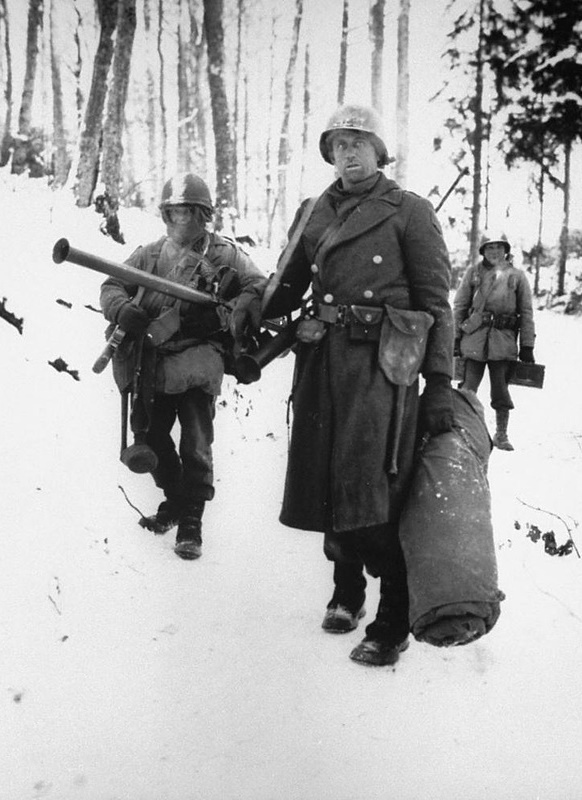
 Task Force Hamilton, meanwhile, was assigned the mission of seizing the heavily defended town of Eschdorf, which dominated the approaches to the Sure River. Advancing up the road to Eschdorf, Easy and Fox Cos 328-IR encountered strong enemy resistance at the tiny village of Hierheck. The enemy pinned our infantry down with intense rifle and automatic weapons fire. Tanks of the 735-TB entered the battle, endeavoring to engage the enemy while the infantry infiltrated forward. The bloody fighting on the road to Eschdorf continued, and the battle for the town itself did not begin until 0100 on Christmas morning. In the struggle which began on Christmas day, Eschdorf was to become one of the most bitterly contested points in the campaign, and the town to be reduced to little more than smoldering rubble.
For two days and nights, Eschdorf was shattered and blasted by the battle. Easy and Fox Cos stumbled through the burning village, under artillery and mortar fire, killing the enemy where they found him, losing contact with their own troops and commanders. By Christmas night, most of Task Force Hamilton was forced from Eschdorf by the violent German attacks, but the Task Force re-entered the town on the following morning to recapture it with the the help of the 1/104-IR.
 With the strategic villages of Arsdorf and Eschdorf cleared of the enemy, all units of the division were facing the Sure River, winding through its deep channel in the hills, and the lofty snow-covered ridges beyond. The 80-ID, on the right of the 26-ID, having now passed to the control of XII Corps, was still held up by the enemy, leaving the 104-IR facing an exposed flank. All during Christmas day, the 4-AD continued thrusting at the enemy’s frantic defenses to block the road to Bastogne. Finally, on December 26, the 4-AD made contact with the defenders of Bastogne and medical supplies, ammunition and food began to move into the besieged Americans. The same day, the attack by the 26-ID was resumed on the morning, with the 101-IR and the 104-IR prepared to cross the Sure River. The enemy was very active on the opposite bank and the efforts of the infantry and the engineers to secure crossing sites were met by heavy small arms and mortar fire, particularly in the vicinity of Bonnal and Esch-sur-Sure.
 By the end of the day using assault boats and footbridges initially, the greater part of the 101-IR and the 104-IR had crossed the Sure. Enemy aircraft were active over the bridging sites, and the 390-AAA Battalion destroyed fifteen enemy planes and damaged three. On the morning of December 27, the 35-ID, having arrived from Metz on the day before, attacked through the 6th Cav Recon Sq, seized objectives north and west of the Sure River on the left of the 26-ID. In the bridgehead of the 101-IR the advance was continued, capturing Mecher-Dunkrodt, Kaundorf and the high ground in the vicinity of Bavigne. Two bridges were now established across the Sure, a Treadway at Esch-sur-Sure and a Bailey Bridge at Bonnal. The 1/104 and the 2/104 had crossed the river at Esch-sur-Sure and seized the high ground east of Kaundorf, assisting the 101-IR in clearing Kaundorf. Through December 28 and December 29, the enemy utilized the high ground to fight a delaying action in the area between the Sure River and the Wiltz River. The 4-AD strengthened and widened the corridor into Bastogne, the 35-ID made slight gains. In the zone of the 26-ID small gains were made by the 1/101 and the 2/101, and Nothum was cleared by the 104 against considerable resistance.

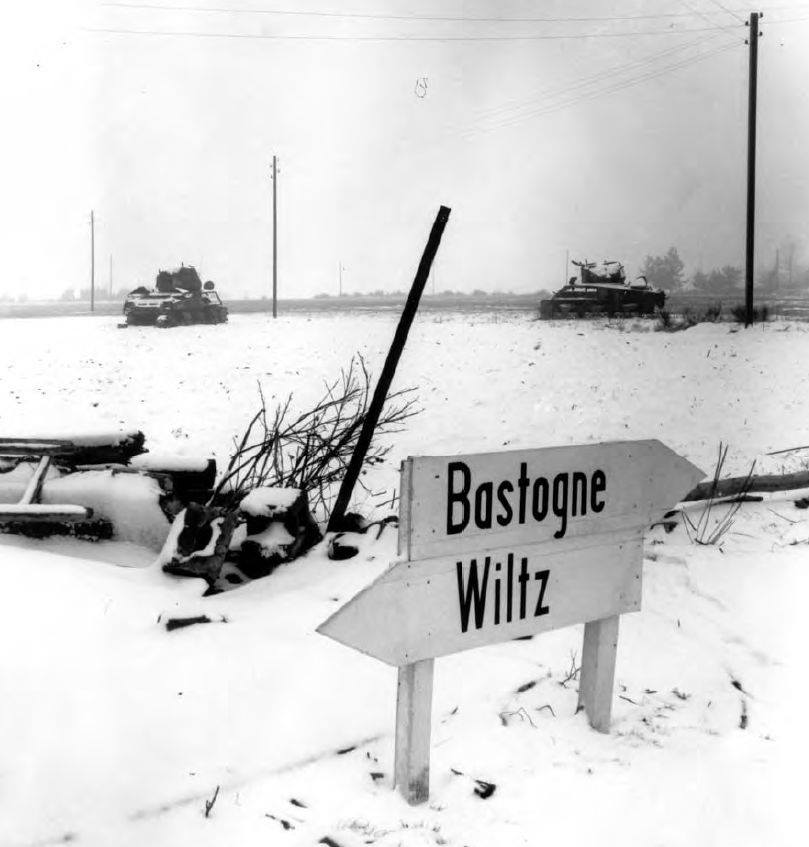
The advance infantry elements were now approaching the key communication and supply center of Wiltz. The enemy indicated a stubborn reluctance to surrender the Wiltz Area, which was vital to carrying on the offensive, which he still hoped to resume.