



(Document Source) Headquarters US Army Intelligence Center, Fort Holabird, Baltimore, Maryland. ACSIH-GC-250/58/M, April 1959, CIC History.

Plélude
The US Counter Intelligence Corps (CIC): Origins, Missions, and Role in Postwar Europe. The (CIC) was a crucial yet often overlooked branch of the US Army dedicated to counterintelligence, espionage detection, and internal security. Officially established in 1942, the CIC played a significant role during World War II and the early Cold War, particularly in Europe, where it was instrumental in rooting out enemy agents, securing liberated territories, and later combating Soviet infiltration.
Origins and Establishment
The origins of the CIC date back to World War I, with the formation of the Corps of Intelligence Police (CIP) in 1917. The CIP was disbanded after the war, but as the global threat of fascism grew in the late 1930s and early 1940s, the US military recognized the need for a more robust counterintelligence structure. Thus, in January 1942, shortly after America entered WWII, the CIP was reorganized as the Counter Intelligence Corps under the control of the Army’s G-2 Intelligence Division.
Recruitment and Training
CIC agents were carefully selected, often based on their linguistic skills, cultural knowledge, and background in law, police work, or intelligence gathering. Many recruits were European Immigrants or refugees, especially from Germany and Austria, who brought valuable insights into Nazi operations. Training took place in US military facilities such as Camp Ritchie (Maryland) and Camp Holabird (Maryland), where recruits learned interrogation techniques, surveillance, document analysis, disguise, and how to conduct field investigations. Agents typically wore standard military uniforms without distinctive insignia to maintain anonymity in the field. Despite their low profile, CIC agents held substantial authority and carried out sensitive assignments behind and sometimes ahead of the front lines.
Core Missions
The CIC was tasked with: (a) Identifying and neutralizing enemy spies and saboteurs; (b) Investigating subversive activities and internal threats; (c) Screening civilian populations in liberated or occupied areas; (d) Interrogating prisoners of war and suspected collaborators; (e) Securing military installations and classified information; (f) Collecting and analyzing intelligence from captured documents.
In Europe, CIC teams operated in tandem with advancing Allied forces. After D-Day, CIC agents were embedded with field units as they moved through France, Belgium, and into Germany. Their work involved vetting local populations, uncovering hidden Nazi personnel, and dismantling enemy intelligence networks.
Operations in Europe
The CIC’s role expanded dramatically as the Allies pushed into Germany, Austria, France, Italy, and other parts of Western Europe. Agents were key players in the denazification process, locating and interrogating former SS officers, Gestapo officials, and war criminals. They were also responsible for protecting critical infrastructure, such as weapons factories, research labs, and communication centers. CIC units collaborated with Allied intelligence services like MI6 and the OSS (the precursor to the CIA), sharing information on fugitives and high-value targets. The CIC also investigated underground escape networks used by former Nazis—some of which were later linked to the ODESSA organization. In the immediate postwar period, the CIC played a vital role in stabilizing occupied zones, tracking black market activity, monitoring communist influence, and assisting with the Operation Paperclip program, which involved recruiting German scientists for US defense projects.
Cold War Shift and Dissolution
As the Cold War escalated, the CIC shifted its focus to countering Soviet espionage and monitoring leftist movements in Europe and beyond. The emergence of the KGB as a global intelligence rival required new tactics and close coordination with other US agencies, including the CIA, FBI, and the newly created Defense Intelligence Agency (DIA). By the late 1950s, the CIC’s operations began to overlap with these larger intelligence organizations. In 1961, the CIC was officially dissolved, and its duties were absorbed into broader military intelligence structures, including what would become the US Army Intelligence and Security Command (INSCOM).
Part 1 – The Ardennes Breakthrough
As the Kaiser’s Army, in 1914, had sped through the Ardennes en route to Paris; as Hitler’s Army, in 1940, had attacked through the same forest on its way to the conquest of France; so, on December 16, 1944, four German Armies, two of them Panzers, attacked the US VIII Corps, in a desperate push toward Antwerp and the North Sea. Inclement weather had permitted von Rundstedt to assemble this huge force and to surprise the Allies
German Intelligence Service Plan Uncovered
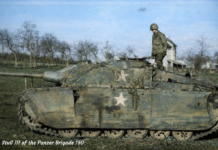
In planning for the surprise attack through the Ardennes, the Nazis had counted heavily upon a brigade, designated Panzer-Brigade 150, organized by the German Intelligence Service (GIS), dressed in US uniforms and equipped with captured US weapons and jeeps. One segment named the Einheit Stielau after the Lieutenant who commanded it (Oberleutnant Lothar Stielau), was to be the espionage, sabotage, and confusion arm. This whole plant was authored by SS-Obersturmbannführer Otto Skorzeny, who had attained a reputation of omniscience among the German High Command by his rescue of Mussolini in November 1943. However, a series of events robbed this maneuver of much of its surprise value.
For several months, US troops had been made increasingly aware of the danger posed by German soldiers in US uniform. From about the middle of August, individual German soldiers had dressed in parts of US uniforms taken from the dead or captured and had stolen jeeps to add mobility to their ruse. These practices were largely the products of individual initiative and, as much, were carried out on a small scale. Since the incidents were scattered and were few (although both the Sixth Army Group and the Twelfth Army Group did experience similar occurrences), not much importance had been attached to them. About twice a week, during November the Intelligence Officer of the 37.Panzer-Grenadier-Regiment had sent English-speaking Germans on long-range recon patrols to gain US order of battle information. Late in November, a four-man German patrol, captured by troops of the 83rd Infantry Division, stated their mission was to remain behind Allied Lines for four days, tapping telephone wires. Components of the First, Third and Ninth US Armies suspected they had been the victims of German wiretapping efforts. On two occasions, the investigation revealed, the Germans had tried unsuccessfully to secure specific information by identifying themselves as the switchboard board chief from Conquer (Conquer being the Code for the US Ninth Army), and a Staff Sergeant from Justice (Justice believed to be the code of the US XVIII Corps).
In mid-November, a prisoner of war stated, under interrogation, that he had seen secret order for all English-speaking personnel and all captured US uniforms to be sent to Osnabruck (Germany). According to the order, this personnel would be trained in recon, sabotage, and espionage. Two German military documents captured at about the same substantiated prisoner’s revelations. They indicated that a call for volunteers had been issued early in November, outlining the necessary qualifications. In addition to the knowledge of English, including the American dialect, volunteers were to be physically fit, mentally alert, competent in close combat fighting, and suitable for special assignments. They were to know military terminology. Significantly, they could not be retained by their units for military reasons. From these volunteers, the documents revealed, a special unit would be formed, about two battalions in strength, for deployment on the Western Front.
Before acceptance by this new unit, each volunteer would be tested for suitability at Friedenthal (Germany), near Orianenburg (Headquarters Skorzeny). This information was disclosed in a letter from the Headquarters of the LXXXVI Corps to their Fallschirmjäger Regiment Hubner. The letter stated further that ‘Captured clothing, equipment, weapons, and vehicles will be utilized for the equipment of these special units’. The only discrepancy between the prisoner’s statement and the documents were in the destination of the volunteers and articles. The destination was not Osnabruck, but Headquarters Skorzeny.
Finally, early on the day of the attack, December 16, 1944, secret orders outlining the plans for Operation Greif (English translation: Grab) were found by troops of the 106th Infantry Division on the body of an officer of the 116.Panzer-Division, who had carried them into the front lines, despite a directive that below division level, they were to be transmitted only verbally. These orders were dated the previous day. Now all doubts as to the German’s plans for the deception were erased. Before the end of the first day of the attack, the word could be flashed to all subordinate units that the Germans planned to operate, in the strength of two battalions, an organization of English-speaking German soldiers, dressed and equipped as US troops. Even the roads they would take and their means of identifying their comrades were known. The following partial translation of the order was carried in the US First Army’s widely distributed Periodic Report: Undertaking Greif will be made by our forces with American equipment, American weapons, American vehicles, American insignias – especially the five-pointed white or yellow star may be painted on the vehicles. To avoid confusion with enemy troops, the forces employed in the Undertaking Greif will identify themselves to our troops (Day) by taking off their helmets; (Night) by red-blue light signals with flashlights. Force of the Undertaking Greif will also identify themselves to friendly troops by painting white dots on houses, trees, and roads used by them.
Increased Security Measures
Although higher echelons of US Intelligence had been skeptical of the enemy’s capability to summon a force of the size and scope indicated by the prisoner and documents captured in mid-November, First Army’s G2 Estimate had warned: their potential threat as infiltration units need no stressing, and CIC had used this potential threat as a basis for improving the security of installations and towns in the forward areas. CIC had given wide publicity to each uncovered case of enemy troops in US Army uniforms and civilian disguises through counterintelligence publications and during security lectures, providing a background for US troops which ultimately proved its worth. Informal phases of security education were being exploited also. Ninth Army CIC, for example, conducted a poster campaign in the XIX Corps rest area. This proved a valuable method for alerting troops to their security responsibilities.
Much CIC effort had been expended on various types of security checks. Front line divisions, growing increasingly wary of the authenticity that a US uniform loaned its wearer, initiated spot checks of all vehicles forward of a regimental command post and personnel in the mess-lines. Some divisions had anticipated the problem of the counterfeit uniform. Particularly prudent was the counterintelligence alert negotiated by the 29th Infantry Division on December 5 in which the 29-CIC cooperated. Created expressly to guard against an invasion by US uniformed enemy troops, this alert lasted long enough for recurrent checks to be made. as a result, troops of the Division became highly security conscious and, even after the alert was over, a uniformed straggler, finding himself in the 29th Infantry Division area, would be detained and turned over to the authorities.
Travel and Frontier Control
By early December, travel and frontier control systems had improved throughout the 12th Army Group. A complicated network of roadblocks, checkpoints, and control points, supplemented with roving patrols between the stationary posts … seriously affected … the Germans Intelligence Service line-crossing operations. The mainstays of the frontier control line were the ADSEC CIC Sections (Advance Section Counter Intelligence Corps Sections) assigned to the First Army and employed on the Counter Intelligence Control Line which functioned along the German frontier. Behind this line and assisting it was the other CIC teams that had been assigned definite territories to the rear of the Armies. These teams, too, were under ADSEC supervision. Shortly before the enemy offensive began, these teams were directed to establish, in conjunction with Belgian and French authorities, an identity control line in the ADSEC territory. Frequent checks of identification at crossroads, bridges, cafes, and hotels tightened security. In the Ninth Army area, 364 indigenous guards from several pre-war Netherlands governmental agencies and resistances groups formed during the German occupation were used to man posts and patrols. In the Third Army area, frontier control was relatively porous, for the situation had been less stable than in other sectors. Three captured Abwehr Agents had told their Seventh captors that long-term agents going to the interior of France were being instructed to advance via Nancy and Toul, rather than risking apprehension in places where traffic was controlled more severely.
Reinforcement of the security produced by the Counter Intelligence Control Line was effected through the strict regulation of travel for the civilian population. In most territories, local civilians were permitted limited travel during specific hours. Farmers could harvest their crops by daylight. Special passes were provided by Military Government and Civil Affairs officials. Persons caught moving about after curfew or wandering along unauthorized routes were held suspect of subversive activity and detained until an investigation proved their innocence. Initial violators of travel restrictions were punished harshly so that their cases might serve as a deterrent to others. CIC aided Military Government in the prosecution of these cases. This web of restriction and interlacing checks often entangled German soldiers who wore civilian clothing behind the lines. These Germans soldiers in civilian clothes could have been sentenced as spies, but policy dictated otherwise. To encourage the desertion of German soldiers, the Twelfth Army Group had established a procedure by which German soldiers in civilian clothes were to be trailed individually, the disposition of each suspect depending on his behavior during interrogation and on his distance behind the lines at the time of his arrest. Thirty-one German soldiers in civilian clothes had been arrested in the first fifteen days of December by CIC units of the Ninth Army were handled following this policy, and all were evacuated through prisoner of war channels.
CIC Agents Fight for Their Lives
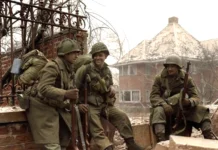
Although the gradual discovery of the German Intelligence Service plan of deception, climaxed by the capture of the plans for Operation Greif on the first day of the German offensive, destroyed the effectiveness of this maneuver, the actual offensive which came to bane known as the Battle of the Bulge, did catch the Allies by surprise. In the resultant situation, many CIC Agents heard the double burden of counterintelligence duties and combat fought shoulder-to-shoulder with other US soldiers. For example, half of the Tactical Reserve Team N°3 (TRT #3) of the 418th CIC Detachment, under the command of 2/Lt Kenneth Hardin, fought an invading force of German Fallschirmjäeger (Paratroopers) that descended on Brandenburg, in the US Ninth Army area, on the first night of he German offensive, and by daylight, began attacking installations in the town itself and firing on traffic on the road. Lt Hardin and Agents Edward E. McCarty, Charles N. Short, Vincent Cleary, James H. Ratliff, and Ferdinand Goetz directed and participated in skirmishing that resulted in rounding up twenty-four enemy paratroopers. One paratrooper was captured by TRT #3 Agent. Thirty-one German soldiers in civilian clothes also were rounded up.
Some Detachments Overrun
Other CIC Detachments were less fortunate, for the swift German advance caused some to be overrun. In these instances, counterintelligence was of lesser importance than self-preservation. Among them was the 99th CIC Detachment. Eight Agents of this Detachment were awakened on the morning of December 17 by the sound of fire from German MP-38/40. Lt Howard V. Stephens, in charge, issued an order for everyone to obtain weapons and to prepare to defend the house in which they were quartered. A seemingly endless of German tanks appeared on the road, and an interpreter, who had been a scout for one of the regiments before joining CIC, volunteered to seek a way out for the group. By the time he returned with the news that the rear was open, German tanks were in front of the house, and CIC Agents held their breaths when one of the tank leaders poked the muzzle of his 88 into the window. The Agents, with the scout in the lead, scampered out of the back way, dodging from shell hole to gun emplacement hole. In the dash toward freedom, the group split, and four went ahead with the scout while four others were pinned down in one hole by small arms fire. In the latter group, Lt Stephens and Agents Charles Sloan, Francis Cody, and Vic Gardin each took a corner of the gun emplacement hole.
Sloan cried out as mortar fire shattered tree branches over-hanging the ditch. Gardin crawled over him, while Cody checked Lt Stephens, who had not made a sound for some time. Stephens appeared to be dead. Cody, also wounded, then crawled over Gardin and Sloan, whose back and one leg had been hit. Cody and Gardin decided to leave Lt Stephens and Sloan, who could not be moved and try to get help from headquarters. They made Sloan as comfortable as possible and left. Not far from the spot, they noticed a group of soldiers coming toward them. Convinced they were caught, Gardin waved part of his clothing on a twig in a gesture of surrender. The group turned out to be US soldiers from the 1st Infantry Division which was moving up. Medics with them gave Cody first aid and sent him to the First Aid Tent. Gardin and the medics returned to Lt Stephens and Sloan but found them dead.
CI Control Line Thwarts German Intelligence Service
After the discovery, on the first day of the German offensive, the Nazis planned to send large numbers of agents in US uniform through the lines as a part of this maneuver, increased security consciousness and intensified counterintelligence efforts were experienced all along the American front. Before the German attack, military security had been uniformly satisfactory, but the German push made it better than ever. Immediately, the 1st Third Army After-Action Report noted: the Counter Intelligence Control Line assumed an even important role, for it represents the only existing cohesive means of preventing mass infiltration by enemy agents. Third Army’s travel control had been less effective than that of the other Armies on the line, but now tighter restrictions were enforced. By the end of December, a well organized and coordinated Counter Intelligence Control Line was functioning in all fours Corps.
The ADSEC Counter Intelligence Control Line in the First Army Area at Division straggler level was severed in the initial stages of the German thrust, but smaller, supporting networks of counterintelligence checkpoints and control posts remained fairly effective. The aggressive intelligence and sabotage activities of the enemy called for the quick mobilizing of all available counterintelligence resources to meet the situation. Intensive checking of identity documents at bridges and defiles; reinforced guards for vital installations; the posting of a Counter Intelligence Control Line along all roads on the east side of the Meuse River which led to bridges; screening of refugees and displaced persons before allowing them to proceed – these were among the immediate counterintelligence measures that were instituted.
ADSEC CIC Sections, even in areas not affected by the German advance, were recalled from frontier control positions to aid in the patrolling of the Meuse River from Givet (France) to Visé (Belgium). They discovered that even, as the German Army was pouring into the Ardennes, 250 Liège Communists held a meeting at the Cinéma Carrefour, Boulevard de la Sauvenière. Speakers indicated they would another attempt to overthrow the provisional Pierlot Government and soon would begin a propaganda campaign employing printed literature. ADSEC CIC made note of this continuance Communist subversion.
The Second Day – CIC Work Increases
By the afternoon of December 17, 1944, the enemy had committed fourteen divisions into battle, half of then Panzers. US units from the reserve areas and the Third Army maneuvered to stem the drive and to bolster weakened forces. The main thrust of the German drive, on the northern flank, was blocked by the First Army. The attack on the center of the line was more successful, and, the enemy had inflicted heavy losses on the 28th Infantry Division and the 106th Infantry Division by the end of the second day. The tempo of counterintelligence work increased. For the first time in the European conflict, CIC was carrying out the mission in the withdrawal situation. The 82nd CIC summed up its counterintelligence tasks as follows in its Monthly Intelligence Report: the detachment resumed work in the combat area – the enemy push – created again major civilian problem – CIC Agents were attached to regiments and established at strategic road control points – initially, the organized evacuation of civilians could not be undertaken because of the fluid front – Enemy use of American uniforms, vehicles and other equipment resulted in redoubled security efforts, including the interrogation of – all men in American uniforms who could not produce positive identification – the questioning of civilians fleeing the front lines resulted in the collection, of positive intelligence which was passed to G2.
The Third Day – First Einheit Stielau Men Captured
The third day, December 18, 1944, was highlighted for CIC by the first capture of members of Skorzeny’s US uniformed and equipment Einheit Stielau. Three men in an American jeep, detained by a Military Policeman at Aywaille when they were unable to give the password, turned out to be Unteroffizier Manfred Pernass (Driver), Obergefreiter Wilhelm Schmidt, and Officer Candidate Gunther Billing. Interrogation revealed that they had been operating in the First Army area for just thirty minutes, having crossed the front lines at Stoumont. These men were dressed with they uniform of the Panzer-Brigade 150 under the US Army uniforms. They were without field jackets and leggings, and only one wore the regulation belt. Their military-type identification papers were fairly complete, yet they had personal documents. They carried German sold-buchs (Pay Books). Each had a US M-1911-A1 .45-caliber-pistol, and their jeep’s equipment included two portable radios, two MP-3008 Neumünsters .cal 9-MM (German made Sten Gun), a German .cal 9-MM Walther P-38 and six German M-39 Egg-shaped hand grenades. In addition to US K-rations and ammunition.
Further querying at the First Army Interrogation Center, to which the group was rushed by Agents of the 301st CIC Detachment, produced information concerning the strength of the German Intelligence Service in uniform. The prisoners estimated the strength of the brigade to be 700 to 1000. Subsequent reports, however, indicate that 3000 to 3300 men, with a combat strength of 2400 would be a more accurate estimate of the Skorzeny Panzer-Brigade. The captives said that there were 150 linguists in the brigade, whose specific mission was to spearhead the German armored attack and cause confusion among the retreating American troops.
The Einheit Stielau (CO Oberleutnant Lothar Stielau), as they described it, was not closely knit group. It consisted of jeep teams of three or four Germans disguised as American officers and enlisted men. In addition to those who worked in conjunction with the armored units, other teams were specialists in demolitions in communications or sabotage. Still, other teams had long-range reconnaissance and sabotage missions.
While SS-Obersturmbannführer Willi Hardieck was the nominal leader of the brigade, the prisoners named SS-Obersturmbannführer Otto Skorzeny as the true leader of the operation. Later reports indicate that SS-Obersturmbannführer Hardieck was killed on the first day of the battle and Skorzeny assumed nominal as well as actual leadership of the Panzer-Brigade 150. Their account training and outfitting showed they had undergone intensive preparation for their task, one which the German Intelligence Service considered of the utmost importance to the success of the entire counteroffensive. Of the three, Officer Candidate Billing was the most disaffected. He said I did not have another choice. I had to obey orders or they would have shot me. Unteroffizier Pernass, the driver of the jeep and the poorest linguist, claimed I could have avoided our capture by the MP’s but I wanted to sabotage our mission because I want the Americans to conquer. Most laconic and most honest was Obergefreiter Schmidt’s statement, I admit that what I did was unfair. The three were tried before a Military Court and found guilty. They were executed on December 23, 1944, at the rear of the Belgian Army barrack in Henri-Chapelle.
The news of the capture of the first team from the Einheit Stielau was publicized widely. Any slight irregularity became a reason for suspicion. The 301st CIC, which officially had arrested the Billing’s team, rounded up three Belgians who owned articles of US military clothing and a German soldier who claimed to be a deserter. All four were considered potential enemy agents until later investigations proved that none were of counterintelligence interest. CIC, of course, could not be concerned if four or, as happened at CIC Frontier Control Station N°5 near Wintringen, forty-eight persons were inconvenienced by detention until they were cleared ultimately of counterintelligence suspicions.
The Fourth Day – Assignation Plot Revealed
On 2310, December 19, 1944, an American Jeep was stopped at a control point near a large bridge over the Meuse River. A Military Policeman from the 769th MP Battalion, in the presence of Agents from the 301st CIC Detachment, challenged the occupants and asked for the password. Stamp replied the officer seated to the right of the driver. Although the correct answer had been supplied, the MP continued to investigate the authenticity of the passengers. He asked for the vehicle’s trip ticket. Several were offered, all blank. Warily, he watched the passengers while he and the CIC Agents searched the vehicle. Their curiosity reaped dividends. German weapons and explosives were discovered, and the CIC arrested the four occupants, all members of the Einheit Stielau. They were searched immediately. Beneath their jackets, they wore a swastika armband – their method of identifying themselves to their German cohorts. The vehicle’s markings, although correct, were freshly painted and roughly done. The name of the team leader was Leutnant Günther Schulz. His co-riders included Leutnant Karl Heinz Weisenfeld, Stabsgefreiter Hans Reich and Feldwebel Manfred Bronny. The four were taken to the First Army Interrogation Center where CIC Agents and other interrogation specialists questioned them further.
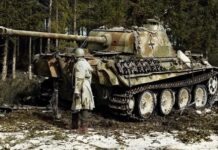
Shulz proved a talkative fellow. He declared that the main effort of the German drive toward the Meuse River between Namur and Liège and that US troops could expect the dropping of a Fallschirmjäger Regiment at a critical time, in Liège, when SS columns were advancing on that city. Approximately seventy tanks, some captured American models as well as German tanks camouflaged to resemble US armor, had the mission, according to Schulz, of exploiting a break-through, moving night, going into the woods during the day while English-speaking soldiers reconnoitered American positions for an attack the following afternoon. While outlining the objectives and the tactic of the Einheit Stielau, Schulz made a startling statement. The prisoner said he had learned from the late SS-Obersturmbannführer Willy Hardieck that at an official meeting in early December, Skorzeny had been given the mission of entering the SHAEF headquarters in Paris to assassinate the Supreme Allied Commander, Gen Dwight D. Eisenhower, and other high ranking officials. Schulz said Skorzeny was to pass-through France with fifty to sixty men, most of them attired in US uniforms. Some, however, would be in German uniforms, pretending to be captured, high-ranking German officers. Schulz named those who would be in the party and said that the group would rendezvous at the Café de la Paix or at the Café de l’Epée in Paris, where collaborators would join them and supply pertinent information.
Skorzeny – A Synopsis
To those who had heard the name Skorzeny before – and by December 1944, everyone in counterintelligence must have – this fantastically bold plan seemed wholly believable. For every war plant destroyed by the resistance groups in France and Denmark, Skorzeny’s saboteurs had destroyed one factory devoted to the production of civilian commodities in those countries. He had engineered the rescue of Mussolini and the kidnapping of Admiral Horthy of Hungary. His success of which there were few and his blunderings of which there were many were all spectacular. The tall scar-faced Austrian had risen quickly among Nazi leaders until, by December 1944, he could bypass SS-Brigadeführer u. Generalmajor der Polizei Walter Friedrich Schellenberger and report only to Reichsführer-SS Heinrich Himmler or SS-Obergruppenführer Heinz Kaltenbrunner, head of the Reich Office of State Security (Reichssicherheitshauptamt – RHSA), Skorzeny was believed capable of any action, no matter how unethical, and counterintelligence experts looked upon the allegations of Leutnant Günther Schulz as highly credible. Schulz information was passed on immediately, with the warning that the assassination party may carry concealed capsules of acid to facilitate interrogation’s escape and that they may be in staff cars, civilian cars, Command and Reconnaissance cars, as well as jeeps.
Paris Dons the CI Cloak
Reports from the front lines to SHAEF Headquarters in Paris traveled fast; probably because reports produced such instantaneous repercussions as the news of an impending attempt on the lives of high Allied military commanders. Forty-three roadblocks were set up to obstruct mobile traffic. Innumerable checkpoints and identity check raids made the civilian population wary and limited their movement to necessities. The alleged meeting-places of the assassins, the Café de la Paix and the Café de l’Epée, were placed under continuous surveillance by CIC Agents. For some time, Lt Col Baldwin B. Smith, who bore a remarkable resemblance to the Supreme Allied Commander, impersonated Gen Eisenhower, riding from the General’s residence in Saint-Germain to SHAEF Headquarters in Paris each morning and returning each evening. From this time on until the reduction of the Bulge, one of CIC’s major worries was that an assassination attempt would be made. There was never any reason to believe that the plan was not an enemy capability, and CIC continued to gather additional information on the plot from captured agents.
Hitlerjugend – Problem Children
With the arrest of line crosser Albrecht Heck and Karl Limburg by 2nd CIC Detachment, also on the fourth day, the problem of Hitlerjugend (Hitler Youth) previously only suspected, became a real one. These youths related much about this fanatical para-military organization of adolescents and pre-adolescents. Both boys were from Butgenbach, members of the Hitlerjugend movement for several years. Through one Walter Dennis, Stammführer of Malmedy for several years, they said they had received instructions to throw nails upon the highway to harass Allied motor traffic; to save small arms ammunition and keep the supplies in hiding until they could attack American soldiers; to gather and forward information about American troops and equipment. Stammführer Dennis, the boys said, gave his orders to the Scharführer in Butgenbach to pass on to certain trusted members of his Schar. Information was to be returned through the same persons if possible.
Counterintelligence investigators wondered whether Dennis received orders from a higher authority? Further, whether he had any system of communication with the Germans and how widespread would be the use of the Hitlerjugend organization. The 2nd CIC Detachment had trapped in its travel control net two youngs and had uncovered the first positive indication that subversive activities are encouraged by the Hitlerjugend, and that the former organizational structure is being employed in part to give leadership to these activities.
The First Army still held the northern flank of the salient, but the German drive through the center of the forest persisted. Civilians from the forward areas were on the roads and in the woods, evacuating the battle zones. As they moved rearward, civilians in that area became apprehensive about the German advance. In Sourbrodt (Belgium), members of the 1st CIC Detachment were 24-hour duty checking identifications of all persons entering the region. Agents attended a conference with Civil Affairs and Military Government representatives, at which the Chief of the Belgian Gendarmerie in the area, Eugène Bourron, reported that several civilians, fearing an advance by the enemy into their local, were preparing to evacuate. Bourton was instructed by CIC to calm down the people and order them to remain. The fears of the civilians were based on the belief that the Germans, remembering the activities of the resistance groups during their retreat in August and September, would impose drastic measures of revenge on the territories they re-conquered. All CIC units remained alert to various types of security threats, turning over petty violators to local authorities.
The Fifth Day – Einheit Stielau Increases Activities
Little changed in the tactical situation on the fifth day except that the VII Corps of the First Army had been regrouped and was capable of counterattacking. At noons, on December 20, however, the First and Ninth Armies came under the control of the British 21st Army Group, headed by Montgomery, and offensive plans were postponed. ADSEC Com Z CIC personnel, whose control line had been disrupted on the first day of the German counteroffensive, had been regrouped, stationed at control points, and assigned to roving patrols. As of noon of December 20, the ADSEC teams in the First Army area had become part of the British 21st Army Group. This did not hamper CIC operations in progress. It worked well for ADSEC for, in addition to forty-five Military Intelligence Interpreter personnel from the Twelfth Army Group, these Agents were permitted control of seven British Field Security Sections.
The main task of the Meuse River Control Line included: screening refugees and permitting none but ‘frontaliers’ (peoples whose home is along the border) to cross the river, halting all civilian traffic crossing the river, with a few vital exceptions; complete checking of identifications of all civilians and military personnel; suspension of ferry and boat service; maintenance of 24-hour security posts by CIC, Military Police, and tactical troops; and questioning suspects and persons of questionable identity at small interrogation centers at each bridge posts.
Twelfth Army Group had received numerous reports by this time of suspicious telephone calls which possibly were made over tapped lines by enemy personnel. As a result, all communication at Liège and Namur was suspended at the request of ADSEC, the Allied Censorship Group, and the SHAEF mission to Belgium. Reports of Fallschirmjäger invasions were investigated with negative results. Guards were doubled at vital installations as a sabotage precaution. Security control of civilians after the beginning of the German push was difficult due to the increasing droves of refugees who had come westward from Luxembourg and Eastern Belgiumw. These refugees were held along the Meuse River line until screened, then sent southward out of the tactical zone to avoid jamming military roads. CIC, together with Military Police and Civil Affairs personnel, handled the situation as it developed. Many persons foreign to the tactical area who were found in these refugees streams, required special interrogation. For example, according to an ADSEC report, displaced Polish nationals arriving at the Civil Affairs Displaced Persons Camps in Namur, were screened by the Namur CIC Detachment. During the screening, three German soldiers and one German national were discovered, arrested, and sent to a prisoner of war enclosure.
In addition to their security control and screening duties at the Meuse River Control Line, ADSEC CIC personnel later operated a travel control line that extended from Huy, on the eastern bank of the Meuse, to Tienen, which guarded the approach to Brussels, the Belgian capital, and Antwerp, the seaport. This travel control line was approximately perpendicular to the Meuse River at the middle of the Namur-Liège baseline. CIC supervised Belgian police and Military Police who were making identity spot checks on the highways, in cafes, and in hotels. This travel control line added several miles to the depth of the Meuse River Control Line.
Thank you for this incredible information! My uncle served with the 99th Infantry Division CIC Detachment, and even though his name isn’t mentioned in the recounting of the events in your article (“Some Detachments Overrun”), you provided more information about this event involving the 99th CIC than I had discovered previously (a document called, “The Role of Counterintelligence in the European Theater of Operations during World War II” by Major William B. Dallas). In that document, he only gave the names of the two soldiers who were killed. I wanted to ask if there was any chance your records gave the names of the unnamed 4 agents who went ahead with the scout and got separated from the 4 who were all named? I imagine you would have included everything you had, but I wanted to check just to make sure. Either way, thank you for making this kind of hard to locate information available to family researchers like myself! It’s invaluable.
Hello
I have deployed all I have found on this but with time I might found something else …
I don’t know
Gunter