



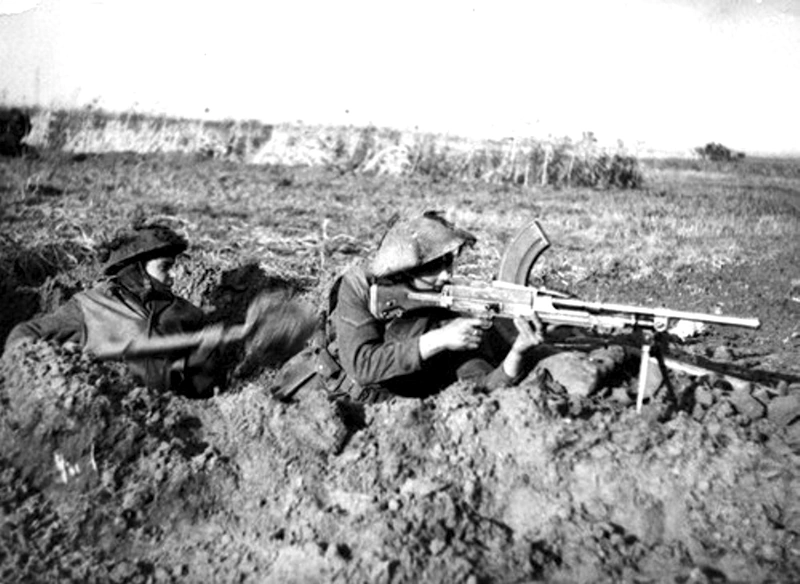
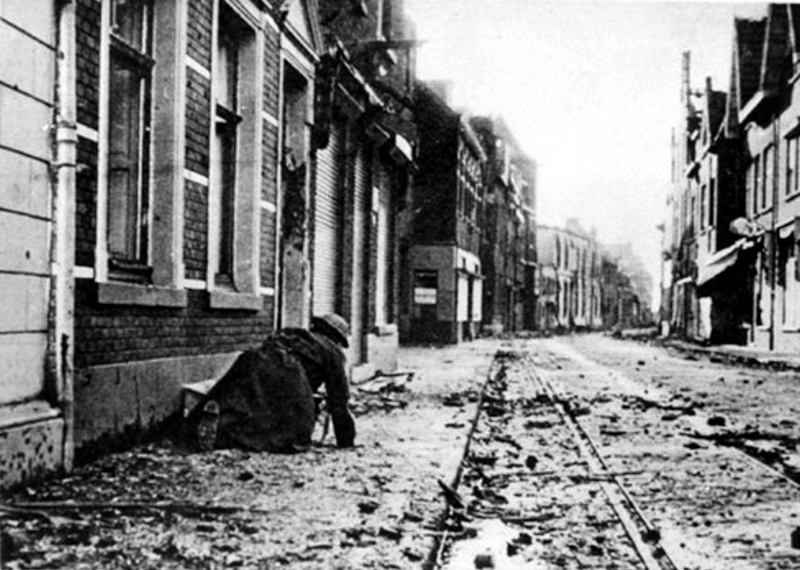
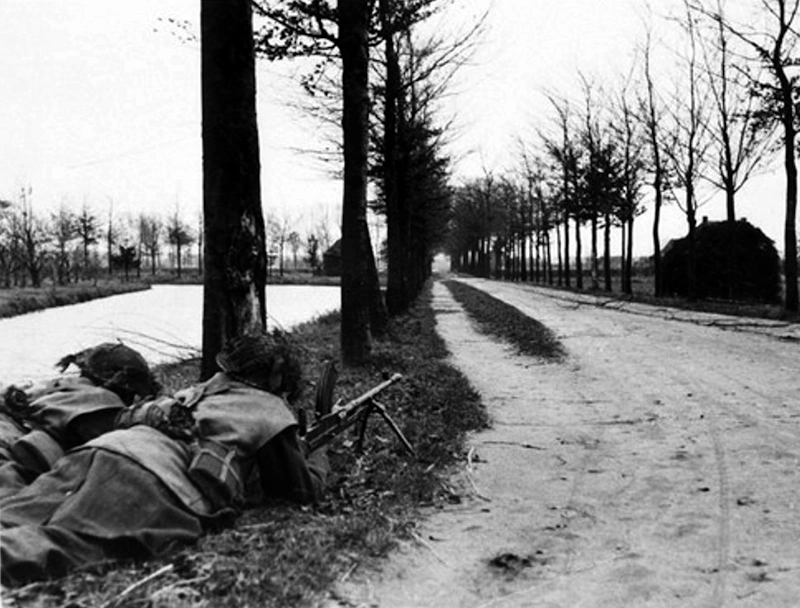
The defense actions in the Venlo bridgehead, September 25 – November 6, 1944
 With the panzergrenadier battalion, the brigade took positions in the line St Anthonis-Oploo. The panzer abteilung and the panzer pioneer company screened the preparations of the other units of Kampfgruppe Walther on both sides of the road and railroad line through Boxmer to the southeast, as well as along the swamp belt south of Oploo to the west of Twist. Within the following defense battles it would have been necessary to deploy the brigade as mobile combat reserve under the command of the leader of Kampfgruppe Walther or the commanding general of the LXXXVI.A.K, according to its organisation, weapons and type of unit. But the infantry elements of the brigade were deployed in the Main Line of Resistance (Hauptkampflinie) with the panzergrenadier battalion in the line on both sides of the road Oploo-Overloon, the panzer pioneer company on the left wing at the border to 180.Infantry-Division. Small groups of tanks or assault guns were taken from the panzer abteilung and used as local reserves for the battalions in the MLR. The rest of the panzer abteilung was a reserve for the commander of Kampfgruppe Walther positioned in the deep rear, at first around Overloon then east of Venray and later most likely in the area Meerlo, the latter the position of the HQ of Kampfgruppe.
The brigade commander supported the commander of the Kampfgruppe as the tank and anti-tank leader of the sector; he supplied and supported the units of the brigade. This kind of command structure was not very satisfying for the troops, but the infantry and artillery weakness of the Kampfgruppe compared to the size of the sector made this necessary. For the actions of the brigade until October 15, then around Venray on October 16-19, and later on, there are no documents available other than the reports about the actions of Kampfgruppe Walther renamed later Kampfgruppe Goltzsch and from October 16, Kampfgruppe 344.Infantry-Division. On October 15, the commander of the brigade Maj v.Maltzahn was ordered away for disposal. It was not possible to find out who replaced him. On October 20, the brigade was subordinated to 7.Fallschirmjäger-Division commanded by Gen Erdmann who took command of the northern sector of the bridgehead. The brigade stayed in action within the narrowing bridgehead until early November, within the 7.Fallschirmjäger-Division and probably with elements within the command of the 180.Infantry-Division on the left. According to an entry in the KTB OB West, in the evening report from October 18, elements of the brigade were isolated in Veulen after a counter attack.
On November 6, according to a Army Operations Staff (Wehrmachtführungsstab), the order of November 3, requested that the brigade was withdrawn from the frontline. It was not possible to find information about the losses and status of the brigade after 7 weeks continuous combat action. In May 1954 Major Maltzahn could only remember the fact that the brigade lost 50% from its officers and 10% of NCO´s and men in the period between September 19 to 29. The HQ and the units were incorporated into the 25.Panzergrenadier-Division which was newly reformed in Grafenwöhr (Germany) and transferred to the Training Ground Baumholder (Truppenübungsplatz Baumholder) at the disposal of OB West.
With the incorporation into the 25.Panzergrenadier-Division, Panzer Brigade 107 ceased to exist. Despite the short training and deployment time and the usual problems of late-war German units the brigade distinguished itself in combat. The report of Maj Maltzahn from May 1954 shows following numbers of enemy equipment captured or destroyed for the time period. September 19 – November 12, 1944: 63 tanks, reconnaissance vehicles, assault guns; 16 aircrafts and gliders; 37 vehicles and guns. The actions against Son and the attack on Veghel within Kampfgruppe Walther were caused by decisions of higher commands with the purpose to destroy the air-landed enemy forces by cutting off the supply routes of the British 2nd Army via Eindhoven, Nijmegen and Eindhoven. Although the actions of the brigade were not fully successful, it participated to bring the allied forces into critical situations at Son and Veghel. In the Veghel bridgehead the brigade had great influence on the tough resistance against superior enemy forces.
Friedrich Sixt
Generalleutnant
Additional Sources
Report of Major Berndt-Joachim Freiherr. V. Maltzahn, Ellerbruch (Niederelbe), May 1954
The Battles of Kampfgruppe Walther, later Kampfgruppe Goltzsch (KG 344.Infantry-Division) Sep to Nov 1944
Generaloberst Kurt Student, Arnheim, Der Deutsche Fallschirmjäger, 1953
War Diary for Oberkommando West for September and October 1944