




 This is the first easily researched evidence that something extraordinary was taking place. The secondary recovery was just starting on the B-24 crash site when the only remains collected to represent the three men’s official graves were already on their way to Belgium.
To this day, Sgt Bartho’s official remains are buried in the American World War Two Henri-Chapelle Cemetery. In that grave, is a mixture of three men’s remains consisting of what was about to look like a human body by weight picked up from the pile of bloody flesh collected so far on that day. The exact same way was also adopted for the Grey and Mear families who had the remains of their loved ones returned for burial in the United States in 1948.
We do not know who the base hospital commander was. However, the author after searching for some time located a Graves Registration member who was stationed at Lille (France). Their small unit was there to recover the dead who were returned to the air bases in the area and also when there was a large number of long-term recovery hospitals in the area. They made weekly trips to all the hospitals to recover remains and to transfer them to the only American temporary cemetery that was open at that time, which the author has visited and found. This cemetery was located twelve air miles from the Hattonville crash site. The hospital at St Quentin was located, roughly one hundred and forty miles to the north of the Limey Cemetery.
What most of these people do not know was that American medics were not allowed to discard any human remains other than covered by regulations. If a hospital removed any piece of a patient, that piece had to be placed in a proper container and held until it could be turned over to the local Graves Registration personnel to be then taken to an American temporary cemetery where they were interned in special graves that contained all such items. Unlike the French, the German, and the British military, who would dig a hole outside their tents and bury severed arms, legs, fingers, or even ears.
When questioned about how often they made their circuits to collect remains, the author was told that in the area if a hospital or unit called in and reported the death they would make a special trip to recover and forward the remains. When they did that they would also forward all the other collected parts and pieces.
When asked how long it would take for remains from the unit at Lille (France) to be buried at the Limey Cemetery, the answer was that it took usually a couple of days but never more than three. They had delivered remains several times and remains recovered one day would normally be buried in the afternoon of the third day.
This may read as unimportant information, however, as the days add up you will begin to see a serious pattern of many military people breaking a host of military regulations including creating two applications for the Congressional Medal of Honor (Gott & Metzger) which from the required ‘eye witness’ officer all the approving signors all the way up the military chain of command had to know. One has to remember that Gen Eisenhower owed his position to Gen Marshall and do you really think that Ike would send something like a falsified Medal of Honor application up the line for him to approve without Marshall knowing the truth?
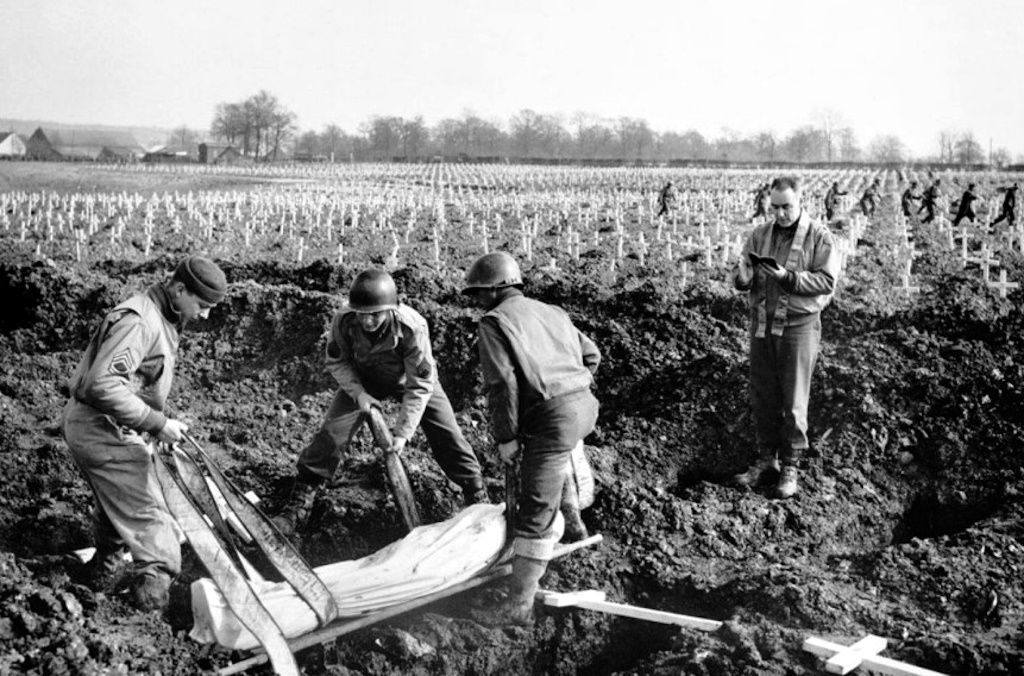
After the second recovery ambulance arrived at the B-24 crash site, the officer saw the large area involved and the large number of adult men and boys standing around observing their feeble attempt to collect remains and decided there was an easy way. A Frenchman came over and was talking in English to the officer when the officer asked him to call the men and boys to come to the ambulance. When they gathered, the officer told the Frenchman to tell them to form a line from the bottom of the crater and extend it until they had reached the edge of the crash site. The line formed from the crater to the southeast and included about 150 men and boys. Then, he asked them to begin to slowly walk counter-clockwise and to study the ground as they walked and pick up any human remains any papers or uniform pieces they might find and bring them to the ambulance to be inspected.
As the Frenchmen began the walk, the officer and two medics picked up an articulated door that was lying nearby. It was one of the bomb bay doors and as the searchers brought bits and pieces of remains and other relics the officer inspected the find and had the medics place remains on the door and stack the rest nearby. In this line, were Bernard and Claude Leguillier from the village of Driencourt located over the hill to the north. They had been woken by the sound of the dive and explosions and as soon as it was light enough. Madame Leguillier told the boys to go ahead and find out what happened. Both were walking with the line and both had found a couple of bits of human remains and made the run to the ambulance.
While doing this, Bernard saw something that he could visualize for the rest of his life. He picked it up and ran to the ambulance. When it was his turn, he held it up with both hands for the officer to see exactly what he had picked up. It was the partial face of a man that looked a lot like the masks the women wore to dances. It began where the lips met went up around the left eye across the temple and back down around the right eye to meet the upper lip. The eyebrows were there, the eyelids were there and even the nose was there. It was as if the face had been cut off the skull by a butcher. The officer reached for the find and pointed back to the line and Bernard rejoined the search.
As reported by several French people and Silva, a staff car drove up and two Colonels got out. Silva recognized one as his base commander the other one was unknown to him and he sure looked very young to be a Colonel. They stood and watched the search which was almost completed, walked down to look at the larger parts of the bomber. One was a nose wheel assembly then came back just as the search ended. The officer told the Frenchman to thank them for all their help and that the actual crash site would be guarded for a while before it would be returned to the farmer’s use.
The Colonels and the recovery officer went to the side and before he left their officer told them to pick up the door with its large collection of human remains and put it inside their ambulance. They asked a couple of the Frenchmen to help them lift the bomber door into the ambulance and when done closed the doors. There can be no doubt that these enlisted men knew the regulations concerning American dead and German dead as far as that goes. They thanked the Frenchman again and the one who could speak English told them what they had collected looked like what they did when a pig was butchered. After a short wait, their officer told the driver and medic to load up and they were leaving.
Later, as they approached the main road which would take them to the St Quentin main hospital the officer told the driver to forget going there and drive across the crossroads and head back toward the base. They passed through Tincourt-Boucly, which is a hyphenated name as Tincourt is the main village with the small village of Boucly attached to the south. They were waved at by the families who had taken in the men who had bailed out hours earlier. Right after they topped a small rise in the road and arrived at a spot that could not be observed from the nearby villages. At this point, the driver was asked to stop.
Walking through the woods a few hundred feet to the north of the road a Frenchman who had helped recover the remains was taking a shortcut to intercept the road and follow it to Cartigny. He was the night fireman at the sugar factory and helped one of the men who had bailed out of the crashed Bomber. He first thought they had stopped to go to the toilet especially after one of the men he recognized got a shovel off the side of the ambulance that was facing him. He was hidden from their view by the brush and trees and he decided to wait to see what they were going to do. He stood there for some time, as he could not see the men as the ambulance was blocking his view. He was on his way home to go to sleep, but the activities of the day so far had him wide awake and he was not in a hurry.
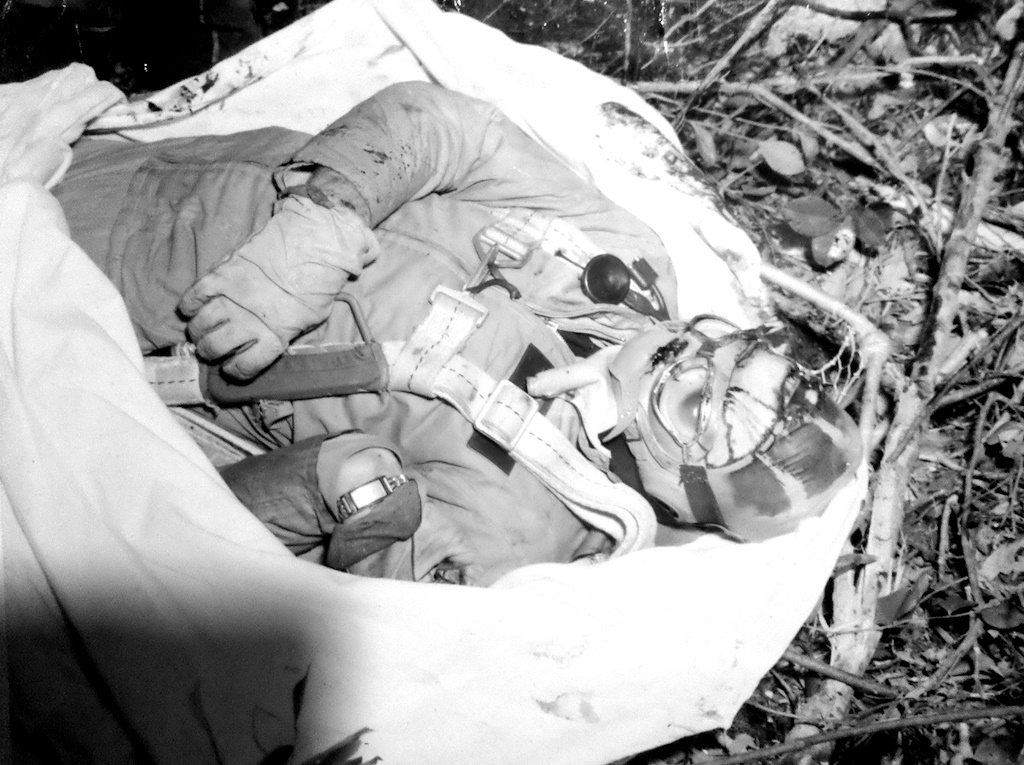
After a while, the men came into view. They opened the back doors of the ambulance and removed the bomber door that held the human remains. It was heavy and they were struggling as they went out of sight. After some minutes one of them closed the door, put the shovel back in place and got into the ambulance. It soon disappeared over the rise ahead which blocked the view of the closest village from seeing the ambulance stop.
After they were out of sight, the Frenchman left the woods, climbed the fences and went to the location where they had stopped. There he found, exactly what he thought he would find. The dirt in the freshly plowed field had been dug out and then replaced with a small mound of the shoveled dirt rising above the rest of the dirt. He walked to the edge of the dug area and began kicking some dirt aside. Again, he found what he thought he would. The Americans had dug a shallow hole dumped the recovered remains in the hole and covered it back up. They had taken the effort to blend their digging as much as they could and they had left no marker to show the location of the grave.
With the fall rains, the Frenchman knew in a day or two unless you knew the exact location, you would not be able to tell where the hidden grave was located. He started his walk back to Cartigny and while walking he remembered his father a World War One veteran telling him about all these soldiers who went to war and were never accounted for. All the families knew that their son was left, that he was in the Army and what he might have written in his last letter. The French government never accounted for over half a million dead and so he realized his father’s description of what the French had done seemed to be followed by the Americans and they were hiding their war dead. He went home, had dreams about that day and the hidden grave got up and November 10, 1944, ended as he was tending the fires at the sugar factory.
Back to the B-17G Lady Jeannette
As of midnight, November 10, 1944, the crashed B-17G #42-97904 (729-BS, 452-BG), consisted of four large pieces lying in the woods of Hattonville, France. One hundred and thirty-eight miles to the northwest is a large hole surrounded by a debris field. Created by the American top secret B-24J #42-51226. The hole and its debris field is all that remained of the Top Secret airplane and its top secret cargo of over 8000 pounds of the Allies most top secret electronic radar, radio and telephone jamming equipment. The B-24J, belonged to the three airplanes attached to the top secret 100th Group or the Royal Air Force.
At the Lady Jeanette crash site, several members of the 563-SAW Battalion’s headquarters detachment were sharing a night guard shift. They had to maintain a perimeter to prevent any French citizens from entering the area of the crash site. There, next to a fire, lying on a canvas covered by another canvas were the two bodies of the pilots, Lt Donald J. Gott and Lt William E. Metzger Jr. Both men had died from blunt force injuries to their faces as the trees of the woods had broken into their cockpit during the lowering of the bomber into the oak forest. Their two complete bodies had been removed from their cockpit with the help of two Frenchmen who were the first to arrive at the crash site.
Next to the two pilots, was the complete body of T/Sgt Robert A. Dunlap, their radio operator, who had been wounded and was lying on the deck of his radio compartment when the B-17 began to strike the trees and when about 450 feet into its journey into the woods both wings sheared off and the tail broke off taking the rear bulkhead of the radio compartment with it. At that time, the B-17 forward fuselage was still moving forward and about 15 feet above the ground. One hundred twenty-seven feet from where the broken-off bulkhead and tail came to rest the nose turret dug into the earth causing a pile of earth to be pushed up in front of the still-moving nose. When it had grown to the required height, the nose swiveled 90 degrees to the west, the broken rear end of the fuselage coming to a rest a few feet to the west.

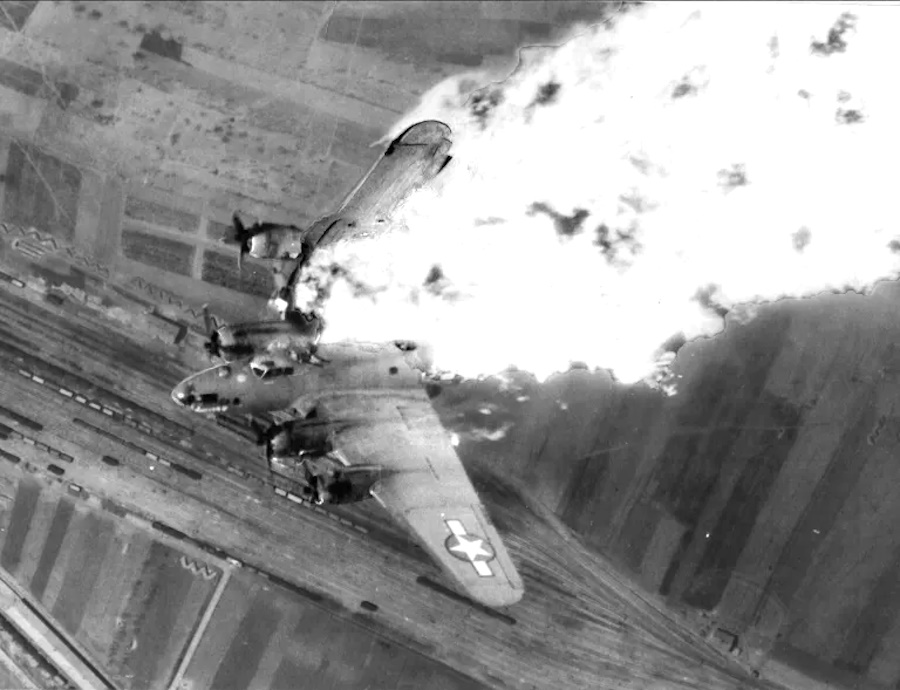
Midway from where the tail broke off and where the nose struck the earth, the unconscious body of the radio operator fell out of his radio compartment and came to a rest. When the wings broke off, the left flew over and alongside the forward fuselage for some distance. When it came to a stop leaning against a tree, its fuel cells broke open and the fuel atomized and spread across part of the crash site including the location where the unconscious radio operator lay in a deep thicket of blackberry bushes. The #3 engine that had been mounted on the left wing was extremely hot and smoking, this ignited the atomized fuel and the whooshing explosion of the fuel was heard by witnesses for some distance.
Though, the radio operator might have died before the crash, based on the French eyewitnesses, his body and flight uniform were lightly signed and they thought the flash fire had killed him. The guards were also very aware of the partial remains of a fourth crewman lying under the covering canvas, where for part of November 9, a duffle bag also occupied part of the space. The fourth dead crewman was the tail gunner S/Sgt Herman B. Krimminger. He had accidentally opened his parachute inside the B-17 just before the bailout order was given. His parachute had blown out of the rear waist hatch and went over the tail.
Krimminger had been pulled out of the hands of two of the survivors and as he was pulled out his body dropped down below the tail where it was held by the parachute shroud lines and the open parachute canopy above the tail. When the B-17 began to lower into the forest due to its slowing speed his body was lower and it was first to begin to strike the tree limbs of the oak forest. Krimminger still had his combat helmet strapped under his chin when he was pulled out. About 200 feet from where his body had to have begun striking the trees, the author found one of the ear flaps that fit over his earphones. The flap had been folded up into a clam-shell shape and basically indicated Krimminger had died at or before that location along the debris trail.
 The guards were used to walking a perimeter, however, an assigned duty that night was to walk along the debris trail leading to the crash site frequently. While completing that circuit, they were to carry a flashlight and continually swing it out into the trees to look for shiny eyes belonging to the foxes, ferrets, badgers and even large wild boars. In the immediate surroundings of the crash site they may not have observed the mud hole and realized that it was a boar wallow. At the same time, they were to loudly talk to themselves sing or just holler.
As it turned dark and the medics had completed the recovery of the remains and added to the pile of torn-apart human remains alongside the three bodies lying on the canvas near the fire which was another added task that night, the military police attachment officer had come out and gave them their orders including the constant walking of the debris trail. Not only was it their job to keep the French away it was also their job to ensure none of the wild animals who were attracted to the crash site by the smell of the torn-apart man and the three complete bodies. Several times during the night, as the two walked the debris trail, one would tell his story of seeing eyes and watching them move.
As November 9, 1944, turned into November 10, an Eisenhower Headquarters staff car arrived. They were told by a young Colonel who got out of the car to take good care of his driver. The Sergeant of the Guard, then took the Colonel to the mayor’s home where the Battalion Commander, Lt Col William L. McBride, the Executive Officer, Maj Maurice E. Byrne, the Medical Doctor Venar, attached to the battalion were living.


We know, from the French that the Mayor and his wife had been asked to stay with one of their children that night to make sure the expected visitor could use their bedroom. As all of what happened was beyond top secret as far as Eisenhower was concerned, there is no documentation that supports what was being done. There is documentation the author has found that proves the official records of involved units had been modified after the fact and that the Battalion cooks had requested extra rations to replace rations eaten by two men who do not show up on any manning document where even transit personnel staying with the battalion, by regulation, were to be documented.
We know also they had talked for some time when the Sergeant of the Guard was called to the Mayor’s home, met at the door by the Battalion Executive Officer, and given a set of instructions to be followed in the morning. Before the November daylight arrived the enlisted Medics, Boatman, Bernardi, and the ambulance driver Zeman who had been jarred out of their bunks by the Sergeant of the Guard, arrived early for breakfast and to pick up the drinks and food on the list the Sergeant of the Guard had given to the mess Sergeant.
As daylight broke, they arrived at the edge of the woods, carried the order to the fire area, and very quickly a Colonel no one knew, their Battalion Commander, their Battalion Executive Officer and the Doctor walked up to the fire and one of the guards broke out their food order. As they were eating and discussing the crash site, Venar told the medics to pick up their recovery gloves and buckets and start their final recovery of the torn-apart men’s remains. As they walked off to the debris trail, the officers began touring the site.
The first thing they did, was to lift the canvas cover and show the Colonel the three complete bodies and what had been collected of the torn-apart man. Then, they walked around the site and part way down the debris trail where they observed the trouble the three medics were having searching through the broken limbs and airplane pieces spread along the debris trail. On the way back, they were observed climbing on a berm located just to the east of the crash site. Such berms dated back hundreds of years, as they were created to provide a border. In this case, the berm was the boundary between the woods that belonged to Hattonville and the National Forest to the east of the berm.
The officers took their time during their tour and several times they often walked further into the forest and then returned to the site. When they had finished their circuit, they walked back out to the edge of the woods and walked out and surveyed the large group of fields where Harms, Harland and Gustafson had landed. When they had accomplished this, they were gathered together around the fire when Boatman came up and reported that he thought they had recovered as much of the man’s remains as they could.
The group stepped over to the canvas-covered remains, Boatman lifted the cover and they looked at the collected remains. Venar took a second look and told Boatman that he only saw one leg to which Boatman replied they had looked up in the trees and doubly along the debris trail and he thought one of the wild animals had been missed by the night guards and had taken the remains. With that, Venar told Boatmen and Zeman to go to the ambulance and bring three sets of remains burial packages.
When they got back, the three officers were near the end of the broken fuselage where the nose had dug an area of dirt down into the forest floor. They stood there for a while and when they came back. The Battalion Commander told the Colonel and Venar that he was going back to their HQ to be able to personally take the calls coming in from various higher commands. As the Battalion Commander was walking away, Byrne told the guard commander that they were to immediately move out far enough to where they could not see the crash site to ensure any French were kept away from the preparation of the dead.
When this was done and checked by Byrne, he came back and gave the medics the verbal formal order to never discuss what had happened at the crash site with anyone and if they did even after going back to civilian life they would be subject to death as that is how important what they had to do to the United States military.
The Colonel told them that what they were about to do would be something that would bother them for the rest of their lives. However, no matter how much it bothered them, or if they were ever questioned about this crash site they were to tell the person, ‘I have no memory and any B-17 crash while I was stationed in Hattonville‘. He reminded them of what Byrne had told them and began telling the medics what they had to do.
First, they were to help Venar create four burial packages. They would do this by dividing the remains of the torn-apart man into four equal amounts which were to arrive at the Limey Cemetery later that day. Then, the hardest part would be completed.
Second, they were going to help hide the complete bodies that had been recovered by burying them at the crash site in such a way that the French who came to the site after the guards left would not realize what had been done. He told them that they could depend on himself and Gen Eisenhower to protect them in the future if what they were about to do was ever revealed to the American public. He also said to ensure they were not alone as he had some time left before he had to go to his next appointment he was going to start digging the grave where the bodies would be placed.
As the first recovery team did at the B-24J crash site, they laid out four blanket sets. When they were done, the Colonel and Venar dropped the surprise. As the torn-apart man had not been in the fire area to properly prepare the four Official Graves of the four dead crewmen, most of the remains had to be placed over the fire and singed and burnt, as if the B-17 and the four men had blown up in a diving crash.
Venar told the men to go cut themselves a stick, to hold the pieces of the man over the fire. When they started to meet that order the Colonel joined them again telling them his action could be considered an insurance that no matter what the future brought, they would be protected, as what they were doing, they were doing under distress and under his direct verbal order.
When they were done and Venar was completing the official documents, he was adding the personal items that had been found for each man. He had three sets of ID tags for the three complete bodies that were not going to be in their official grave and only one ID tag had been found in the debris of the trail. As he began to place the articles in each ditty bag Boatman approached and asked Venar if the bodies had been torn apart and burnt, as the remains were when they completed their task.
The personal items of each of the men must also show fire damage. Both, McBride and Venar agreed and soon they were placing the ID tags, coins, and the bracelet that Metzger had on his right arm that had been badly bent when one of the limbs slammed through the cockpit and pushed his arm and bracelet into Metzger’s skull. After a few minutes, Boatman retrieved the items, missing a couple of blackened coins and Venar placed the items in the ditty bags and tied the ID tags to the ditty bag with the drawstring.
Then, all five men finished digging the hidden grave and carrying the complete bodies they placed them side by side in the hidden grave. McBride spoke some words and the bodies were covered up with the covering being blended into the dirt that had been disturbed by the B-17 chin turret during the crash. When they were done, the men rechecked the site for anything that had to disappear then McBride called the guards back in and told them that their duty would end when the day ended.
They carried the three small official burial packages back to the ambulance. The officers got in a parked jeep and headed back as Zeman and the medics headed for the village where Zeman would later take the dead to the Limey Cemetery. When they arrived back, the Colonel was gone and things were returning to normal. When questioned about the crash site by other members of the unit, they were told everything had been taken care of and they did not want to talk about it.
Later that afternoon, Zeman arrived at the Limey Temporary Cemetery where the Graves Registration men removed the burial packages and placed them on individual tables. An old service sergeant went through the documents and suddenly stopped and asked why the one burial package had only one ID tag. Zeman asked what difference it made. The Graves Registration men had to account for both ID tags before the dead could be properly identified. If Zeman was not able to account for the Krimminer’s missing ID tag, he would have to go back and tell Venar and he knew they would be back out at the site searching for that tag. So, he told the sergeant that he had seen two ID tags for each man in the possession of their Battalion Doctor who had completed and one ID tag was gone. The doctor must have kept it. The old sergeant told Zeman to go ahead and then he wrote an entry on Krimminger’s official Burial Record that the Graves Registration officer of the 563rd SAW Battalion had kept one of Krimminger’s ID Tag. Without this entry, the author would never have broken the wall he had reached concerning the identity of the unit that recovered the dead from the Hattonville crash site! Zeman returned to the HQ and reported to McBride and Venar that he had accomplished the delivery and that basically ended November 11, 1944, except for the men and civilians who were still talking about the bomber.