


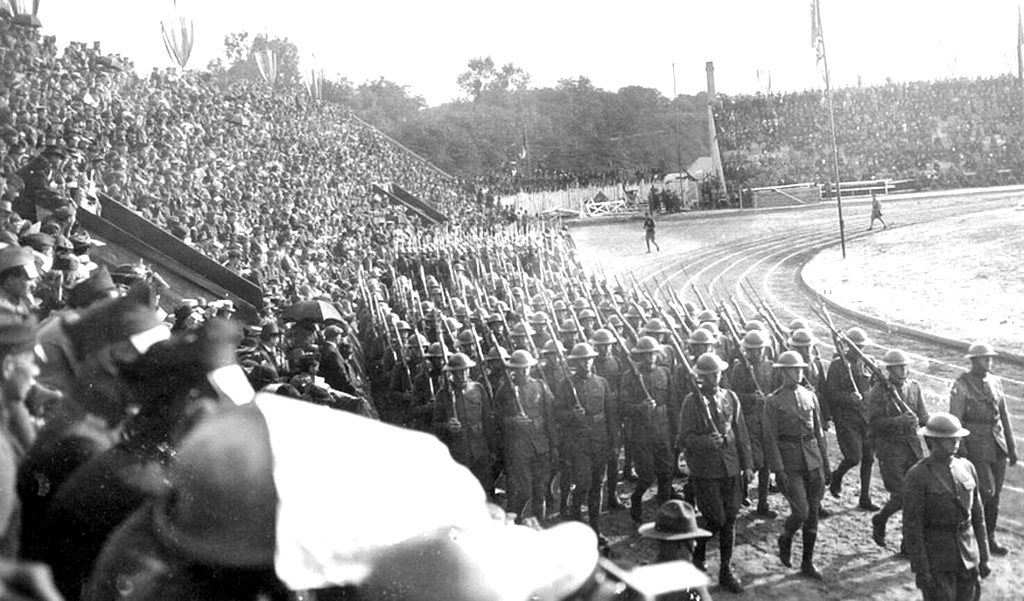
July 2 (Wednesday). This was the day for the Military Jumping. Chamberlain was the first – he made the ride on Nigra – a very pretty exhibition over the 15 jumps – with very few faults. He was followed by Col Soutzo, the Roumanians Merchant’s horse frightened when the crowd cheered, ran off to one side and so ran over the time limit of 3 3/4 minutes. Commandant de Soras won first place on an old gray that had had 1ong experience in the horse show game. The French team took first place, ours second and the Italians third. Chamberlain tied with Commandant Morel of the Belgians for the second individual prize. Gen Blackbellair was very complimentary of the work of our men – said it was the kind of riding that was best suited for all purposes. Vatel was up from Saumur for the day – he is now a major and Écuyer-en-chef at Saumur. Soccer football is intensely interesting to watch – more so than our own game.
July 3 (Thursday). The jumping în pairs today resulted in the Italians taking First and third places, and the French second. The stadium is packed
every day now.
July 4 (Friday). I attended the Chamber of Commerce luncheon at the Hotel du Quai d’Orsay. Marshal Foch and Gen Pershing were the guests of honor. Lord Derby, of the British cabinet, Tardieu the French High Commissioner to the US, Gene Reed, Eph. Peyton, Mr. Veit, about 500 in all. Mr. Walter Berry, President of the American Chamber of Commerce, made a good address in French, Tardieu spoke – Gen Pershing made the speech of the day and was enthusiastically received. He recited what the American Army had done. The audience was enthusiastic and gave him a great ovation when he sat down. Then they all called for Marshal Foch and he spoke briefly, complimenting the American Army. I spoke to Gen Weygand, Foch’s Chief of Staff, who was at Saumur as a captain and instructor when I was there. He remembered me and spoke of my having had typhoid – said he was very glad I had spoken to him. Tonight, the 4th of July was celebrated at the Stadium with Fireworks, music, and gymnastics by the Yugo-Slavs. The Arabs gave a great exhibition on their beautiful horses, chasing each other around the Stadium, throwing light wooden spears at each other, and firing their carbines while riding at a full gallop. But the real celebration came after dark, when the band marched in, followed by seven beautiful floats, representing Victory, France, Paris, Italy, Belgium, Great Britain and finally the US, with Uncle Sam perched up on the top. Half a dozen dark soldiers marched beside each float and kept it brilliantly illuminated with bright torches.
July 5 (Saturday). This was the day for the individual jumping championship. The Italians led again with their fine horses and their excellent riding. Maj Ubertalli took first and third places on two of his horses. We were all very glad to see Maj Jacob of the Rumanian team take the second prize on his dark bay. In my opinion, he is the best horseman here – a graduate of the Italian Cavalry School, now Chief Instructor at the Rumanian Cavalry School. He would have won a place in the Military Jumping on Monday if he had not made a mistake in the course and failed to take four of the jumps. There was nearly an international complication when the Italians threatened to withdraw from the contest unless the lath strips were put on the obstacles to indicate tips – Col Richmond ruled against them and there was a tense moment. Then Capt Amalfi clapped his heels together, saluted, and announced very dramatically that ‘for the Americans’ they would yield and would continue in the competition. The day was saved.
July 6 (Sunday). Gen Pershing presented the medals and trophies at the Stadium this afternoon. I was detailed to march in the Second Group, comprising the winners in the Riding, Fencing, Rifle, and Pistol Shooting. All were dressed in the uniform in which they had contested. I succeeded in marshaling all the riders, but the fencers and shooters were shy of many of the foreign representatives. In 1430, the band marched in, then the composite regiment commanded by Conrad Babcock, then the various groups of Winners. It was supposed to be a military formation, but as such, was a good deal of a joke. We got them safely in and lined up in front of the platform, then each, in turn, went up and received his medal, then the team captains returned to take the trophies. Many of the latter were beauties. The French Riding Team which was first in the Military Championship received a silver cup presented by Albert 1er, the King of the Belgians. Among the Americans is a black soldier, Sol Butler, who won the broad jump. The King of Montenegro Nicholas happened to be at the Stadium that afternoon, 50 the winners for the day were called up before him to receive a Montenegran decoration. Someone asked Butler afterward what his decoration meant. Oh, that was given to me by the King of the Mountain Niggers.

Tonight I was a guest at a dinner given by the Rumanians. Gen Galvanescu presided, Sandy MacNab, Jr. was on his right, I on his left, Dave Goodrich, Lt Carroll who was in the 5th Pursuit Group of the 24 Army Air Service, Harries (son of the General), and several other Americans, Col Soutzo, (a Rumanian prince, the one who fell at the first jump on Monday), Maj Jacob, the best rider here, and many others. The Rumanians are very cordial and very friendly to the Americans.
July 7 (Monday). Started demolishing the stables and breaking them up today. This evening Richmond and I were the guests of the Italian Team at dinner.
July 8 (Tuesday). Maj Ubertalli, Maj Caffarati of the Italian Team, and Maj Jacob, the Rumanian, lunched with me at Fort Champigny. The Belgian Team got away yesterday, the American horses today, and some of the officers.
Jule 9 (Wednesday). Dined at Father’s with the Janets this evening.
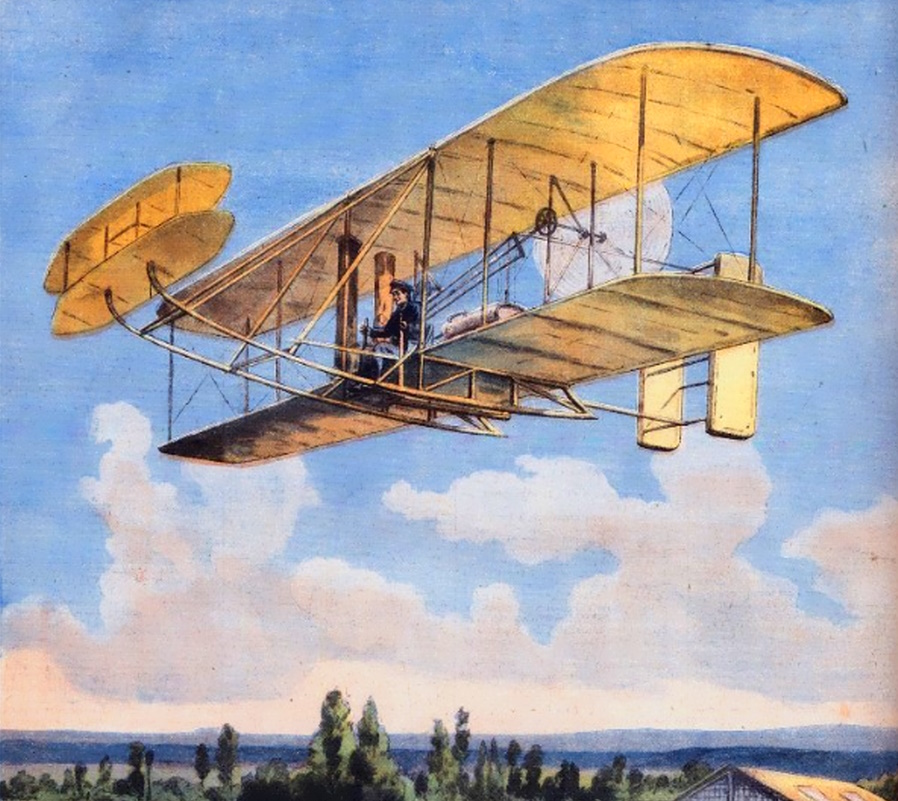
July 12 (Saturday). Left in a Cadillac at 0730 arriving at the target range at Le Mans just after noon. This is the ground on which Wilbur Wright flew in 1908, I rode into Le Mans (6 miles) and found Clara Bowen at her General Officers Club which she has been in charge of for the past 4 months, at the 41 Avenue Leon Bolleé. She took me to call on Mme Bolleé but she was in Paris. Then we rode up on the hill to old Le Mans, left the machine, and wandered thru the quaint little narrow crooked streets till we found the 14 Rue de Vaux, and M. Hervé, the painter. His house was built in the 16th century – his studio looks out over the Sarthe and its valley. He has a very good oil painting of Wilbur Wright which he did in 1908 when Wilbur was flying here. I suggested buying Wilbur’s portrait but he wanted 2000 francs more than I had with me! Found Jack Keyes at the range when I got back. Later, my father purchased the picture and presented it to the Smithsonian to be placed in a projected National Air Museum.
July 13 (Sunday).Found Frank when I came to the apartment this morning. Louise Kimball dined with us tonight after which we walked up the Champs-Elysées. The decorations were having their finishing touches – the lights were partly on. At the Arc de Triomphe the crowd was already so great that mounted Garde Republicaine and dragoons were on duty – a large catafalque stood under it, with the watch-fires burning in honor of the dead. A Caquot (captive balloon) rose from the Tuileries with a full moon behind it. People have already lined up as many as six deeps on the sides of the Avenue, where they will spend the night so as to have places for the review at 0830 tomorrow. The trees were full too, and it is chilly tonight.
July 14 (Monday). Father and I were up at 0630 and after much difficulty succeeded in making our way thru various barriers, and the crowds, to the other side of the Place de la Concorde, finally reaching the Hotel Elysée. The palace where we had tickets and found good viewpoints was in the windows on the 4th floor, with the Foreign Service Committee of the Aero Club of America, including Dr. and Mrs. Jones. Col Hull is in charge of the build-in – the windows were filled with officers and their friends. At 0840 with a combined band, and mounted Republican Guard leading, Marshals Joffre and Foch rode down the Avenue, after passing under the Arc de Triomphe. The crowd went wild. Then came the Americans, Gen Pershing leading and looking very pleased and happy. Behind him were perhaps 30 of our major generals and brigadier generals, Frank Parker one of them. Conrad Babcock followed with a battalion of his composite regiment – none marched quite as well as they did. The colors of all our regiments were there, Marshal Haig led the British who looked very fine and impressive, particularly their naval band and troops. Then there were all nations – the Japs represented by officers only. The Czech-Slavs looked well, as did the Servians – also the Italians.
Last were the French, by Corps with their leading generals, Mangin, Gouraud the popular one-armed general, Gérard, and dozens of others. One company presented each Corps, but with the coïors of all the regiments. Then came the African troops, including the Arabs with their long flowing robes – all mounted of course. It took 2 hours to pass, President Poincaré and Clemenceau 1eaving the reviewing stand and riding by at the end of the review. There was never before and never will be again such a sight – so many different nations, so many great generals, so great an occasion.
July 17 (Thursday). The Roumanians left today and this afternoon the last officers and men left Fort de Champigny which I turned over to the French sergeant caretaker.
July 19 (Saturday). Phoned Van Vorhis at Brest today and he gave me a reservation on the Leviathan sailing on July 30. No reservations for Capts or Lts who have to go steerage!! So, Oldys and Graves are probably out of luck.

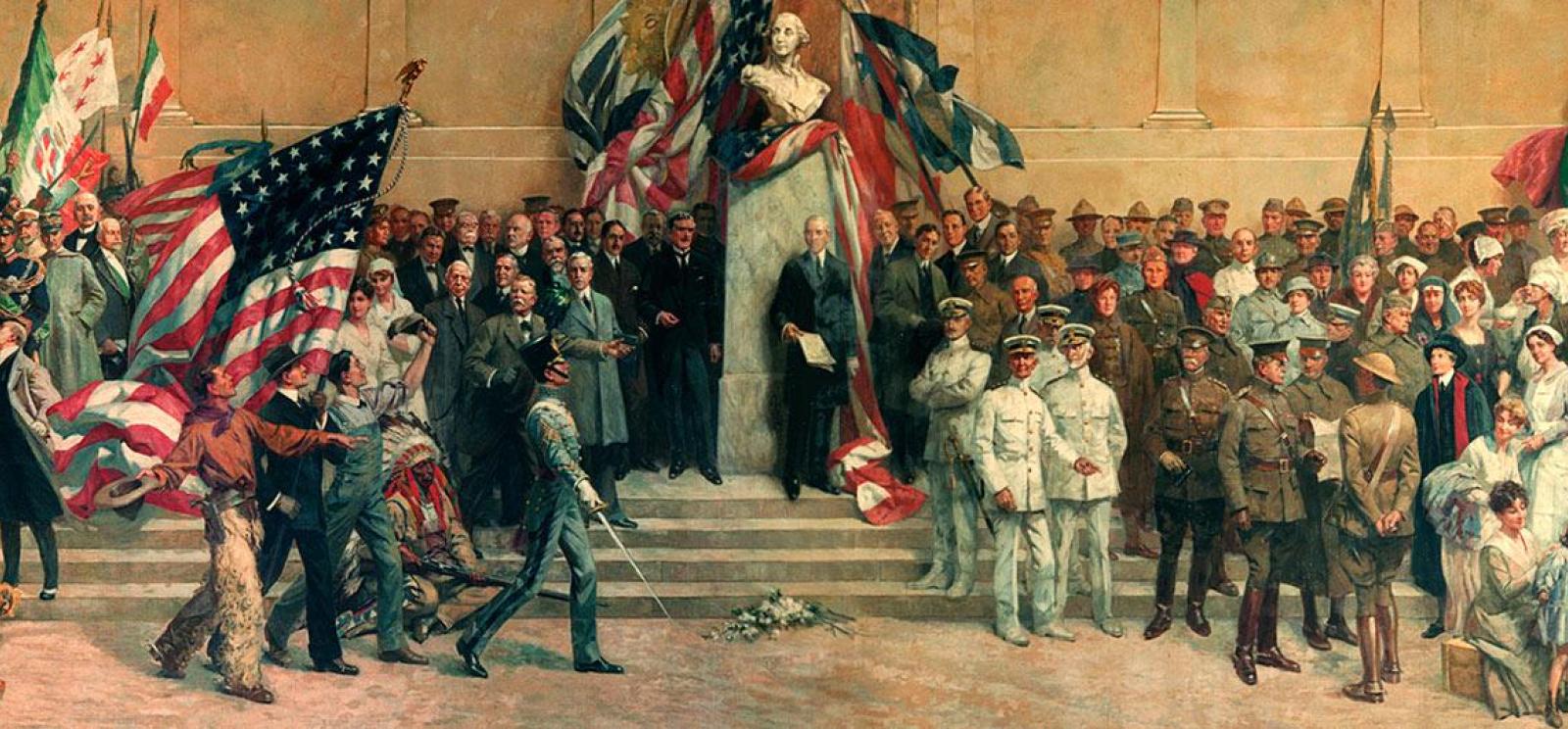
July 25 (Friday). Last evening Father invited Louise Kimball and Miss Merckel, another Toul Red Crosser, for dinner and afterward, I took the party to hear ‘La Fille de Mme Angot’ at the Opéra Comique, a very pretty little opera that was first sung about 1872. Graves, Oldys, and Osler went thru a couple of days ago on their way to Brest after a very successful 10 days trip to London and up thru Scotland. These past few days have been devoted to visiting with Father, getting my ‘clearances’ to sail, etc. Yesterday we saw ‘Le Pantheon de la Guerre’, a beautiful panorama near the Invalides, with over 6000 portraits of generals, rulers, and diplomats of all nations who have been prominent in the war, except naturally the Boches. It gives a panoramic view of France showing the battlefront from the Channel to the Alps; troops are arriving from all directions for the triumphal march past the Victory Temple on the steps of which are Joffre, Foch, Poincaré, Clémenceau, Guynemer, Fonck and hundreds of others. Qur forces are represented by Pershing, Harbord, Bliss, Bullard, Summerall, Bundy, and Lejeune. It was painted in the early days, so the generals of our 1st and 2nd Divisions are prominent, the only ones they knew in those days.
July 26 (Saturday). Mr. Tronchet dined with us tonight. He is a government architect and decorated the Place de la Concorde for the Victory Review on the 14th. I asked him if he had seen the Pershing Stadium. He said he knew it well as he had made a report to the government showing what work would be required to put it into safe and usable condition. The work had been hurried, so as to finish it for the games, consequently the structure was not considered strong enough for safety.
July 28 (Monday). Took the train from the Invalides Station for Brest. Gen Rhodes, Hawkins, Maj Fornance, an infantry major, and myself in one 1st Class compartment – not an extra seat on the train. No one slept much. We had several carloads of ‘gobs’ on their way back from leave in Paris, well supplied with cognac, so having a merry time. When they discovered they could stop the train by pulling the alarm signal, they proceeded to do so regularly and often – especially if they saw a French girl along the road. Then they would proceed to give away their blankets, cigarettes, money, etc to the waiting Bretons who seemed perfectly accustomed to this procedure and were always waiting expectantly when we stopped.
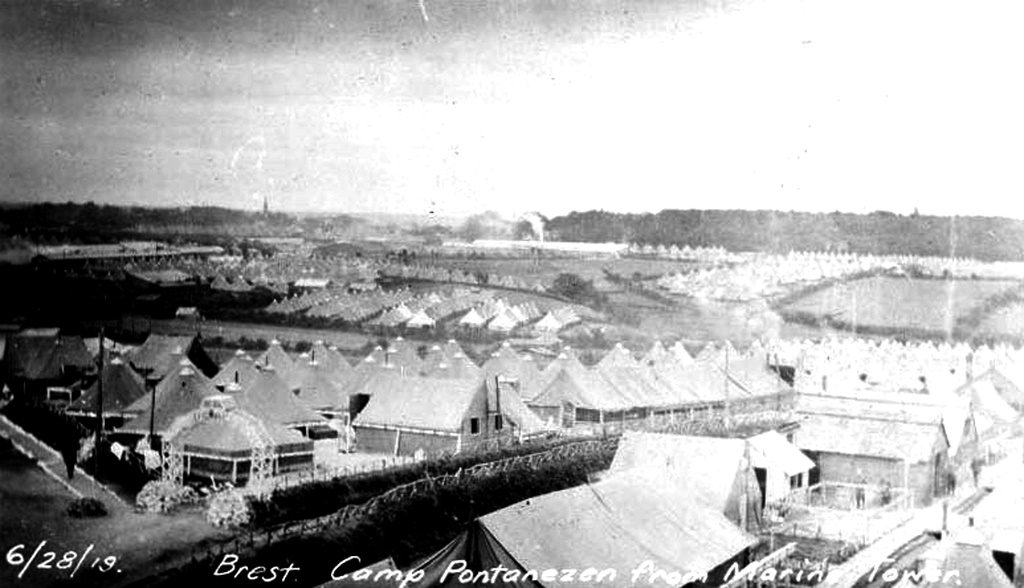
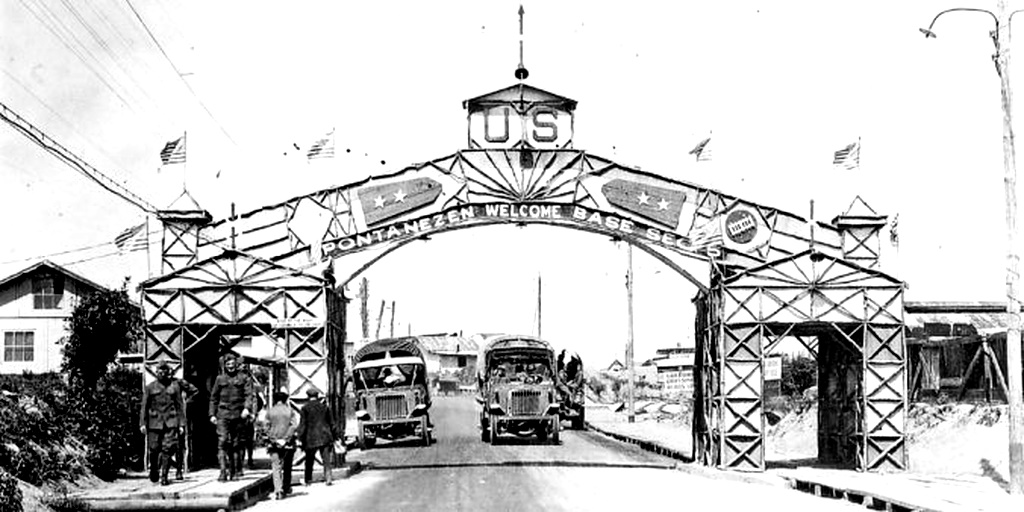
July 29 (Tuesday). Reached Brest at 1400 instead of 0800 thanks to the ‘gobs’. Gen Helmick in command. Ran out to Camp Pontanezen afterward, where they had as many as 8000 men at one time, either coming from the US or waiting to embark. Van Vorhis în charge of Troop Movements – 26 US ships waîting in the harbor now ready to carry troops. The soldiers have been pretty nearly cleaned up, but there are some 2000 officers here waiting to be sent home. Ran on to Miss Walmsiey at the ‘Y’ hut. The permanent personnel that runs the Port of Brest and camps is 40.000, much more than the whole US Army when I joined it.
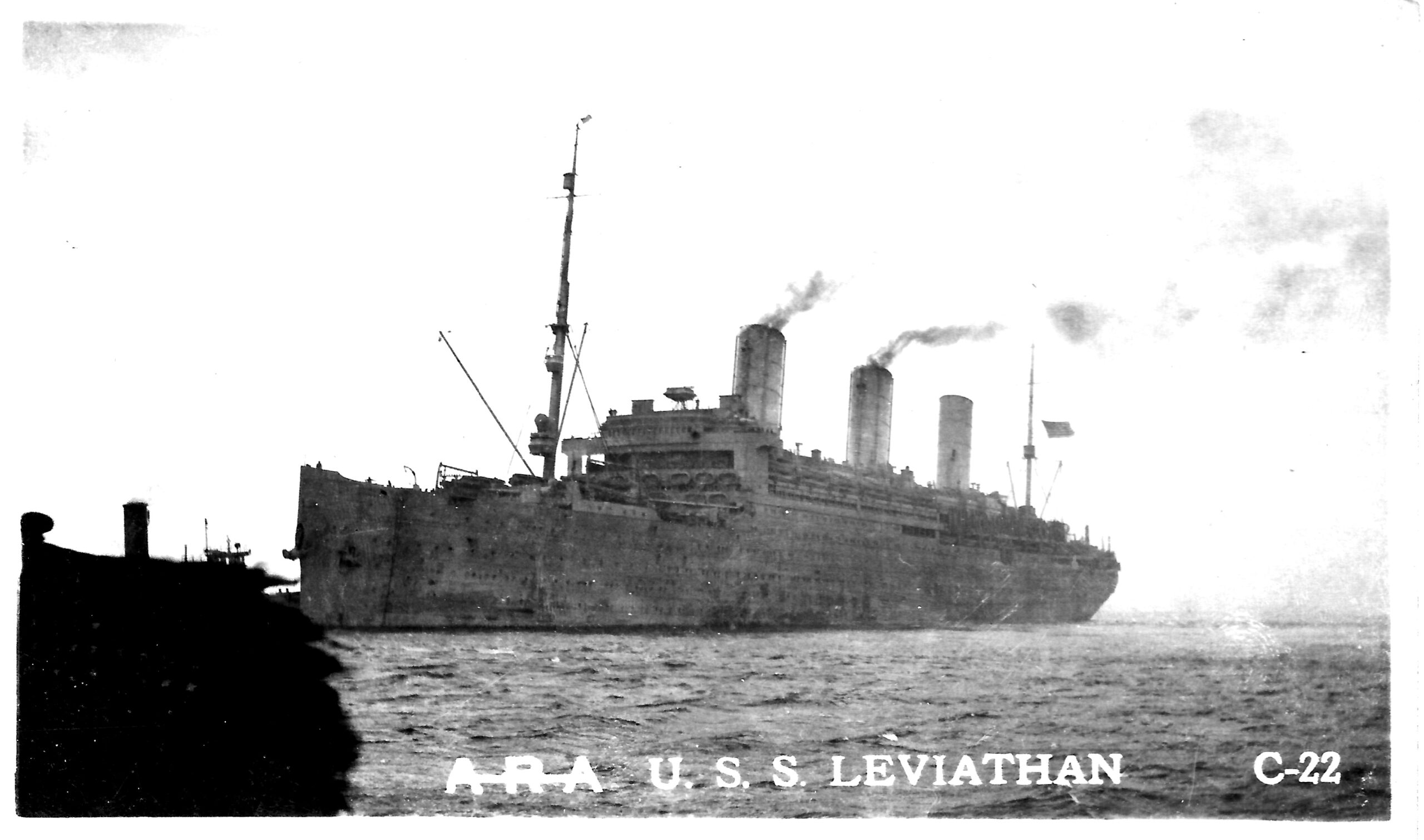
July 30 (Wednesday). Discovered last night that I had no pillow or sheets on my bed, so went over to the hospital where they gave me a good bed in a room with Bob Foy. Was ready at 1215 for the bus to take us to the dock. From then till 1815, it was mostly a case of standing in line, first for embarkation orders, next to get money changed, and next for a 2 hours wait on the launch before starting for the Leviathan, anchored out in the harbor. Here it was a line for a stateroom ticket, a line for a dining room ticket, and finally, when we got to the table at 1830 all were ready for a regular meal and could have enjoyed it to the full in the ‘Ritz’ dining room, except for a sailor jazz band which worked during dinner. This is the former ‘Vaterland’ and a fine big ship, easily the finest I have ever seen. The passengers (1st class) are practically all field officers and nurses, with just a few caps and lieuts (aides), some Red Cross and some Y.M.C.A. Gens John Biddie, Lassiter, Dawes, McKinstry, Craig (field artillery); Eph. Graham Peyton, Bob Foy, Wait Johnson, Hawkins, C. E., Von Holtzendorf, Alen, Collins, John Danford on his way to West Point to become commandant and dozens of others I know. I have a large stateroom with a Navy man (Swede evidently) who has been in command of a collier. We have a washroom and also a bathroom, but no hot water, no steward, no service except a darky sailor who comes in to read your papers and make the bed.
August 7 (Thursday). We reached the dock in Hoboken yesterday morning. I was off at 0740 and after passing thru the ‘part’ of the examinations etc. slipped off to the visitor’s room and found Gertrude and Dorothy (Lahm). They had been up since 0530 and had had a much more strenuous ‘landing’ than I. The crossing was highly uneventful, perfectly comfortable, and entirely different, from any I had ever had. The Leviathan is so large, 600 ft. long, 30,000 tons, and the sea was so calm all the way, you hardly appreciated you were on the ocean. This was all the more true because the deck space was largely given over to the troops, very rightly so as we had a large smoking room on ‘A’ deck, and lobbies on two other decks, and as they were cool and airy, you did not feel the desire to sit on the deck as you ordinarily do. There were two dances from 2 to 4 and two from 8 to 10 every day, besides band concerts, and moving pictures every evening. Capt Durell of this ship is the husband of Mae Nicholson – he never appears except late at meal times. A regiment of infantry (Bolles, 39th), the 12th Field Artillery, some 2nd Division trains, etc. a hospital unit, many nurses, some Red Crossers, Y.M.C.A.’s, and a dozen French brides make up the list. Found Eskridge on duty at the Embarkation office. After many formalities, got off to the Pennsa. Hotel New York. Called the Aero Club late yesterday afternoon – both Hawleys, Post, and Woodhouse having a governor’s meeting and invited me in. We took in the Ziegfeld Follies in the evening. Unable to locate my second steamer trunk, so we left this morning for Washington. Curry is on the train and just landed in the Finland on the 6th. Hot Hot – and when we landed here at 1640, it was hotter.
August 8 (Friday). Reported at Air Service HQs this morning at 6th and B – one of the many large temporary office buildings put up for the war. Found everyone there – Mitchell, Whitehead, Milling, Pratt, Jones, B.Q., etc. Gen Menoher was up before the Congressional investigating committee. This afternoon, Pratt and I called at the Army War College on Jimmy Gowen and Malin Craig to get some idea as to what our status and work would be as ‘special students’. This detail is to keep me in Washington and orders were issued today assigning me here. We called on the Pegrams this evening.
August 9 (Saturday). Gertrude and I slipped out to the ball game this afternoon and saw Walter Johnson beat the Chicago’s in a one-sided game. We stayed until the last half of the eighth inning and then just had time to catch the 6 o’clock train on the Pennsylvania.
August 10 (Sunday). Mom, Aunty Nell, Will (William Weldon), and William was waiting for us at the Mansfield, Ohio station when we rolled in at 0920.
End of this Archive
Additional Images Sources
https://www.aviationgraphic.com//aviation-lithographs/2173-spad-xiii-s4523-ag-28.html