


May 30 (Friday). ‘Decoration Day’ and everywhere the French are making it a special day long to be remembered. They have taken the initiative – at the Justice Group Hospital Cemetery, a French general made an address, and a French military band and an American firing squad took part. Miss Andress and her Red Cross force did the decorating, mostly with flowers furnished by the French.
May 31 (Saturday). Ran over to Maron on the Moselle, about 12 km southeast of here, found the ‘maire’ who took me thru a house and into a yard overlooking the river where Lufbery fell just a year ago in a fight with a Boche. His plane was in flames and he jumped out, probably hoping to land in the water, but he missed it by about 150 meters and landed on a fence; the broken pickets are still there.
June 2 (Monday). This afternoon, Oldys, Bryan and I went to Maron, a sergeant from Colombey who brought the Lufbery memorial in a truck with six Boche prisoners who built a concrete base in front of the house of M. Alfred François the first house on the right as you enter the village coming from Toul. Bryan came up from Sautxures in the Vosges yesterday with the stone and after a long conversation with the maire yesterday, later with M. François, it was agreed that the stone and tablet could go where we put the concrete base in today. We go back tomorrow to set up the stone after the base has dried and set. The memorial is very pretty – it consists of a bronze plate inscribed ‘Raoul Lufbery Major Air Service United States Army killed in aerial combat, May 19, 1918’. This tablet is placed here in his memory by his comrades in the United States Air Service. This is set on a granite stone 2′ 5″ wide, 2′ 4″ high, and 1′ 3-1/2″ thick – it is a very pretty gray granite such as the one found in the Vosges – the plate sits on a sloping surface. It was necessary to draw up an agreement between M. François and myself saying that he could have it removed if he wanted to change his house or if it otherwise interfered with his use of his house. This is to be signed by M. François and myself, witnessed by the maire and M. Gatenois, in whose yard Lufbery fell, and is to be officially recorded in Nancy.
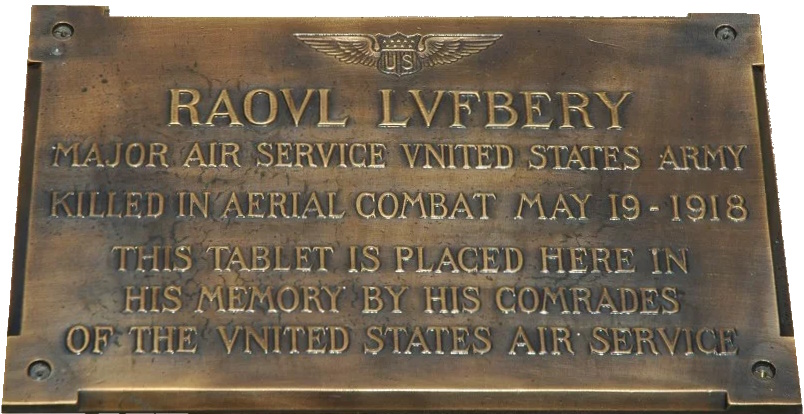
June 3 (Tuesday). This afternoon, Oldys, Bryan, and I went to Maron, with a detail of men, set the monument up on the concrete base, photographed it, and took some pictures of the spot on which Lufbery fell. Then we waîted for M. le Maire to come in from wood-cutting, in order that we might have the ceremonÿ of dedication. As he did not come, I finally climbed the hill above the town and found him, working in his woods. He came back with me, but when I said we would take some pictures, he insisted he must dress up which he did – then we picked up M. Gatenois and lined up beside the monument to have the pictures. Someone suddenly noticed M. François was missing, so I went in and called him. He could not find his Sunday coat anywhere, Madame François was away and he was befuddled. Finally, he found it and came hurrying out, putting on his coat as he came. He had the pictures, then I got off the discourse (speech) that I had prepared for the occasion, telling who Lufbery was, how he came to fall here, then consigned the monument to the care of the Maire and commune of Maron. The Maîre replied, saying they were deeply touched and would take good care of it. (The people of Maron truly lived up to the Mayor’s promise. As late as 1962, I received a letter, and several snapshots of the marker, from a resident of the house in front of which I had placed the monument. The marker was in good condition).
We then adjourned to the house to cement the ‘entente cordial with a couple of bottles of champagne that I had brought for the occasion. It was a happy occasion – we drank to the commune, to the Americans, to the American Army, to the French Army, to the Aîr Services – they were intensely interested in hearing about ours – în hearing that we could see right into Maron from over Toul. When I told them of flying into Paris in an hour and a half and that I was going there in the morning, they said it was tho’ I was going to Sexey-aux-Forges, just across the river from Maron. M. le Maire then said he wanted to come to Colombey to go up in an airplane with me. They thought he was crazy. We had to leave to get back to a dinner at the Red Cross Rest House with Miss Andress, Miss Merckel, Miss Smith, Louise Kimball, and a couple of others.
June 4 (Wednesday). Odys and I left Colombey in a DH 4 and landed at Orly after a very good trip. Ran onto Frank Parker in Foulois’ office and found he had arranged for Katherine to sail on the Agamemnon on the 8th or 9th – too soon for me, I fear. Asked for my order and Oldys’ today.
June 5 (Thursday). We took off from Orly in the DH 4, with threatening skies all around, particularly to the east. The heaviest rain storm of the year had hit Colombey 1/2 hr before our arrival, but fortunately had passed on.
June 7 (Saturday). Great celebration in Nancy this evening, the various athletic societies came in today, including a Czecho-Slavic contingent in a gay hussar (sic) uniform. Tonight they paraded in the Place Stanislas, with a military band, drums, and trumpets playing the very military, martial music that is so peculiarly French. The soldiers were out under arms, some detachments carrying torches – it was a gay sight. Yesterday I journeyed to Maron, where with all due ceremony and with two bottles of ‘vin blanc du pays’ (native white wine), M. le Maire, M. François, M. Gatenois and I assembled around the table in M. François! kitchen, and solemnly affixed our signatures to the agreement relative to placing the monument in front of M. François’ house, today I had it registered in Nancy and took copies to Maron for the Maire and M. François.
June 12 (Thursday). Came to Paris on the train this morning and it was hot. The first time I have really felt it since landing more than a year and a half ago. Found a cable in my mail at 45 Avenue de Montaigne which had been forwarded by courier from Coblenz, dated Baltimore, May 27, saying Gertrude had been operated on for gall stones and was in fine condition!! Sixteen days ago and here I am just finding ît out. One thing is sure, no further news means she is coming on well, and I am sincerely glad she has had the operation and is thru with it. I felt that it was to be done as soon as I got back anyway. Sent Dr. Burnam the Baltimore surgeon who operated on Mrs. Lahm, a cable tonight for a later report – but imagine she has left the hospital by this time. These past 5 or 6 days have been spent oscillating between Toul, Nancy and Colombey-les-Belles, trying to close up the affairs of the Air Service Book. I finally had to leave Graves and Osler there for a few more days, when they will report to me in Paris. Ran out to Thiaucourt and Chambley one afternoon – a lot of former Austrian prisoners are housed in the stables at Chambley, they are being released and sent back now as they are Roumanians or some other tribe that is fighting with, for, or behind the Allies. It is hard to keep up with races, nations, and affiliations these days. Colombey-les-Belles, or rather the 1st Air Depot is now a thing of the past – it was turned over to the French yesterday and all our people will be out in a few more days. Katherine and the kids sailed Tuesday morning (June 10) on the Agamemnon.
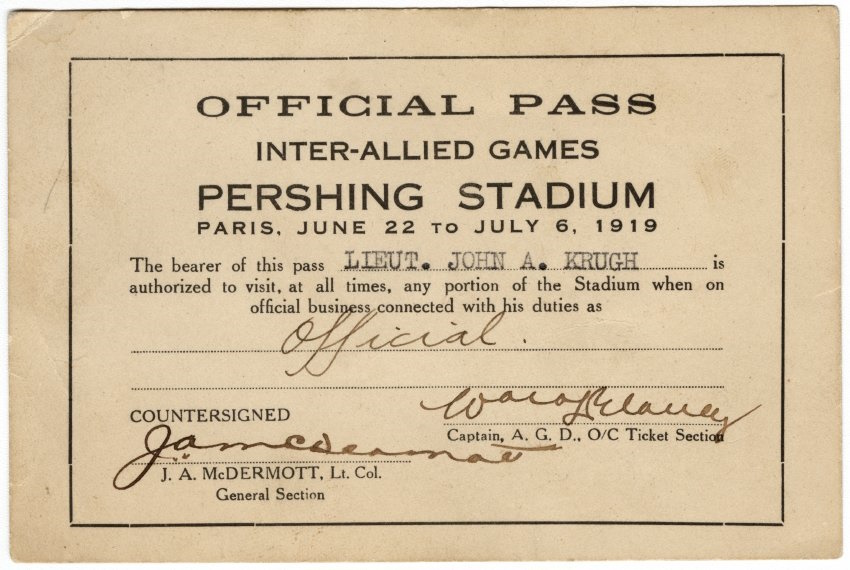
June 14 (Saturday). Told Col Richmond this morning that I was ready to go to Fort Champigny, so he sent me a car which brought me to the Fort. (Lahm had been asked to remain in France and play the ‘host’ at Fort Champigny to riding teams from several Allied nations which were to take part in the International Games to be held in the newly built Pershing Stadium, on the edge of Paris). There, I found Red Erwin in command and quite ready to turn over to me. The American riding team is here, Merchant in charge, with West, Harry, Chamberlain, Taulbee, Kobbe, and about 15 others, with some 35 horses. HQs are in the Fort itself, the horses are in temporary stables put up outside, then there is a training ground with jumps already built, just outside the Fort. The Portuguese and Roumanians are here, and last but not least, the Arabs with about 30 Arab horses and 4 camels. My first official act was to receive the Arab general, who wanted barley for his horses as they wi11 not eat oats. The billeting officer found me a room in a beautiful house in a more beautiful garden, near the Marne, in the village of Champignol. The old father and mother live here for six months including the summer and in Paris the winter. Two sons, about my age, are ‘industries’ in Paris, but come out in the evenings. A great big bed of white and yellow pansies in front of the door – roses in abundance, a vegetable garden – stable at the rear – no horses, but at least one auto. They invited me to have dinner with them, then we walked around the grounds and sat until 2200. when all adjourned to bed, just as the last of the daylight glow was disappearing in the west, and a bright full moon was rising in the east.
June 15 (Sunday). This has been one of those beautiful days in June that the poet tells about. (Lowell’s Vision of Sir Laufal, Part 1, Prélude, Stanza 5: ‘And what is so rare as a day in June? Then, if ever, come perfect days …) Cols Richmond and Col Hawkins were out for lunch today. This afternoon I took Erwin and rode in to see the Pershing Stadium. It is a great institution – a concrete amphitheater with a seating capacity of 25000, with a covered grandstand on one side with boxes in front. A large force of men is working on it – and are rushing it to completion for the opening of the Inter-Allied games on the 22nd. We rode over to Orly to look for tools to fix up the training ground at Champigny. Only 1/2 dozen planes and a small detachment left here.
June 18 (Wednesday). Whitehead phoned out the good news from Dr. Burnam, a cable saying Gertrude is nearly well. The Arabs gave us a great exhibition today. They brought out their finest-looking horses, with their fancy saddles, bridles, and trappings. One saddle was covered with gold embroidery. Then their long lances – they ride well and their horses are well traîned. The Arabs have a good seat, and use a severe curb bit, but have light hands and only use the bit to stop their horses, which they do well. One stunt was to set the end of the lance in the ground, then gallop around it, holding on to the other end. They had wonderful mounted combats, in which they rode around and chased each other over the field, flourishing and twirling their weapons. They handle the latter very well. The camels raced, one with its mouth wide open and bellowing as it came. Unfortunately, the Arabs have lost one horse from pneumonia, will probably lose another, and have half a dozen sicker with strangles or shipping fever. A trip to Fort de Vincennes today, netted the promise of authority tomorrow to put the sick horses in the Fort de Sucy about ten kilometers away. It is garrisoned by a company of the Foreign Legion made up entirely of Roumanians that have been in the French service since the beginning of the war.
June 21 (Saturday). I reported today at Gen Pershing’s house, 73 Rue de Varenne, close to the Invalides. There were gathered Col Vidmer, Col Eph Peyton, Gorrell, Daley of the Engineers, Albright, and three or four others whom I did not know. Gen Patrick was there as a spectator. Gen John J. Pershing came in and shook hands all around, then an aide read out the citations, one at a time, after each one of which Gen Pershing pinned on the D.S.M. made a little speech, and thanked each one, congratulated and shook hands, then passed on to the next. Afterward, we all congratulated each other, talked awhile, and then said ‘Good Day’ to the General. I took Col Vidmer to the apartment for lunch with Father. He came in with 4 more Raviers that had belonged to Harpignies, and which he is much pleased with. This week has been a round of organizing, policing (sic) up, riding a little myself, a couple of visits to the Fort De Sucy south of here where some stables were put together today and where I had 4 of the Arabs sick horses moved this evening. A representative of the French team came to look into quarters etc. He tells me Vatel, now a major is in charge of their team which is training at Saumur. Vatel was an ‘écuyer’ (Riding Instructor) and at the same time took the course in my class at Saumur.
June 27 (Sunday). Today was the grand opening and dedication of the Pershing Stadium. I took Father out. From the Porte De Versailles it was one vast crowd. The Stadium was filled to its capacity of 22000 people. First to march in was the Garde Républicaine Band, followed by detachments of cadets from Polytechnique, St Cyr – Infanterie de Ligne, Chasseurs Alpins or ‘Blue Devils’, then the Africain troops. They lined up facing the Tribune d’Honneur, then came a band with a battalion from our picked regiment from the 3rd Army, which Conrad Babcock commands. They looked fine and marched excellently. Most of the officers wore from one to three wound stripes. Then the athletic teams of the 20 Allied nations marched in with their multi-colored costumes. All were represented except England. Arabs, Czecho-Slovaks, Portuguese, and all the usual nations besides. Président Poincaré of France and Gen Pershing then came in with their ‘suites’, marched to the front and center, and received the salute – then mounted the platform, Mr. Carter of the Y.M.C.A. presented the Stadium to Gen Pershing, who in turn presented it to Mr. Leygues one of the French cabinets who accepted for France. There was a final grand review and it was over. We chanced to sit beside Waddington and his sister, who invited us to their house near the Parc de Monceau for tea. Mr. Waddington is a Frenchman of English descent, and Mrs. Waddington is an out-and-out American, of the Hayes family.
June 23 (Monday). Gen Blackbellair came out this afternoon to look over the ground to see about sending out the French team. I had always heard of him at Saumur, where he was écuyer-en-chef a long time. Later I hurried in and joined Vidmer and Babcock at the house of Georges Scott, the painter – and his wife, a former opera singer, and a very charming woman. Mr. S. showed me his studio and his pictures, they are wonders and all too true to life. He paints the war, but not always the pleasant aspects of ît. But the masterpiece is his panorama of ‘La Victoire de La Gloire’ – a study which he will enlarge to 10 meters (33 feet). In the foreground are the dead rising up from their graves, planes circling overhead, troops of all nations, flags of all nations (and none quite so prominent as the Stars and Stripes) extended for miles, surrounding the Arc de Triomphe which surmounts a hill. On the steps leading up to it are the Boche battle flags, lying as they were thrown. Just at 7 we heard guns booming very near and realized it meant the Boche had agreed to sign the Peace Treaty. On my way back, people had already begun to decorate, and after dinner when I left the apartment and rode down the Boulevard on my way out to Champigny it looked almost like Mardi Gras. The streets were packed, everyone singing and having a gay time. The French like an excuse to do this. A crowd in front of the Opéra was waiting to hear one of the Prima Donnas sing La Marseillaise.
June 24 (Tuesday). I forgot to tell you about the airplane parade over the Stadium on Sunday – they dropped a couple of large bouquets of roses which were presented to Mme. Poincaré and some other notable’s wives. I lunched today at the restaurant în St Maur with Gen Galvanescu and the other Roumanian officers. They were very cordial and we drank the health of everything and everybody. They are very proud of their country, which stood up from August 1916 to Aug 1918 against the Boche before it went under. They claim to have never had any Bolshevists, tho’ surrounded by them but look for trouble in the future as they are surrounded by enemies and rely on the Allies to help them.
June 25 (Wednesday). I took Col Soutzo. Maj Jacob, one other Roumanian officer over the 55-kilometer course today, including the 5 kilometers over obstacles in the Bois de Meudon.
Jun 27 (Friday). I met Vidmer at the Hotel du Palais this afternoon, we picked up Babcock at the Grand Palais where the Franco-American Ambulance was having a farewell reception before breaking up. Met Mrs. Lawrence Benet, whose husband is on the Foreign Service Committee of the Aero Club of America. Vidmer, Babcock, and I then rode up to the Scotts and heard some beautiful singing. Mme Scott and her sister Mne Myrhis sang duets and solos. Mme Scott sang several from Manon (French Opéra). Mme Myrthis sang La Bohème (French Opéra) – it was perfect, both are finished, artists.
June 28 (Saturdayp. Peace was signed at 1500 today – I was at the games at the Stadium, where it was announced, the games were suspended, and an Opéra singer sang the Marseillaise from the boxing ring – it was very stirring. The king of Rumania was there in full uniform and at the end decorated the winners for the day, including the American darky, Sol Butler who won the broad jump easily, and also the Opéra singer. The crowd was out tonight, all Paris celebrating the Peace signing – Poilus & Americans – arm in arm; they took particular delight hauling round the cannon from the Champs-Elysées, with a load of soldiers perched on top. Moved into a new billet today.
June 30 (Monday). At 0900, Chamberlain on Nigra led off from the village of Chennevières on the 55 km (35 miles) military ride. At 5 minute interview, 22 contestants started, representing the US, France, Belgium, Italy, Portugal, Roumania, and Hedjaz. Gen Blackbellair, the Hedjaz general, and numerous others were there to see the start. All made perfect scores and arrived at the finish within 4 hours, except two Arabs or Hedjaz whose horses would not take the jumps in the Bois de Meudon, and who were consequently eliminated, tho’ they finished in the 4 hours in good shape. As a matter of fact, all stood it very well – the 5 kilometers in 15 minutes over 15 jumps was easy for all but the Arabs – they come from a flat country where there is no jumping and consequently are not trained for it.