

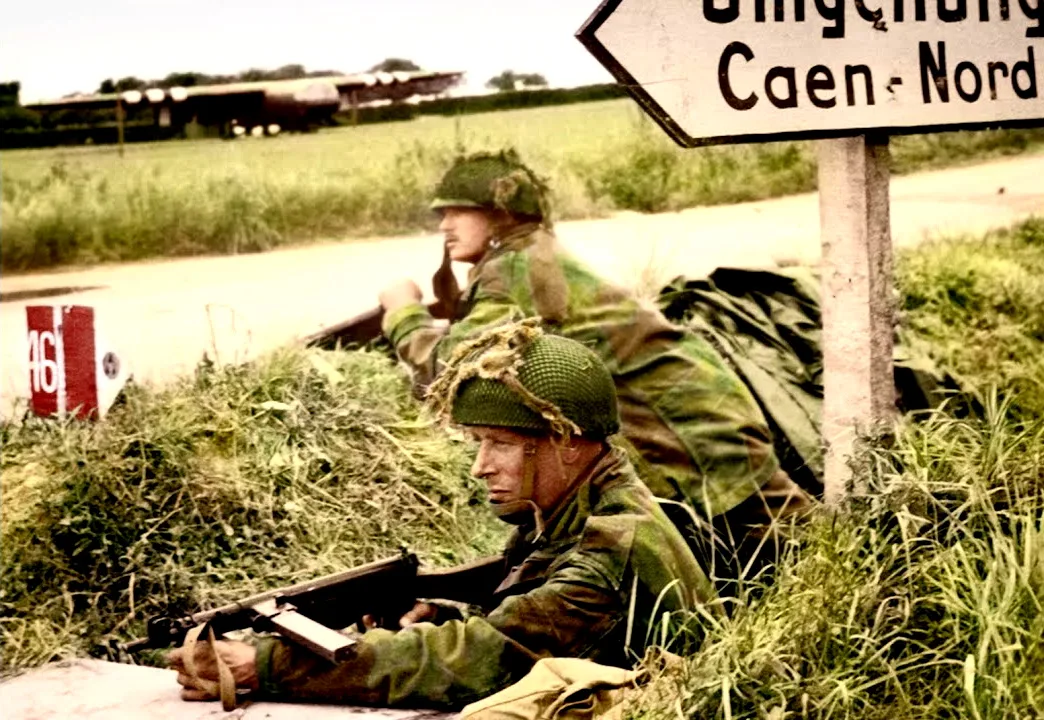
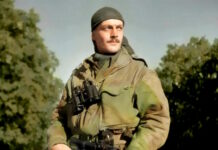

The 1st Canadian Parachute Battalion was ordered to seize and hold the central area on the western edge of the woods, where there was a main road running north from the Wesel to Emmerich, and to a number of houses. It was believed this area was held by German paratroopers. Charlie Co would clear the northern part of the woods near the junction of the roads to Rees and Emmerich. Once this area was secure, Able Co would advance through the position and seize the houses located near the DZ. Baker Co would clear the South-Western part of the woods and secure the battalion’s flank. Despite some of the paratroopers being dropped some distance from their landing zone, the Battalion managed to secure its objectives quickly. The battalion lost its commanding officer, Col Jeff Nicklin, who was killed during the initial jump on March 24. Following the death of Nicklin, the last unit commander was Col G.F. Eadie until the Battalion’s disbandment.
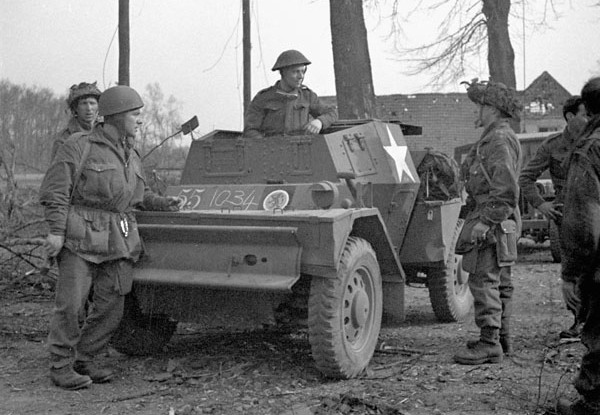
The airborne assault over the Rhine River, (Operation Varsity), was the largest single airborne operation in the history of airborne warfare and also involved the US 17-A/B. Five battalions of the British 6-A/B took part. The first unit to land was the brigade which suffered a number of casualties as it engaged the German forces in the Diersfordter Wald, but by 1100, the DZ was almost cleared of German forces. The key town of Schnappenburg was captured by the 9th Battalion in conjunction with the 1st Canadian Parachute Battalion. Despite taking casualties, the brigade cleared the area of German forces, and by 1345, the brigade reported it had secured all of its objectives.
The outcome of this operation was the defeat of the I.Fallschirmkorps in a day and a half. In the following 37 days, the Battalion advanced 285 miles (459 km) as part of the British 6-A/B encountering the Bergen-Belsen concentration camp on April 15, 1945, and taking the city of Wismar on May 2, 1945, to prevent the Soviets from advancing too far West. It was at Wismar that the battalion met up with the Red Army (the only Canadian army unit to do so during hostilities, other than a Canadian Film and Photo Unit detachment). The armistice was signed on May 8 and the battalion returned to England.
With the Victory in Europe and the Pacific War ending in August 1945, the 1st Canadian Parachute Battalion sailed for Canada on the Isle de France on May 31 and arrived in Halifax on June 21. They were the first unit of the Canadian Army to be repatriated and on September 30, the battalion was officially disbanded. The battalion was perpetuated in the infantry commandos of The Canadian Airborne Regiment (1968-1995), whose colors carried the battle honors: Normandy Landing, Dives Crossing, The Rhine, and North-west Europe 1944–1945.
During the 1st Canadian Parachute Battalions jump into Normandy on D Day, two-thirds of its sticks were dropped miles from the DZ. This unit displayed all the major characteristic initiatives and flexibility of airborne troops along with more than its share of bravery right through to the end of the war. On the cessation of the hostilities in Europe, FM Sir Alan Brooke, the Chief of the Imperial General Staff, wrote to the Canadian Chief of the General Staff, now Gen JC Murchie, to say, ‘I realize that circumstances have made it inevitable that the Battalion should now cease to form part of the 6-A/B, but I should like to tell you how sorry we are to lose this magnificent battalion, which has taken such a distinguished part in the great battles of the past year. I know how high is the regard and affection of all ranks of the 6-A/B for their Canadian Parachute Battalion’.
Department of National Defence, Ottawa. August 3, 1945.
The Canadian Army
The King has been graciously pleased to approve the award of the Victoria Cross to No. B.39039 Corporal Frederick George Topham, 1st Canadian Parachute Battalion.
On March 24, 1945, Cpl Topham, a medical orderly, parachuted with his Battalion on an enemy strongly defended area east of the Rhine River. At about 1100, whilst treating casualties sustained in the drop, a cry for help came from a wounded man in the open. Two medical orderlies from a field ambulance went out to this man in succession but both were killed as they knelt beside the casualty. Without, hesitation and on his own initiative, Cpl Topham went forward through intense fire to replace the orderlies who had been killed before his eyes. As he worked on the wounded man, he was shot through the nose. In spite of severe bleeding and intense pain, he never faltered in his task. Having completed immediate first aid, he carried the wounded man steadily and slowly back through continuous fire to the shelter of a wood. During the next two hours, Cpl Topham refused all offers of medical help for his own wound. He worked most devotedly throughout this period to bring in wounded, showing complete disregard for the heavy and accurate enemy fire. It was only when all casualties had been cleared that he consented to his own wound being treated. His immediate evacuation was ordered, but he interceded so earnestly on his own behalf that he was eventually allowed to return to duty. On his way back to his company he came across a carrier, which had received a direct hit. Enemy mortar bombs were still dropping around, the carrier itself was burning fiercely and its own mortar ammunition was exploding. An experienced officer on the spot had warned all not to approach the carrier. Corporal Topham, however, immediately went out alone in spite of the blasting ammunition and enemy fire and rescued the three occupants of the carrier. He brought these men back across the open and although one died almost immediately afterward, he arranged for the evacuation of the other two, who undoubtedly owe their lives to him. This NCO showed sustained gallantry of the highest order. For six hours, most of the time in great pain, he performed a series of acts of outstanding bravery and his magnificent and selfless courage inspired all those who witnessed it.
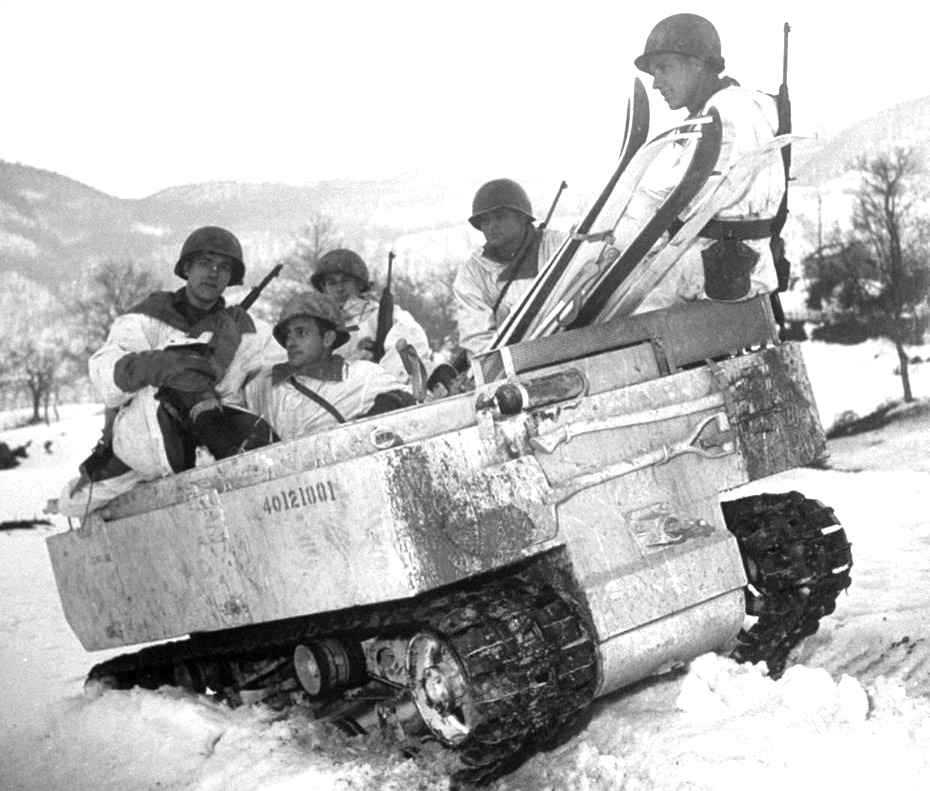
(Above) The Airborne units needed a suitable over-snow vehicle. In April 1942, since no suitable vehicle existed, the US government, therefore, asked automobile manufacturers to look into such a design. Studebaker subsequently created the T-15 cargo carrier, which later became the M-29 Weasel. The T-15 snowmobile vehicle was capable of carrying four men and was used by the 1st SSF in the Aleutians. A larger vehicle known as the T-24 (later standardized as the M-29), was used by the Force in Italy, although in limited numbers. In January 1944, 12 of the 100 T-24 Weasels the Force had brought to Italy were uncrated for the first time. The Force found it preferred mules in much of the terrain found in Italy, due to the rugged hills they were forced to operate in. A few Weasels were used by the Canadian Army in Europe.
The 2nd Canadian Parachute Battalion background. The initial idea for these Airborne forces was based on a plan submitted by Geoffrey Pike, a British inventor working for the British Combined Operations. Pyke devised a plan for the creation of a small, élite force capable of fighting behind enemy lines in winter conditions. This was to have been a commando unit that could be landed, by sea or air, into occupied Norway, Romania, and/or the Italian Alps on sabotage missions against hydroelectric plants and oil fields. Allied commandos were to be parachuted into the Norwegian Mountains to establish a covert base on the Jostedalsbreen, a large glacier plateau in German-occupied Norway, for guerrilla actions against the German army of occupation.
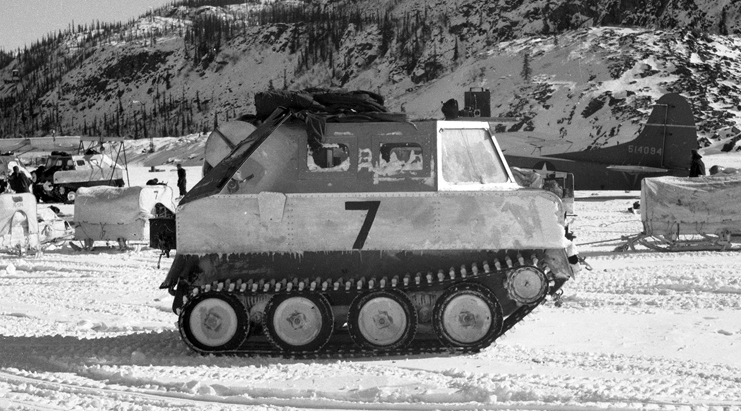
In May 1942, the concept papers for Plough were scrutinized by Col Robert T. Frederick, a young officer in the Operations Division of the US General Staff. Frederick was given the task of creating a fighting unit for Project Plough and was promoted to Colonel to command it. In Canada, the Department of Munitions and Supply was asked to develop a snowmobile and did produce an effective vehicle, the Canadian Armored Snowmobile MK-1. The Penguin was originally open-topped with a two-man crew, a driver in front, and commander in the rear. An aluminum cab gave more room and could be heated. With these modifications, the Penguin gave good service in the Army’s post-war Arctic exercises.
 The photo (left) is of one of 15 Penguin snowmobiles during Operation Muskox which took place on Great Bear Lake in the Northwest Territories in 1946. They traveled in the dead of winter from Churchill, Manitoba up through the Arctic. Three machines were diverted to Cambridge Bay where the RCMP supply vessel St Roch was frozen in for the winter. One of the three Penguins, No. 8, was commanded by Capt Bob Inglis, Canadian Army. They ended up in Edmonton (Alberta). Machine No. 8 survived and was sent to the Bombardier Museum but because they didn’t build it, they scrapped it.
In July 1942, the Canadian Minister of National Defence, James Ralston, approved the assignment of 697 officers and enlisted men for Project Plough, under the guise that they were forming Canada’s first airborne unit, the 1st Canadian Parachute Battalion. Due to a decision to raise an actual Canadian parachute battalion, the Canadian volunteers for Project Plough were also sometimes known unofficially as the 2nd Canadian Parachute Battalion. The Canadian element did not officially become a unit until April–May 1943, under the designation, 1st Canadian Special Service Battalion. On 1 May 1943, the commander of the Canadian contingent began signing the unit’s war diary as the CO of the 1st Canadian Special Service Battalion.
 While its members remained part of the Canadian Army, subject to its code of discipline and paid by the Canadian government, they were to be supplied with uniforms, equipment, food, shelter and travel expenses by the US Army. It was agreed that a Canadian would serve as second in command of the force and that half of the officers and one-third of the enlisted men would be Canadian. Col McQueen, formerly in command of The Calgary Highlanders in the UK, had returned to North America to accept the position of senior Canadian in the Force. He broke his leg in parachute training on August 13, 1942, and left the Force shortly afterward, going to Washington DC in a liaison role for the force. He later commanded The Lincoln and Welland Regiment in Normandy. Col Don Williamson of the Dufferin and Haldimand Rifles took over as senior Canadian and executive officer (second-in-command) of the 1st SSF. Approximately half the leadership positions in this force were occupied by Canadians, with about 1/3 of the unit’s personnel drawn from the Canadian Army.
 The combat force was to be made up of three regiments. Each regiment was led by a lieutenant colonel and 32 officers and boasted a force of 385 men. The regiments were divided into two battalions with three companies in each battalion and three platoons in each company. The platoon was then broken up into two sections. Following initial training period in Montana, the FSSF relocated to Camp Bradford (Virginia), on April 15, 1943, and to Fort Ethan Allen (Vermont), on May 23, 1943.
 The 1st Special Service Force. Canadian Paratroopers also drew much inspiration from the history of the 1-SSF. The Regiment bears the 1SSF battle honors Monte Camino, Monte Majo, Monte La Difensa – Monte La Remetanea, Anzio and Rome on its Regimental Colors. As well the unconventional nature of the First Special Service Force, similar to the British SAS and the current US Army Special Forces and elsewhere, was not replicated in the more conventional role of the Canadian Airborne Regiment. Nevertheless, its accomplishments served as a model for many members of the new Airborne.
The First Special Service Force was a unique joint formation of Canadian and American troops assigned to perform sabotage operations in Europe in the Second World War. Simply named Special Forces to conceal its commando or ranger purpose, this unit later gained fame as the Devil’s Brigade. The Canadians were designated the 2nd Canadian Parachute Battalion.
Members were handpicked and sent to Fort William Henry Harrison, Helena, Montana, for special training. The Canadians wore American uniforms and equivalent ranks to eliminate any questions of command among the troops. Their work-up took place in three phases, with extensive physical training throughout the program. The first phase included parachute training, small unit tactics, and weapons handling—all officers and ranks were required to master the full range of infantry weapons from pistols and carbines to bazookas and flame throwers. Next came explosives handling and demolition techniques, then a final phase consisted of skiing, rock climbing, adapting to cold weather, and operation of the Weasel combat vehicle. Exercises in amphibious landings and beach assaults were added later. It was decided that the FSSF would be blooded against the Japanese force occupying the Aleutian island of Kiska. The FSSF arrived at the San Francisco Port of Embarkation on Jul 4, 1943, and sailed for the Aleutian Islands on Jul 10, 1943. On Aug 15, 1943, the 1st SSF was part of the invasion force of the island of Kiska, but after discovering the island was recently evacuated by Japanese forces, it re-embarked and left the ship at Camp Stoneman, California. The FSSF returned to Fort Ethan Allen, arriving Sept 9, 1944.
 The FSSF was then sent to Italy where it was reassigned to Gen Mark W. Clark’s 5-A, which was fighting its way north through the rugged mountainous terrain of Italy. German forces entrenched in two mountains were inflicting heavy casualties on the 5-A.
After a 12-day attack was stopped cold at Monte la Difensa, the Force went in and cleared the veteran German 104.Panzergrenadier-Regiment from the summit, a feat immortalized in the 1968 motion picture The Devil’s Brigade.
The first regiment with 600 men, had scaled a 1,000-foot (300 M) cliff by night to surprise the enemy position. Planned as a three to four-day assault, the battle was won in just two hours. The force remained for three days, packing in supplies for defensive positions and fighting frostbite, then moved on to the second mountain, Monte Majo, which was soon overtaken. In the end, FSSF suffered 511 casualties including 73 dead and 116 exhaustion cases.
The commander, Col Robert Frederick, was wounded twice himself.
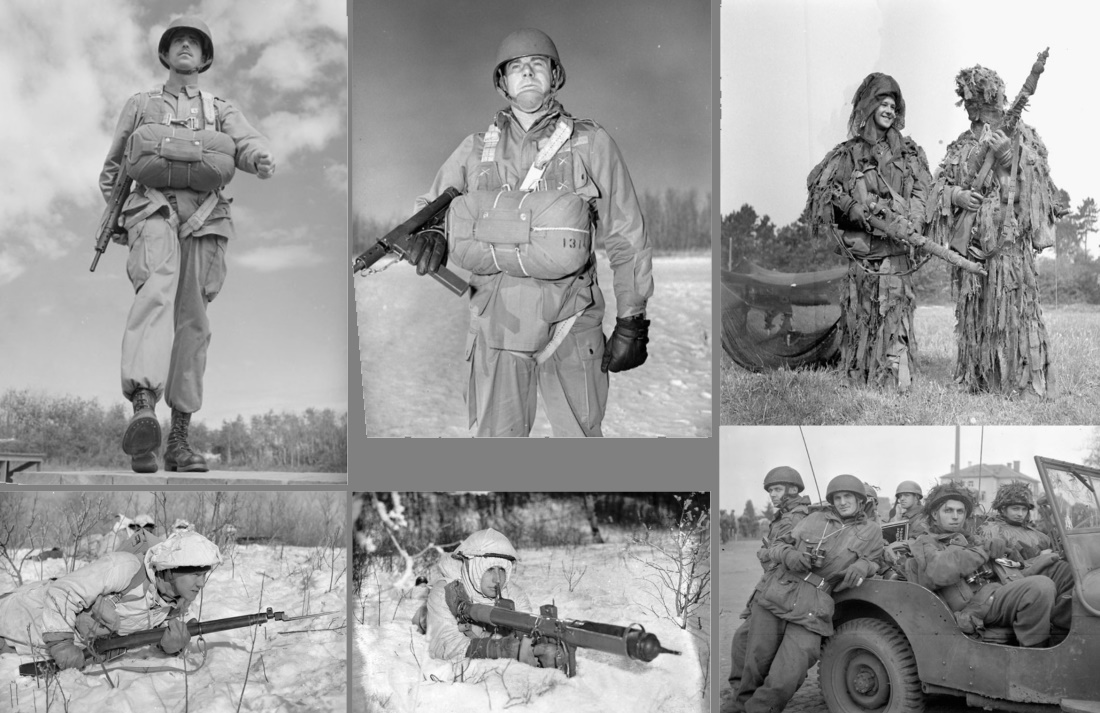
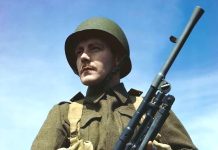
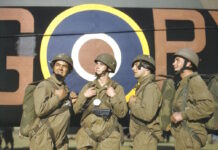
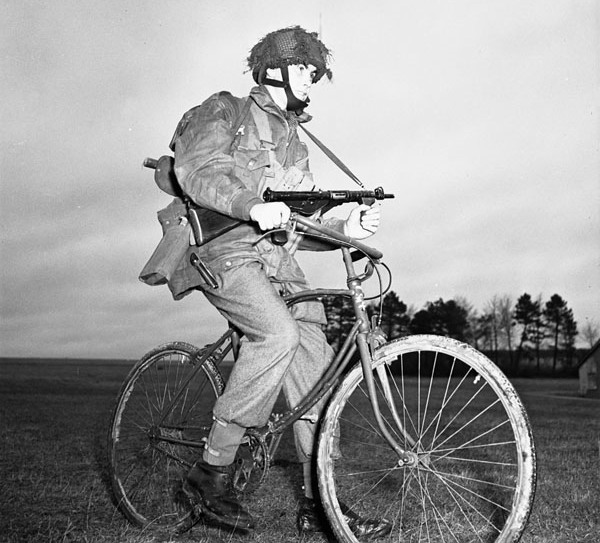
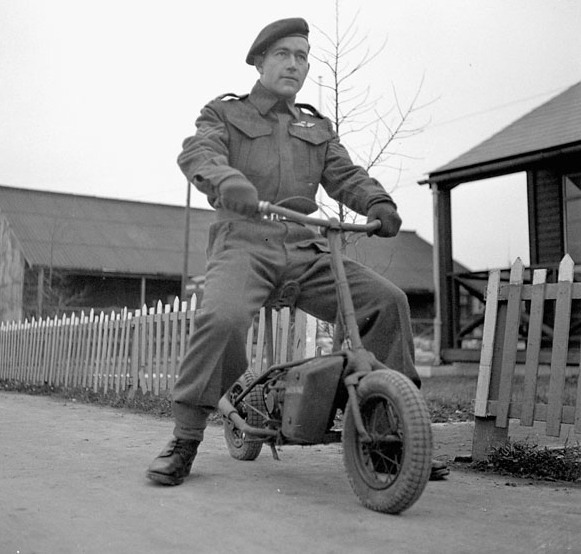
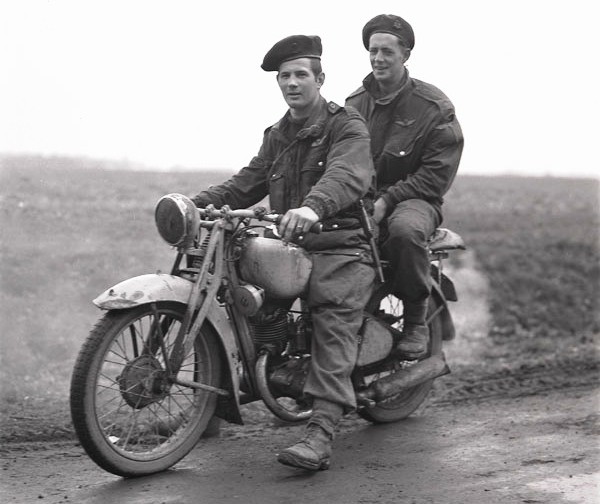
(Photo Above) (1) Lt Tom Brier, 1st Canadian Parachute Battalion, wearing American Parachute Jump Suit M-1942, Parachute Pack Assembly T-5, Corcoran Jump Boot, and M-2 Paratrooper Helmet at the A-35 Canadian Parachute Training Centre, Camp Shilo, March 20, 1945. (2) Canadian Paratrooper with a 9-MM Sten gun preparing for a jump at the A35 Canadian Parachute Training Centre, Camp Shilo, 20 Mar 1945. (3) 1st Canadian Parachute Battalion snipers in Ghillie Suits during an inspection by King George VI, Queen Elizabeth and Princess Elizabeth, Salisbury Plain, England, May 17, 1944. (4) Canadian parachute-qualified personnel armed with .303 Lee Enfield rifles, shortly before they were posted to the 1st Canadian Parachute Battalion undertaking winter infantry training at A-35 Canadian Parachute Training Centre (Canadian Army Training Centres and Schools), Camp Shilo, Manitoba, Canada, March 20, 1945. (5) Canadian parachute-qualified soldier armed with a portable infantry anti-tank (PIAT) weapon, undertaking winter infantry training at A-35 Canadian Parachute Training Centre (Canadian Army Training Centres and Schools), Camp Shilo, Manitoba, Canada, March 20, 1945. (6) Members of the 1st Canadian Parachute Battalion, Kolkhagen, Germany, April 30 1945.
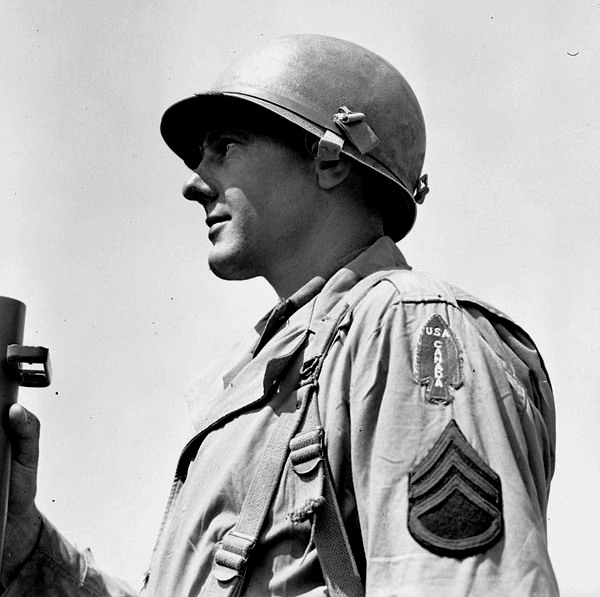
 (Photo Left) FSSF Sergeant, wearing the distinctive FSSF patch on his shoulder, Anzio, Italy, Apr 20, 1944. He is armed with a 2.36-inch Bazooka man-portable recoilless anti-tank rocket launcher, widely fielded by the US Army during WW-2. Also referred to as the Stovepipe, the innovative bazooka was among the first generation of rocket-propelled anti-tank weapons used by infantry in combat. (Photo Right) FSSF. Lt Joe Kostelec, Calgary, Alberta, wearing the distinctive FSSF patch on his shoulder, Nocci, Italy, Jan 1944. Joe Kostelic was a former enlisted man and NCO who had joined the Loyal Edmonton Regiment on Sep 4, 1939. He was wounded in Dec 1943 and received a commission in Jan 1944 after the attack on Mount la Difensa. Joe Springer reported that Lt Kostelec was a natural leader. Kostelic was listed as missing in action (MIA) after a night raid on Anzio.
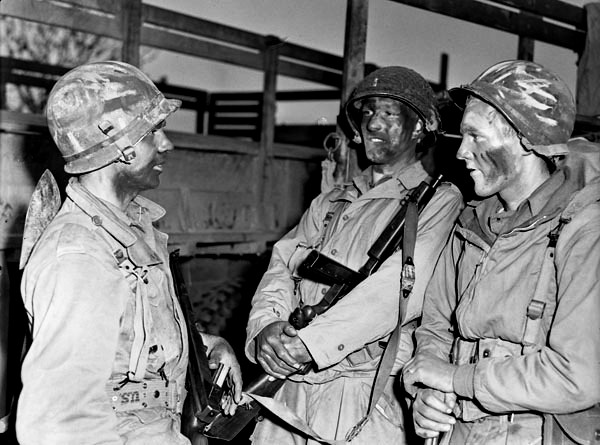 By Jan 8, after roughly two months in combat, the 1800 men making up the combat strength of the Force had dropped to just over 500. The FSSF received glowing praise from the corps and army commander in the wake of the fighting at Difensa and Remetanea. The FSSF saw continued action throughout the Mediterranean, at Monte Sammucro, Radicosa, and Anzio. For the final advance on Rome, the FSSF was given the honor of being the lead force in the assault and became the first Allied unit to enter the Eternal City. Their success later continued in southern France and then at the France-Italian border. Often misused as line troops, the force suffered continuously high casualties until it was finally withdrawn from combat.
In Aug 1944, the Force was able to use its amphibious skills during the landings on islands flanking the invasion beaches in Southern France as part of Operation Dragoon. The unit then fell under the operational control of the 1st Airborne Task Force, clearing the French coastline east to the Italian border.
It was their last major mission, and in Dec 1944, with the need for specialized forces waning, the Force was disbanded. The Canadians went largely to the 1st Canadian Parachute Battalion, the Americans to the 474th Infantry Regiment (Separate), or to US parachute units. The parachute-trained and combat-tested Canadians of the FSSF were seen as a valuable asset for the 1st Canadian Parachute Battalion then training in England.