



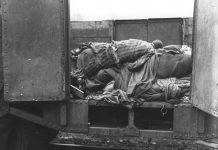

Kristallnacht at the Dinslaken Orphanage
Reminiscences – By Yitzhak S. Herz
At 0700, the morning service in the synagogue of the institution was scheduled to commence. Some people from the town usually participated, but this time nobody turned up. At about 0730, I ordered 46 people, among them 32 children, into the dining hall of the institution and told them the following in a simple and brief address. As you know, last night a Herr vom Rath, a member of the German Embassy in Paris, was assassinated. The Jews are held responsible for this murder. The high tension in the political field is now being directed against the Jews, and during the next few hours, there will certainly be antisemitic excesses. This will happen even in our town. It is my feeling and my impression that we German Jews have never experienced such calamities since the Middle Ages. Be strong! Trust in God! I am sure we will withstand even these hard times. Nobody will remain in the rooms on the upper floor of the building. The exit door to the street will be opened only by me! From this moment on, everyone is to heed my orders only!
At 0930, the bell at the main gate rang persistently. I opened the door, and about 50 men stormed into the house, many of them with their coat or jacket collars turned up. At first, they rushed into the dining room, which fortunately was empty, and there they began their work of destruction, which was carried out with the utmost precision. The frightened and fearful cries of the children resounded through the building. In a stentorian voice, I shouted: “Children go out into the street immediately!” This advice was certainly contrary to the order of the Gestapo. I thought, however, that in the street, in a public place, we might be in less danger than inside the house.

The children immediately ran down a small staircase at the back, most of them without hats or coats, despite the cold and wet weather. We tried to reach the next street crossing, which was close to Dinslaken’s Town Hall, where I intended to ask for police protection. About ten policemen were stationed here, reason enough for a sensation-seeking mob to await the next development. This was not very long in coming; the senior police officer, Freihahn, shouted at us: “Jews do not get protection from us! Vacate the area together with your children as quickly as possible! Freihahn then chased us back to a side street in the direction of the backyard of the orphanage.
As I was unable to hand over the key to the back gate, the policeman drew his bayonet and forced open the door. I then said to Freihahn, “The best thing is to kill the children and me, then our ordeal will be over quickly!” My officer responded to my “suggestion” merely with cynical laughter. Freihahn then drove all of us to the wet lawn of the orphanage garden. He gave us strict orders not to leave the place under any circumstances. Facing the back of the building, we were able to watch how everything in the house was being systematically destroyed under the supervision of the men of law and order – the police.
At short intervals, we could hear the crunching of glass or the hammering against wood as windows and doors were broken. Books, chairs, beds, tables, linen, chests, parts of a piano, a radiogram, and maps were thrown through apertures in the wall, which, a short while ago, had been windows or doors. In the meantime, the mob standing around the building had grown to several hundred. Among these people, I recognized some familiar faces, suppliers of the orphanage or tradespeople, who, only a day or a week earlier, had been happy to deal with us as customers. This time, they were passive, watching the destruction without much emotion.
At 1015, we heard the wailing of sirens! We noticed a heavy cloud of smoke billowing upward. It was obvious from the direction it was coming from that the Nazis had set the synagogue on fire. Very soon, we saw smoke clouds rising up, mixed with sparks of fire. Later, I noticed that some Jewish houses, close to the synagogue, had also been set alight under the expert guidance of the fire brigade. Its presence was a necessity, since the firemen had to save the homes of the non-Jewish neighborhood.

Kristallnacht – Susan, Germany, 1938
 A young Jew in Paris had killed a German diplomat. This event was used as a trigger to commence long-planned raids on Jewish homes and businesses, well-organized pogroms. That night I woke up to noise, shouting, and screaming. About 8 young storm troopers, drunk or crazed in some other way, smashed up our home. By the time they came into the bedroom I shared with my younger sister, they had done a lot of damage to other rooms and had locked my parents into their bathroom. My parents were terrified for their children, and I could hear them screaming and shouting, and then I became very frightened. I could not imagine what was happening to them. When the storm troopers came into our room, they pulled me out of bed and tore my nightdress to shreds. As a 15-year-old, I was, above all, embarrassed. They then told me to get dressed and to get my clothes out of my wardrobe. This was of the heavy, continental type. When I stood in front of it, the 8 young men threw it over. No doubt this was to kill me, and they left the room. Luckily, there was so much destruction in the room that a table, previously turned upside down, held the wardrobe at an angle long enough for me to wriggle out from underneath.
The memory of that event will stay with me forever. My concern was also for my little sister. She had crawled under her blankets, and her bed was completely covered with broken glass, but she was all right. The men departed to do more damage in other houses, and we were able to release our parents and survey the wreck that had been our home. Our elderly maid could not believe that Hitler, whom she admired, could be responsible for anything like this! (“If only our Führer knew about this!”) A friend of mine, who was staying with us, was hiding on the balcony; she was cold in her nightdress on a cold November night. She had told me the day before that she did not know whether to accept what her much-loved Jewish step-father had explained about the Nazis, or what she had been told by her aunt, who was an ardent Nazi supporter and whom she had just been to visit. After that night, she knew. When I took her to the station the next day, she begged me to come and stay on their farm near Munich with my family, so that no harm would come to us.
 The following morning, at my father’s request, I got onto my bicycle and went to check on our family friends. No one dared to use a telephone, and this was the only way to see that they had all survived. All had terrible stories to tell of events the night before. The general opinion was to get out of Nuremberg that day. The reason for this was that Nuremberg was administered by Obergruppenführer SA Julius Streicher, Hitler’s chief Jew hater, and he had called a big public meeting for that evening. All sorts of dreadful things could happen after that. My family aimed to get to Munich, where the British Consul had told my father to come to shelter at the Consulate, if ever things got too difficult. (It would have been nice for me to know that in that town there was a 17-year-old boy who would one day be my husband. We packed a few things, and my father gave me his important papers to hide in my underwear, so that he would not be carrying them, and we departed during the evening.

On our approach to Munich, we could see that cars leaving town were being stopped. Our driver told us not to worry, because he knew Munich quite well, and would take us in on a back street where there were not likely to be road blocks. He was wrong, we were stopped and my father was removed from the car after being asked whether he was a Jew. He was put into a lorry with other Jews who had been rounded up. As the lorry drove off, my mother gave instructions to follow it. Eventually, it pulled into the courtyard of some barracks, where, although it was the middle of the night, there were people standing around jeering.
As the lorry was unloaded, my mother bravely followed her husband into the building. My sister and I were tired and frightened of the aggressive mob around us. One of the storm troopers came over to us and told me to start walking back to Nuremberg, as we would not see our parents again, and they were confiscating our car. Obviously, I had no idea how to walk to Nuremberg. I decided to do nothing and hoped my parents would come back soon. My mother did come back after a while. She was distressed. She had not been able to achieve anything, not even to see my father. She decided to try the following morning again, and meanwhile, to find a hotel for us to spend the night. She had traveled a lot with my father and knew several hotels in Munich. At the first one, where she had stayed not long before, there was a notice at the entrance, which read “no Jews”. We found that similar notices were on the doors of all other hotels we tried. It was too late at night to go to the British Consulate, and while we wondered what on earth we could do, the doorman of one hotel followed my mother to the car. He gave her the address of a small hotel belonging to his sister and a note requesting his sister to look after us.
We got there, were given a room, and we children went to sleep immediately. We woke up late and found that our mother was not there. She had left us a note to tell us that she was going back to the barracks and that we were to stay in our room. Eventually, she returned. She had not been able to see my father, had not been told where he was, but was told, “We will send you his ashes”. In fact, he was by then on his way to Dachau Concentration Camp. My mother decided to take us two children to my friend’s farm, and to go back to Nuremberg to see what she could do to help him. She found out that at that time, one could get released from the concentration camp if one had a business or property that one signed over to the Nazi authorities. My father had both, and she prepared the necessary papers. One also needed a visa to go to another country before being released. And she worked on this with the help of friends. She tried to obtain visas for America, for England, for Palestine, and maybe other countries.
After a week or two, an uncle in Switzerland sent his lawyer to collect my younger sister, so one member of the family was safe. I stayed on the farm and helped with all the work there. Life on the farm started about 0400 a.m. The farmer was a former diplomat who found out that he was Jewish, although his family had converted to Christianity before he was born. He was not able to remain a diplomat, and therefore, he and his family had settled on a farm. Everyone worked hard, but after breakfast, while his wife and daughters and I did mending or vegetable cleaning, he read serious literature to us for at least an hour. My father was released early in December while I was still on the farm, but only after giving all his property to the Nazis. I was shocked when I saw him. In a month, he seemed to have aged 10 years. His head had been shaved, and the stubble that came through was gray instead of brown. He would not wear his hat, as he normally did. He wanted “them” to be ashamed, since he had nothing to be ashamed of, yet had been imprisoned. He told us of some of the horrific experiences of the previous month. He had always been kindly and patient, but now he was angry and nervous.

Unedited account by my father, Johannes U. Hoeber
The night of November 9-10, 1938, in Düsseldorf, Germany
[…] The conversation had centered around the recent political events, Chamberlain’s Munich surrender, and its repercussions on Germany’s internal policy. Munich undoubtedly had bolstered the regime’s declining morale, and everybody viewed with alarm the reviving arrogance of the Nazis after a period of relative moderation. Incidentally, our friend told us that he had heard on his way to our house that Ernst vom Rath, secretary of the Paris German Embassy, who had been shot by a young Polish Jew, driven to despair by the treatment of his parents by the Nazis, had died that afternoon. We did not discuss the implications of this news item. Not because we did not fear them. But in the past six years of our lives under the Nazi Government, we had developed a habit that might be called a technique of mental self-defense: not to speculate on the possibilities of disaster implied in any news, before we were confronted with this disaster and could cope with the concrete emergency by concrete maneuvers. None of our company that night was Jewish, but we all had some very close Jewish friends. I myself have some Jewish ancestors, not enough to make me subject to the humiliating clauses of the infamous Nüremberg Laws, yet enough to brand me as a second-class citizen in the Germany of today, the Germany of the Bohemian-born Hitler, the Egyptian-born Hess, and the Baltic-born Rosenberg.
The possible consequences of vom Rath’s death were uppermost in my mind when I drove to the station at about 2300 to mail some letters. In the streets, I noticed an unusually large number of brown shirts. First, I thought they were on their way home from some of the day’s celebrations. Then I noticed that they did not go in the direction of the residential quarters but hurried towards the center of the city. So, on my way home, I drove through some of the main thoroughfares of the downtown business section and found, in two different places, brown shirts gathering quietly in front of Jewish business establishments. I went home and, without telling my wife what I had seen, offered our friend who had to leave at midnight to drive him to the station and asked my brother-in-law to accompany us. After having dropped our friend at the station, we hastily drove downtown. We had to drive very far to find what we had anticipated.
In front of a large shoe-store, owned by a Jewish woman whose husband had been killed in action during the First World War and who, therefore, despite six years of Nazi boycott, had still one of the largest businesses in the field, a detachment of brown shirts had assembled. We just came in time to see two of them starting – on a given signal – to break the shop windows. This done, they forced the entrance and the whole group rushed into the store. It was one of those modern outfits with plenty of glass, attractive wood paneling on the walls, and every shelf full of shoeboxes. Twenty minutes later, it was so completely devastated that no bombshell could have done a more thorough job. No piece of glass, no piece of wood was unbroken. The carpets were cut up, the lamps torn from the ceiling and walls, shelves, tables, and chairs smashed to pieces. The problem of destroying thousands of shoes in a hurry other than by fire had been solved ingeniously: they had been strewn all over the place, and then oil paint had been poured over and into them. When they had finished their job, the wrecking crew, on the blow of a whistle, assembled in front of the store, in a line two deep, stood at attention in perfect military discipline, drilled into them by endless training, and marched off.

We got into our car and drove on. A few blocks away, we encountered another group of stormtroopers looting a fashionable lady’s outfit store. This was on our city’s Fifth Avenue, and the wrecking crew corresponded with the district’s distinction. Our city is the seat of a higher district leader of the Nazi Party. Every such district leader has a staff of his own and a bodyguard of his own whose members are easily recognized by red squares on the lapels of their brown uniform coats. The squad that wrecked this store was composed almost entirely of members of the district leader’s staff and bodyguards under the personal command of a well-known Nazi-Lawyer and SA officer. A few yards away, a police car with two higher police officers was parked at the curb. The two officers watched with apparent interest the work of destruction carried out under the leadership of the chief aide of their superior. The next time we stopped in front of a tailor’s workshop. Here, a particular problem presented itself to the wrecking crew: how to destroy the stock of bolts of cloth. It was solved no less efficiently than the shoe problem had been solved. One man unrolled the bale, and another poured ink over it from one end to the other. Then they left it lying in the street.
After an hour of driving around town, we were convinced that not one single Jewish Business in Düsseldorf would survive that night and that more than a hundred thousand people would have to pay for one man’s act of despair with the destruction of their lives’ work and their basis of existence. What happened during the next hour, however, outgrew the wildest anticipations any one of us, trained by six years’ lessons of terror and used to incredible brutalities, had ever entertained. At 0130, we stopped in front of an apartment house because we noticed two SA sentries guarding the house door. On the opposite pavement stood a small group of civilians looking at a brightly lit apartment on the fourth floor. We joined them and asked one of them what was going on. They are avenging von Rath, he said. Which firm has its offices up there? I asked. That is no office, that is a private apartment occupied by a Jewish tenant. Before we could continue our conversation, one of the SA sentries came across the street and ordered us to move on. A few seconds later, the windows of the apartment came down in splinters, and one after the other, the lights went out in the apartment, the last one being a large crystal lamp that we saw wildly swinging up and down before we heard it crashing to the ground. Then panic gripped us.

Hanna Tennenhaus, Montréal, Canada
That fateful night, November 9, 1938.
I studied late. After finishing my homework, I took a piece of paper from a notebook, wrote Ich hasse Hitler (I hate Hitler), then quickly burned it in the dying embers remaining in the red tiled stove and went to bed. At 0200, there was a great commotion in the street. Juden Raus, Juden Raus (Jews out, Jews out) went the awful shouts. Our bell rang incessantly. My mother, in a long white nightgown, went from room to room in great agitation, while my father prayed silently. Finally, I opened the door to our apartment. The front door had already been opened by the deputy mayor of our town, who lived on the second floor and was obviously aware of all the horrors to follow. In front of me stood three machine-gun toting SA men, who told us to get dressed quickly and come with them. I was not quite 15, my anger was greater than my fear, and I told those thugs, You’ll have to wait while I brush my teeth. They obeyed, dumbfounded by my defiance, which could have cost me my life. We crossed the park, small but lovely, where I had spent many happy hours playing or reading, and we were led to a large square where the whole Jewish Community was being herded together. Mrs. Einstein, our paralyzed neighbor in her 80s, was dragged there, suffering shock and numerous bruises as a consequence. The square was surrounded by armed Nazi.
Someone asked to go to the bathroom and was scornfully told, Jews don’t need that! Men, women, and children were ordered to stand apart. Not wanting to leave my trembling mother. I disobeyed. Our usually awe-inspiring principal and physics teacher arrived in pyjamas with his family, including twin baby girls in a carriage. The November night was exceptionally cold. We were standing there shivering and dazed, in shock and fear. Suddenly, the sky turned pink. The synagogues, not far away, were burning, together with the community center, the library and and the mikvah. Some people were screaming, They are going to burn us alive! Around 0700, they led us through the streets to a hall once donated by a Jewish Philanthropist. We were jeered by emerging towns people. Then the women and children were sent home, the men incarcerated in the hall. Some beatings and sadism took place, but none of the fathers ever spoke about it.
A few hours after the release of the women and children, a neighbor came to our apartment asking me to accompany her to the hall to give her imprisoned husband his heart medicine. When we arrived there, an armed Nazi guard sneeringly told the poor lady: Your husband won’t need his pills. We are going to burn you all, together with your swinish Torah Scrolls. Soon after we arrived home, the bell rang once again, more armed Brown Shirts looking for men. I trembled for two hours. Later in the day, news spread that we could bring food to our captive men. I hard boiled two eggs, added some bread and set out once more into the hostile streets. A solitary figure was walking to wards me – it was my father, who was the only man released. The others would be sent to the Dachau Concentration Camp.
To this day, I remember the in credible joy I felt, comparable only to my overflowing gratitude when my brother Joseph came home from Dachau, eight long weeks later. Meanwhile I had witnessed the disintegration of my home and school life, the premature end to my child hood and the decimation of my ancient community. I was sent to England with the Kindertransport; my brother and sister also escaped to England. Sadly, my parents with 900 others from our community (almost half) perished in concentration camps. May their martyrdom never be forgotten.

Epilogue
The tragedy of the Kristallnacht was not the destruction. No nation has been free of violence. No nation has been free of the rowdiness of the ignorant. The tragedy, rather, was that government, which should protect the individual and his property against violence, in this instance encouraged and abetted the violence against the Jews. The violence was a joint act by the government and the populace. Early on the day of November 9, a message went out from Gestapo headquarters: There will be very shortly in Germany actions against the Jews, especially against the synagogues. These actions are not to be interfered with
Leonard Baker
Documents Sources
www.motlc.wiesenthal.com
wwv.yadvashem.org/
fjmc.org/events-2/kristallnacht/
www.hoebers.files.wordpress.com
www.shturem.org)
Images Sources
Souvenir coin with a swastika and Star of David owned by a young German Jewish girl
Birmingham Holocaust Education Center (Der Ewige Jude)
Encyclopedia US Holocaust Memorial
www.ashkenazhouse.org (Historical Correction)
www.holocaustresearchproject.org