


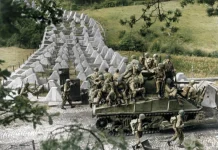
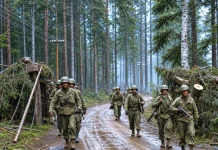


Unit commanders were advised that Charlie Co had been attacked by a heavy force, had suffered many casualties, and had lost the area around Diepenlinchen as well as failing to take the objective at Wiesenberg. Many casualties had been evacuated but small groups were believed holding out in positions in Diepenlinchen after being cut off. Baker Co, with several tanks attached, would lead the attack. The infantry was to advance under cover of the woods on the left flank while the tanks would proceed up the road. On reaching the edge of town the infantry was to emerge from the woods, join the tanks and launch a coordinated attack through Diepenlinohen. Able Co was to follow Baker Co until the latter left the woods to join the tanks, at which time it would continue northeast through the woods to the further edge and there take up positions to secure the left flank of Baker Co. As the infantry reached a point in the woods opposite the outskirts of town the tanks were echeloned to their right. The infantry-tank team launched its attack under scattered small arms, mortar, and artillery fire. Tanks covered the infantry by direct machine gun fire into all buildings as the infantry worked from house to house. By darkness the attack had cleared the town and reached the factory district, taking 49 prisoners en route. Defensive positions were organized for the night, Baker Co tying in with Able Co on its left flank. Elements of Charlie Co were contacted throughout the day and a count taken in the evening indicated that battalion casualties for the day totaled 115.
Shortly after dark an enemy counterattack developed on Able Co’s open left flank which threatened the rear of the battalion position. The ammunition and pioneer Platoon were thrown in on the left to cover this flank and the attack was beaten off one hour later. The critical condition of the supply system became apparent during the day when Lt Phillips, commanding the 8l-MM mortar platoon, received word that ammunition was not available at the army dump to replace his exhausted stocks. This was brought to the attention of the division commander and within 24 hours a 2.5-ton truckload arrived at the mortar position, direct from Paris via the Red Ball Express. This represented a distance of over 200 straight-line miles.
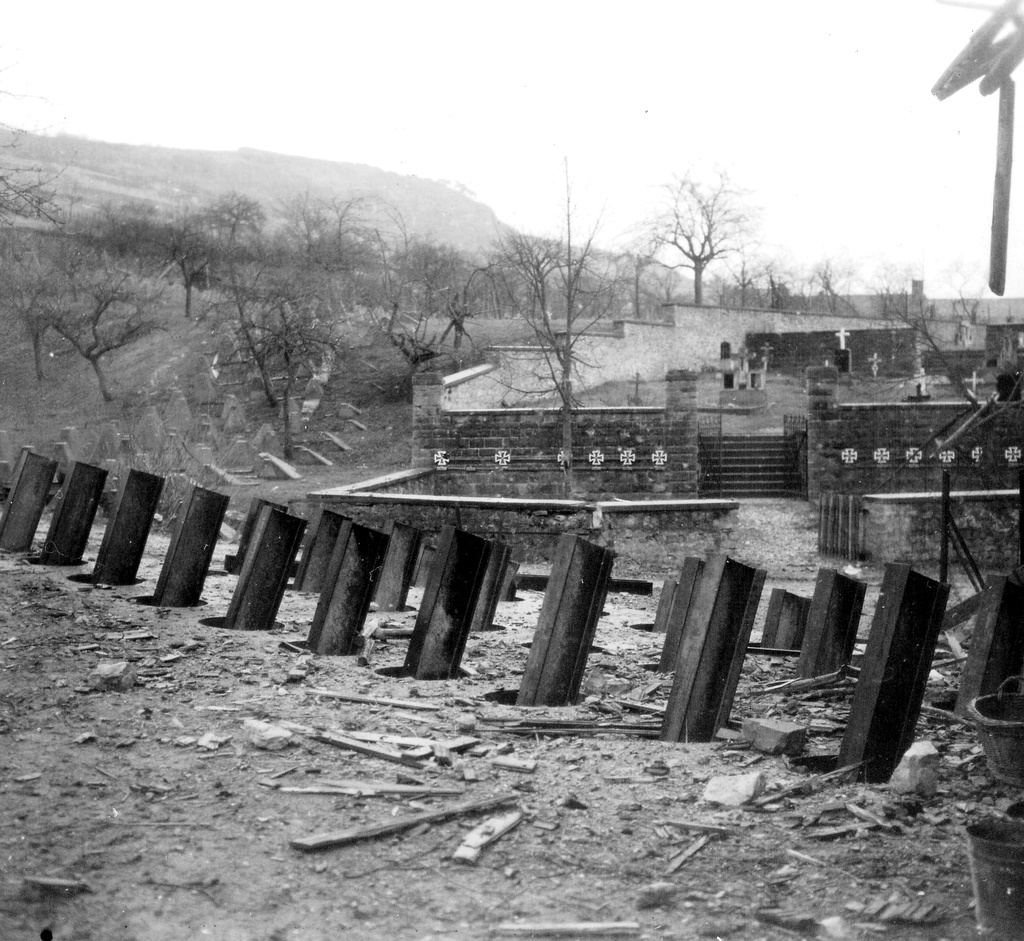
On the following day, September 19, shortly after daylight, Baker Co continued the attack in the factory area. However, due to deadly enemy fire at close ranges from behind a maze of thick walls and numerous supporting pillars, coupled with difficulties of control, progress was very slow. As a result, the task force commander decided to try the right flank envelopment. Able Co, with a company of tanks attached, would attack at 1200, from its present position, seize and defend the high ground in the vicinity of Weisenberg, putting off Germans in the factory area. Able Co jumped off with two rifles and two tank platoons abreast, leaving the balance of the rifle and tank companies in a concealed position to cover the attack. As the line reached a point midway across the open ground, it came under concentrated fire from all types of enemy weapons, including 20-MM guns. To quote the words of Col Hogan, task force commander, ‘I never saw such a concentration of German artillery before or since’. The infantry pulled back to the cover of prepared positions in the woods and the tanks, having no infantry protection, also retired.
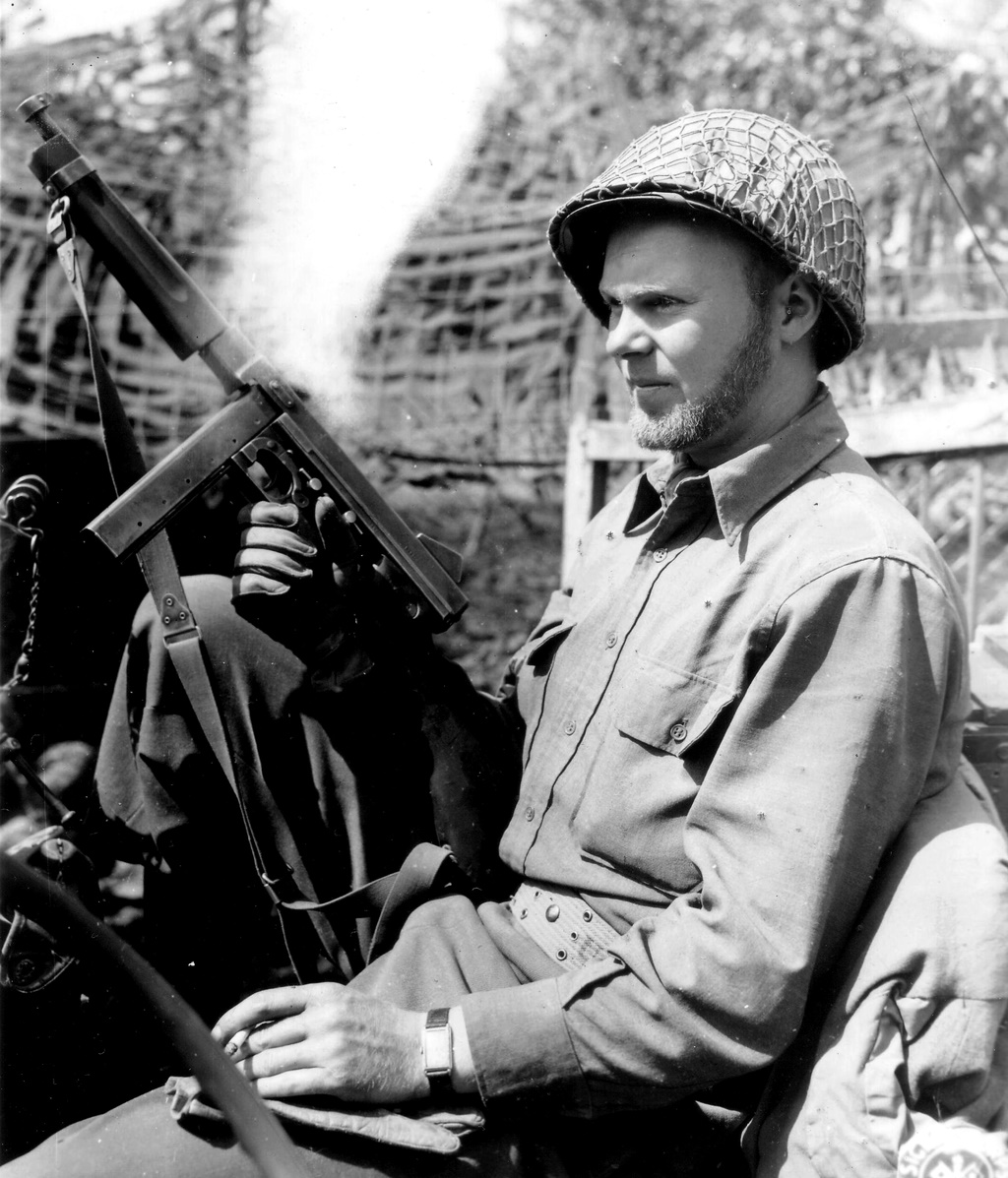
At this time, Gen Truman E. Boudinot, commanding CCB-3-AD, directed the task force commander to effect an envelopment around the right flank of Baker Co, to seize Weisenberg from the south. The task force commander objected to this plan as he had previously considered the plan but had dropped it when a personal reconnaissance proved the boggy ground was unsuitable for tank maneuver. However, he was directed to attack immediately. So, at approximately 1400, Charlie Co, with a strength of 62 men, and with four tanks attached, moved out of its reserve position. As the column crossed the open, boggy terrain just south of the factory area, it came under heavy mortar, artillery, antitank gun, and small arms fire from the east and northeast. The tanks soon were mired in the bog, had to be abandoned, and were destroyed; the infantry was forced to take cover.
It was then decided to make a second attempt to envelop the position from the left flank, to be preceded by a 10-minute barrage from all available artillery in the corps. Smoke would be used to screen Able Co’s left flank from enemy observation as it crossed the open ground. In the event that the infantry could not keep up with the supporting tanks, the tanks were to continue on alone to the objective, Weisenberg. Able Co was forming on the line of departure as the heavy preparation began. However, many rounds of friendly artillery appeared to be falling short of the target, in fact, the concentration searched back toward our line of departure to the extent that Able Co was forced to withdraw to covered positions minimizing casualties from overhead tree bursts. After a 30-minute delay to permit registering on the target by all forward observers, the concentration was repeated. Again tree bursts forced the infantry to take cover. The tanks, however, jumped off according to plan and had reached a line just short of the woods when two tanks were destroyed by AT fire from their left flank and a third was knocked out by a round from a Panzerfaust, the German equivalent of our bazooka. Without infantry protection, the remaining tanks retraced their route to the assembly area.
No further attempts were made to take the objective on this day. The task force commander considered the possibility of a night attack that night but the shot-up, exhausted condition of the troops prohibited driving home such an attack. Enemy prisoners captured late in the afternoon stated that a company of German infantry had been forming for a counterattack when our tanks had opened fire on their position in the woods, disrupting the plan. In view of this, a counterattack was considered likely on our left flank during the night. Outposts reported the considerable activity to their front but no patrols were encountered. As our troops had suffered considerable casualties and were exhausted, a plan was devised to keep the enemy off balance during the night. The company of tanks attached to Able Co was to crank up at midnight, move out in a line to a point halfway across the open ground to the front, then cut loose with all guns blazing. At midnight, a terrific volume of fire suddenly fell on the target area and continued for five minutes before the enemy could call down his supporting fires, causing our tanks to withdraw.
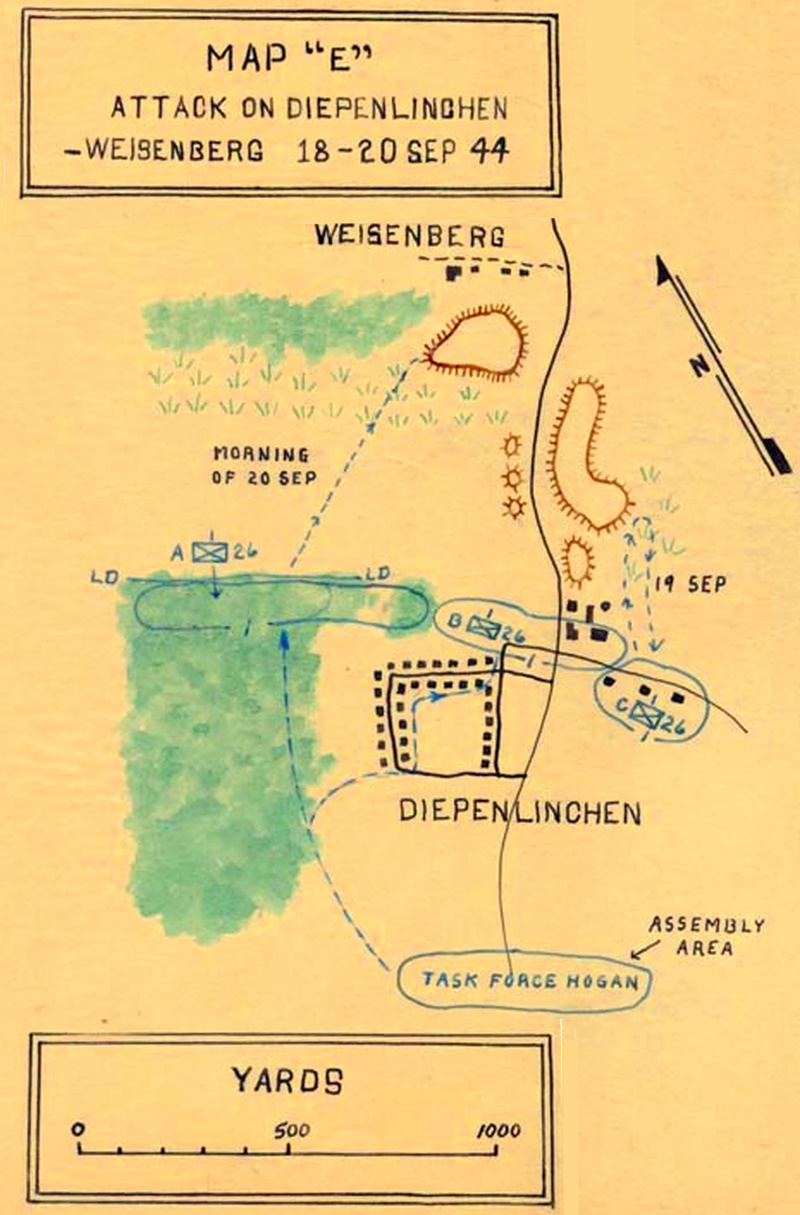
A tank-infantry attack with full artillery support was planned for the following day, September 20; however, at O63O, an intense fog covered the area limiting visibility to 50 yards. Plans were changed in view of the possibility of achieving a surprise. Artillery preparation was canceled and tanks were ordered to remain in their present positions. Guides were to be sent back to lead the tanks up after Able Co had secured the objective. Company A would move across the open ground as had been attempted previously and, in complete silence, attempt to swamp the position before the enemy was aware of the attack. This attack went according to plan. Many of the enemies were overrun as they slept in their foxholes. Thirty-three prisoners were taken as compared to only two casualties suffered by Able Co. These prisoners, who appeared completely demoralized, stated that, the sudden heavy tank fire at midnight again had caught them forming for a counterattack and had cut them to ribbons. Baker and Charlie Cos were brought up on the flanks to consolidate the position.
During the night of September 20, at 2130, the 1st Battalion, 26th Infantry was relieved by elements of the 9th Infantry Division. It had suffered 229 casualties in the eight days since crossing the German frontier, the battalion moved to an assembly area 1000 yards behind the lines, where the men received a hot meal and some rest, preparatory to a continuation of the attack in another sector on the following morning. The battalion received the Presidential Unit Citation for this action.

End
Captain Armand R. Levasseur