
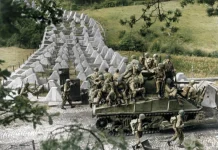


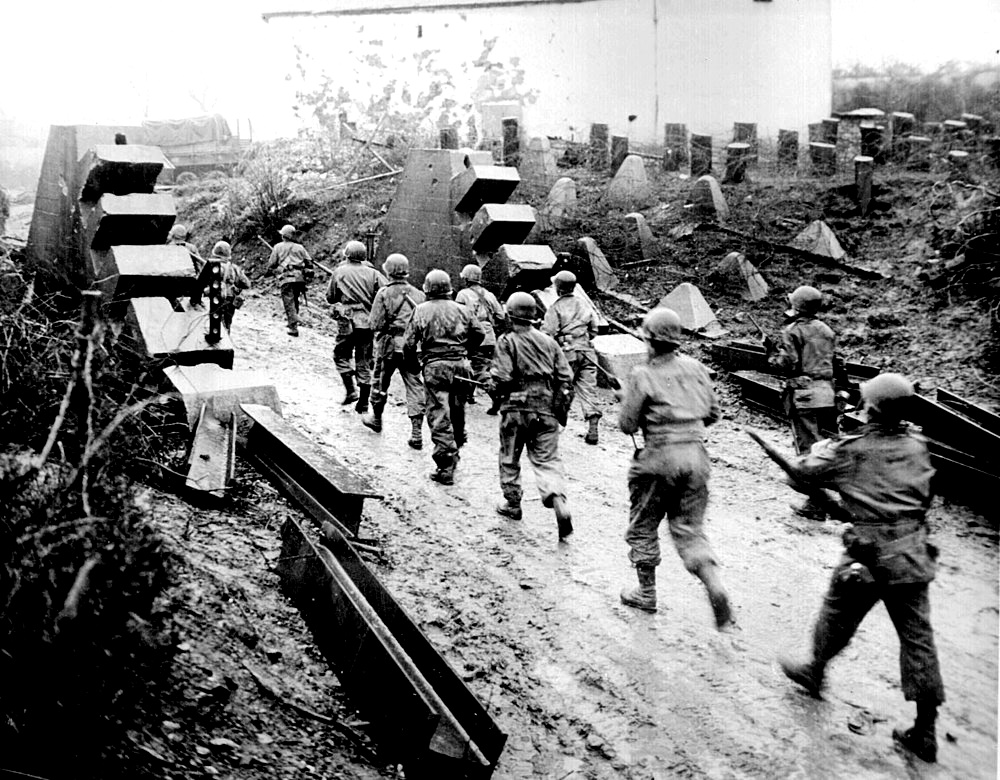
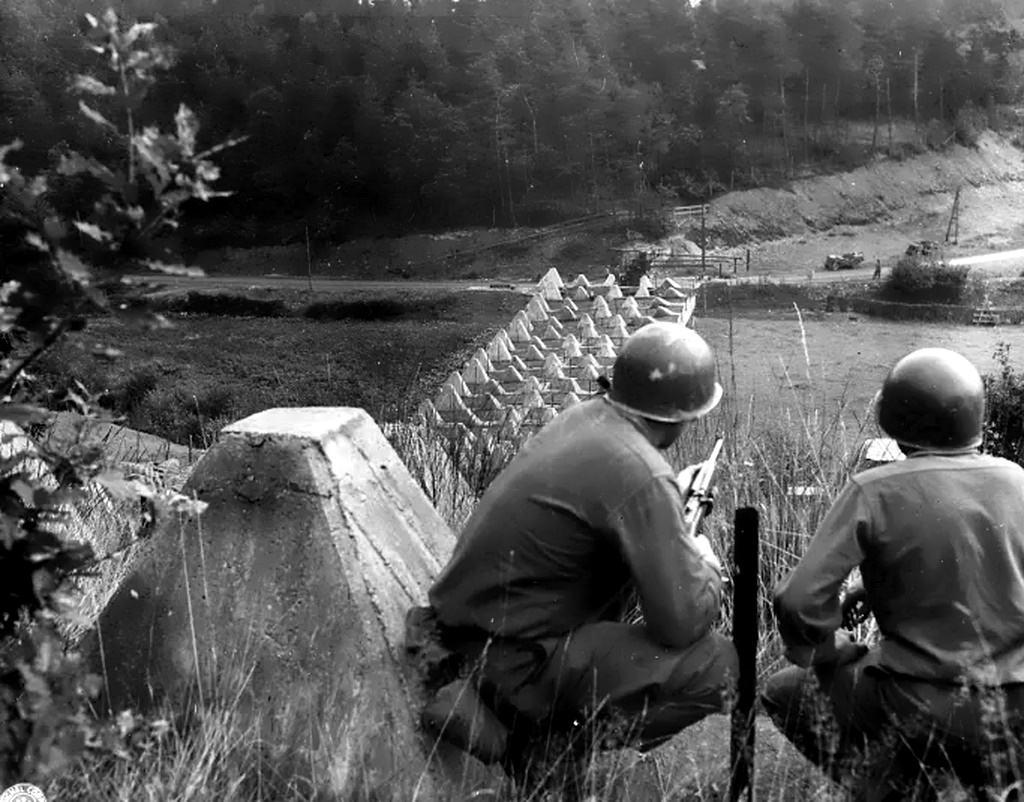
At about 1500, an attempt was made to cross an area in the dragon’s teeth previously filled in with gravel, apparently for the convenience of civilians in the area. The attack was successful; twenty tanks were quickly rushed over the homemade ramp, followed by a battalion of armored infantry. Their mission was to take the German town of Nütheim, 2000 yards to the northeast. However, extremely heavy artillery and the antitank fire soon disabled ten tanks and dispersed the infantry, requiring reorganization before the attack could be renewed. In 1710, the task force commander reported additional forces would be required to effect a breakthrough. Gen Hickey chose this moment to commit his reserve, the 1/26th Infantry, which had been attached to his command that morning. Their mission was to overrun the heavily fortified positions holding up the advance of the armor. The battalion was to attack NÜtheim from the west in conjunction with an attack from the southwest by Task Force X, now reorganizing.
Little time was available to the battalion commander for reconnaissance as the attack was to be launched as soon as the battalion could be moved from the assembly area. From the northeast edge of the woods, the line of dragon’s teeth antitank barrier could be seen several hundred yards to the front. Several of our tanks were burning just short of this barrier. Little could be seen beyond, as a gentle ridge running northeast and southwest masked further observation. A hasty map reconnaissance indicated gentle folds in open terrain offering little cover from small arms fire. The plan of attack most likely to succeed appeared to be a frontal attack through the barrier for 500 yards, then a change in direction to the southeast. This provided a flanking approach to Nütheim from the rear of the enemy’s main defenses. The ridge running northeast and southwest would offer concealment from enemy observation to the north. Little was known of the enemy other than his determined resistance as evidenced earlier in the day.
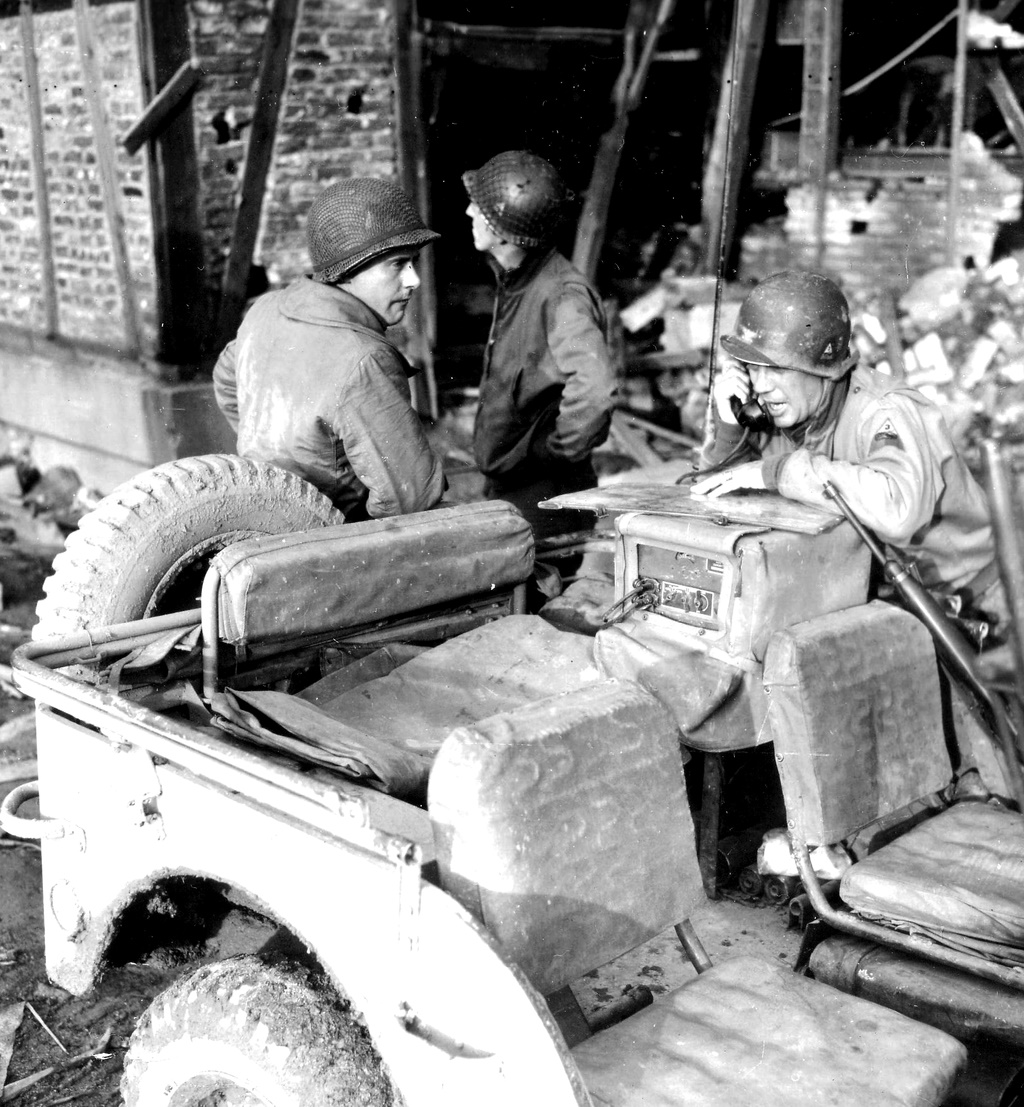
Company Commanders were issued the attack order from a vantage point at the edge of the woods, which would also serve as the line of departure. Able Co, with a section of machine guns attached, would lead the attack, followed by Baker and Charlie Cos with a section of machine guns attached. The command group was to be located initially with Baker Co while the balance of HQs Co was to remain in the assembly area. Tanks were to support the attack by firing into pillbox embrasures from fixed positions until masked by the troops or terrain. Armored artillery and mortar support would be available through dismounted forward observers from Task Force X and the SCR 300 radio sets with each company commander. The 81-MM mortars, from positions in the assembly area, were to place harassing fires on Nütheim and be prepared to fire missions on call during the night by map. All organic transportation was to remain in the assembly area, including an attached platoon of 57-MM AT guns, until ordered forward.
As the attack jumped off at 1830, the troops were immediately taken under heavy mortar and machine gun fire from the front and right flank. Three platoon leaders in Able Co became casualties and the formation was broken; the word was passed along the line to keep moving and reorganize in the vicinity of a burning barn several hundred yards to the north; the momentum of the attack carried through the barrier and its covering pillboxes. Baker and Charlie Cos, following behind Able Co, suffered relatively light casualties as the enemy’s observation was becoming limited with the approaching darkness. Able Co reorganized and continued the attack to the north. Coming upon an unimproved road leading to Nütheim, the company commander believed it to be a country road not appearing on the map; accordingly, the column continued on several hundred yards to a hard surfaced road running to the southeast. Here the column turned southeast believing it was heading toward Nütheim, the battalion objective, wires observed along the road were out. Soon an enemy bicyclist came down the road searching for the break in the wire and was taken prisoner.
Several minutes later a motorcycle patrol appeared, also looking for the break in the wire, and was in turn taken prisoner. Making an estimate of the situation, Capt Anderson concluded that artillery or mortar positions were located at the end of this wire, as lighter weapons were located in pillboxes which would have underground communications. Due to the appearance of two patrols in rapid succession, these positions were believed to be close by. Accordingly, the column deployed on either side of the road and proceeded to the edge of town. At this point, a squad was deployed to the rear of the buildings on either side of the street and one squad worked down the street. Soon the squads working in the rear of the buildings came upon German positions. The Germans were having supper on the position without posting security. The squad on the left captured one 105-MM Howitzer and two 12-CM mortars and the squad on the right captured two 88-MM guns. Surprise had been complete; the weapons were put out of action. Interrogation of the prisoners indicated the enemy was aware of an attack developing toward Nütheim but believed they would receive ample warning of any penetration, either from the south or west. At this time the company commander realized he had overshot his objective and sought shelter in a hallway to check his map. Having determined his location, he gave the order to form rear guard action and retrace the route of advance. Now, however, the enemy had discovered the presence of Able Co and suddenly opened fire from all directions with automatic weapons and hand grenades. Fighting its way out of town with the prisoners, the company retraced its route to the turning barn, arriving at 2100.
Turning back to the start of the attack, the balance of the battalion was following Able Co when concentrations of mortar fire on the dragon’s teeth caused Baker Co to lose contact with Able Co. Before contact could be regained Able Co was lost under cover of darkness. Patrols were sent out but failed to locate the Company; radio contact could not be established. The battalion commander decided to continue the attack minus Able Co. As the advance progressed a number of pillboxes were encountered and some Germans in outside positions were taken prisoner without a fight. No attempt was made to investigate possible strong points and suspected areas of resistance were bypassed. Flank security was sent out to the limit of visibility to guard against ambush. No mines were encountered during this phase and only barbed wire was found on pasture fences. One thousand yards to the south a violent exchange of tracers between pillboxes and tanks of Task Force X was evident. At 2100, radio contact was established with Able Co. A patrol was dispatched immediately from the battalion which contacted the company and rejoined the battalion at 2200. At 2300, contact was made with elements of Task Force X which had been converging on Nütheim from the south. At a commanders conference, it was decided that the attack would halt, troops would set up defenses for the night in present positions, and the 1st Battalion, 26th Infantry would clear Nütheim of the enemy starting at daybreak, to permit a resumption of the attack beyond Nütheim by Task Force X.
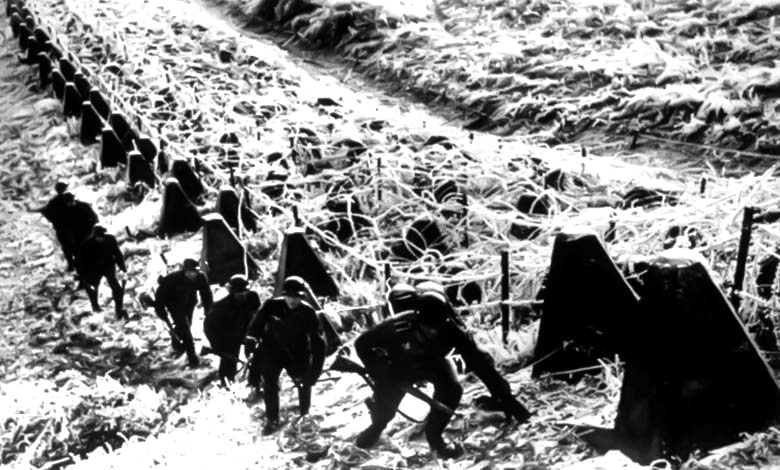
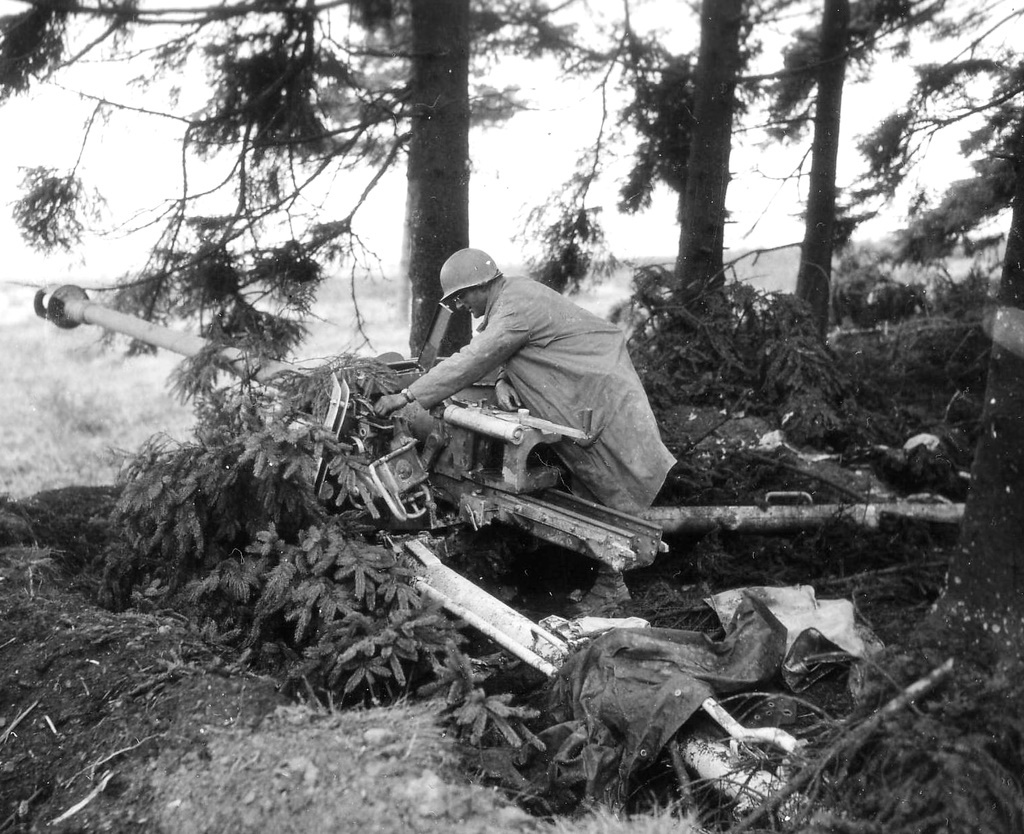
During the night, engineers brought up welding torches and cut off the iron rails which had been cemented in the roadblock. Shortly after dawn, the first vehicles were pouring through the antitank barrier bringing forward rations and ammunition. At daybreak, Baker Co, with several attached tanks, was dispatched to mop up Nütheim. After clearing out minor resistance, roadblocks were organized covering the key approaches to the town. These roadblocks consisted of riflemen in a defensive perimeter centered on the road, backed up by attached 57-MM AT guns. Shortly after the roadblocks had been completed an enemy counterattack developed, attempting to break through the position. This was driven off with heavy casualties to the enemy; 22 prisoners were taken. Able A took up defensive positions south of Nütheim and sent a reconnaissance patrol into Walheim, 1000 yards to the southeast. As the patrol entered the town it received a large volume of small-arms fire and retired after a brief skirmish. An abandoned 88-MM gun with three AT mines was found on Able Co’s position. Prisoners captured in the area stated that the gun had been placed on the position with only twelve rounds of ammunition and three AT mines. When the ammunition was expended they were instructed to destroy the gun with the AT mines if capture was imminent; no transport was available to withdraw the weapon. Our tanks had made destruction unnecessary by piercing the barrel with a round of 75-MM armor-piercing shells.
Baker Co was echeloned from Able Co southwest to the barrier crossed on the previous night. Some of the pillboxes in this area were found to be occupied and offered stubborn resistance. Occupied strong points were not mutually supporting, however, where a pillbox contained two mutually-supporting embrasures, men attempting to close with hand grenades, and a bazooka was caught in a deadly crossfire. Various combinations of firepower and movement were attempted as squad teams experimented with assault tactics. One successful method used was for the riflemen to cover all openings to deny fire from enemy individual AT weapons while the tanks fired into the embrasures at close ranges, killing or wounding those in the compartment and severely shaking those in adjacent compartments of the pillbox. A key position on the forward nose of a ridge was knocked out in this manner yielding 35 prisoners.
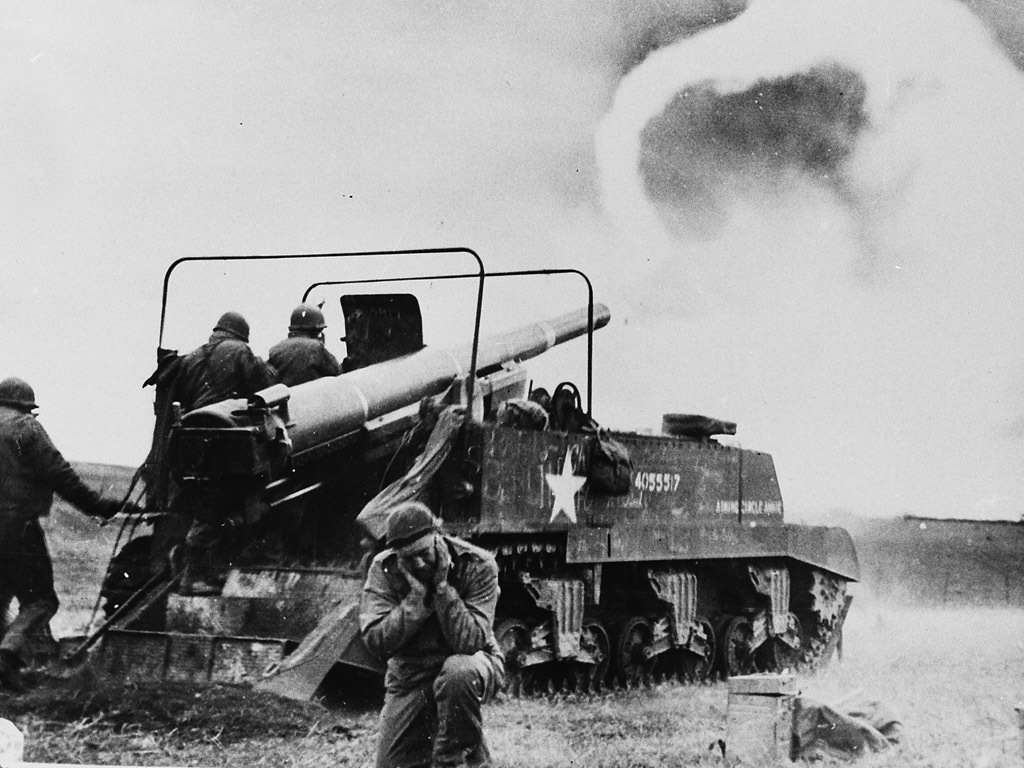
During the forenoon, a 155-MM M-12 self-propelled gun was brought up to test its effect on fortified positions firing a new type of concrete bursting shell. It was possible to safely maneuver the gun within close range of an occupied strong point due to the absence of enemy weapons in the area, other than small arms. After firing several rounds, a white flag was hoisted. Close observation revealed that penetration in the reinforced concrete had been only one and one-half feet. However, the concussion in the enclosed compartments had been powerful enough to cause blood to flow through the eyes, ears, nose, and mouth of the 35 prisoners taken. By noon the area had been cleared and the battalion reverted to the control of CCR-3-AD as other elements of the division continued the attack to the northeast. On the following day, September 15, a dangerous gap developed between the 3-AD and the 1-ID on its left flank. To secure this flank a task force was organized from the division reserve. This force was comprised of a battalion of tanks commanded by Col Hogan and the 1st Battalion of the 26th Infantry motorized. This task force moved from Nüheim approximately two miles northeast to the town of Dorff, immediately setting up roadblocks covering all approaches to the town. No activity was reported during the night save for the shooting of two civilians who had attempted to circulate in the perimeter after dark.
The following day, September 16, the task force was given the mission of clearing Büsbach, a town one mile to the northeast which were located the outer defenses of the Siegfried Line‘s the second belt. On the outskirts of the town plunging machine gun fire from a church steeple was encountered. The 155-MM self-propelled M-12 gun was called forward and promptly neutralized the position by direct fire through the church steeple. The main resistance in the area consisted of three large pillboxes on a hill several hundred yards to the northeast. A company of tanks was attached to Able Co for this mission. To cover the assaulting echelon, two platoons of tanks were maneuvered to hull defilade and a rifle platoon provided a steady stream of small arms fire. The position was taken from some frightened Germans without difficulty. As the 81-MM mortars were being set up a fire mission was received. Overhanging branches from a large tree standing close by had not been considered, resulting in several casualties within the gun crew as the fuze was detonated in the branches overhead. By 1500 hours, positions were being consolidated on the north edge of town, several hundred yards short of the second series of dragon’s teeth antitank barriers. The enemy was becoming increasingly sensitive to all observed movement and early in the evening laid down an artillery barrage on our forward positions.
THE ATTACK AT DIEPENLINCHEN
At 1700 hours, Charlie Co was detached from the battalion and sent on a separate mission at Diepenlinchen, three miles to the northeast, arriving at the designated assembly area at 1900 hours. There, the company commander was briefed by the staff of CCB-3-AD, to which he was attached, on the current situation. A battalion of the 36-AIR had been driven from the objective, the high ground southwest of Weisenberg, during the afternoon by an enemy counterattack. Elements of this battalion, having been cut off, were believed to be holding out on the objective. This could not be confirmed as no contact had been made in several hours. Charlie Co’s mission was to establish contact with these elements, evacuate any wounded men found en route, and recover weapons abandoned on the position at the time of withdrawal. At about 2000, Charlie Co started forward with a platoon of tanks attached. The head of the column had reached a position immediately southwest of Diepenlinohen when a strong enemy outpost or patrol of approximately 35 men was encountered. As the column halted to investigate, the enemy opened fire with automatic weapons. Due to the difficulty of control in extreme darkness over the unknown ground, the company commander deemed it unadvisable to attempt further advance during the night. The company withdrew and took up positions at the southwest edge of Diepenlinchen.
During the night the company commander made a thorough map reconnaissance and at dawn, the company renewed the advantage, this time by skirting Diepenlinchen around the northwest across open ground. The attached tanks remained at the line of departure to avoid giving the enemy advance notice of the attack. A heavy fog that concealed the column suddenly lifted as the point reached a position just short of the objective, a high bluff rising sharply to a height of 50 feet. Down a trail leading through the center of this bluff, a company of enemies was observed advancing to counterattack. To avoid a meeting engagement with a force that had the advantage of high ground, the company commander ordered a delaying action. The withdrawal was proceeding in an orderly manner when enemy automatic weapons opened fire from the right flank, cutting off the point squad together with the company commander. The balance of the company retired to positions occupied during the night and prepared to meet the enemy attack. Meanwhile, back in the town of Büsbach, Task Force Hogan (minus) was being relieved by another unit, and at 1035, on September 18, this force reached the designated assembly area and was organizing for an attack.