


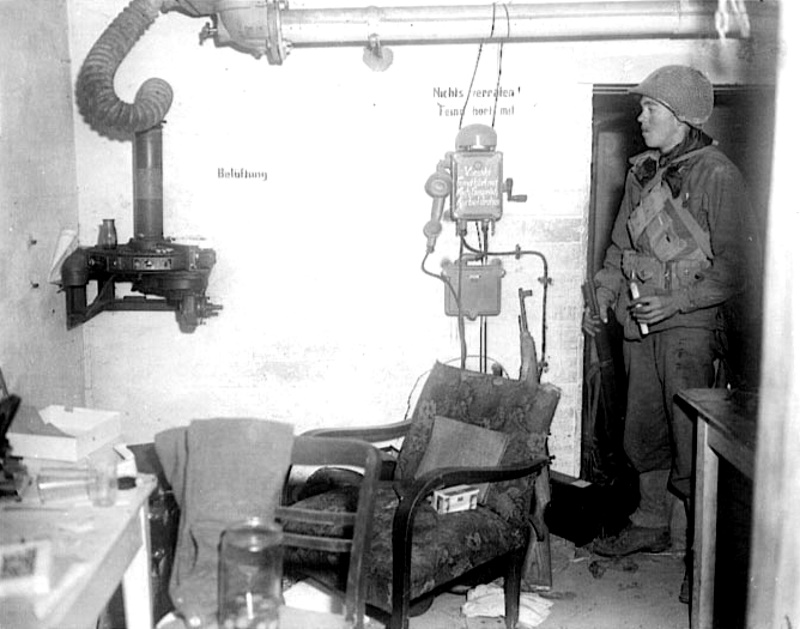
 The actual taking of the pillboxes was accomplished by assault from the flanks. Artillery pounding and the accurate rifle and machine gun fire had often caused many casualties inside; hand grenades and rifle grenades proved effective when the assault detachment could get close enough. In the case of one pillbox in each of the two assault company sectors, flame throwers proved the most persuasive tool in forcing the crew to capitulate. In the case of one pillbox, a Baker Co detachment thought they had captured it and placed it under guard, Capt Robert Spiker, Baker Cos Commander, arrived and captured nine enemies hiding in an adjoining room of the pillbox. As the battalion advanced toward its objective, increased small arms fire came from the enemy atop the two slag piles commanding the area, and from the houses and area of Palenberg. Nevertheless, casualties for the day’s fighting showed that 75-80% were victims of artillery and mortar rather than small arms fire. Because of the rains of the preceding day, the tanks of Able Co 743-TB, slated to assist the 117-IR, were bogged down during the early part of the operation of October 2 and did not get across the river until the bridge had been built at Marienberg, after the 1/117-IR had reached its objective and buttoned up for the night.
Having reached its objective, the 1/117-IR established defensive positions for the night. Col Frankland said that he knew a counterattack would come on the night of October 2-3, but there was only a minor thrust against Able Co which was of little consequence. To guard against a counterattack, defensive fires had already been planned and discussed for artillery and mortars. Each company commander had in his possession an overlay showing the fire plan for these defensive fires, and how they could be called for on very short notice. Fortunately, they were not needed.
Of the operations of the 1st battalion in the first ten days after the breaching of the Siegfried Line, Col Frankland rates the first day’s fighting as by far the sharpest of any; the next sharpest being the push through the town of Ubach against even heavier enemy artillery fire than was encountered on D-Day of the operation. To summarise the operation of the 1st battalion, it was accomplished by training, speed, and a high degree of coordination.

When the 117-IR jumped off on October 2 at 1100, most of the men were thinking about the speed with which they had to advance in order to cross the Wurm River and assault the pillboxes. We could see a little smoke which the bombing had caused in Palenberg, but we were in too much of a hurry to worry much about the bombing said Lt William O’Neil, platoon leader of the A & P platoon of the 1/117-IR which was responsible for bridging the Wurm River. Just at the hillcrest on the outskirts of Marienberg a big shell got its first victim in Baker Co. Its only result was more speed – we took off like big-assed birds for the river. From the hillcrest west of the river down to the Wurm, enemy mortar and artillery fire crashed intensely. For a minute Baker Co, the leading assault company, faltered; a lieutenant smashed a shovel down on a barbed wire fence and yelled Jesus, let’s get out of here, and the men double-timed onto the river. We were really pooped after running with all those bridges we had to carry said one corporal, and some of the boys wanted to stop and dig in. Luckily they didn’t. Over to the south, Charlie Co, the right assault company was caught just over the brink of the hill. They were zeroed in, and a dozen big babies spattered right in the middle of the 2d platoon, practically wiping it out. There were only six boys left unwounded and alive.
The river crossing was spark plugged by Lt Don Borton, a 225-pound six-footer. He was the first to reach the stream, and immediately waded across and slammed a 20-foot bridge down on the far bank. The battalion had trained to use two lengths of bridge as a V-shaped base supporting a third length from bank to bank. But Borton, after putting in a single length turned around and hollered: There’s yer god-damned bridge, and Baker Co ran across.
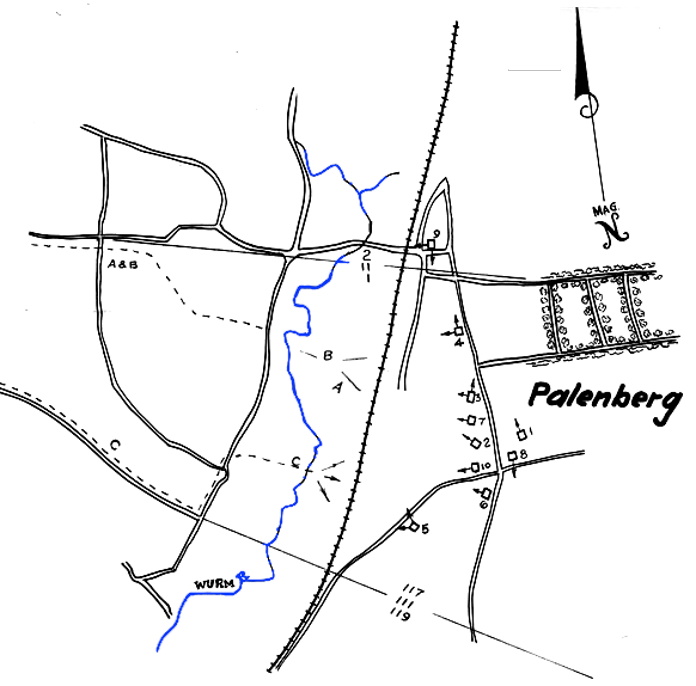
At about this time, Easy Co and the rest of the 2d Battalion were cracking the left side of the line. Easy Co’s Commander, Capt Harold Hoppe, said we leveled our bazookas on the two pillboxes which were holding us up, and that the trick more than anything else. When Able Co rushed in to relieve Charlie who had been pinned down at the river, the biggest job they had was to reduce a pillbox (# 5) on the road near the Rimburg Castle. Lt Theodore Foote, who led the platoon assaulting the pillbox put two support squads on the road, and then led the assault squad toward the pillbox, following his belief that you can’t push a string, you gotta pull it. The BAR men rattled away at the embrasures of the pillbox, while the bazooka and demolitions men crept up close. Put it in low, Gus, somebody yelled to Pfc Pantazapulos as he took aim with his bazooka. The shot sure caused a lot of commotion, said Pantazapulos, and tore a hole three feet wide in the firing slit. I put in a second one, and the dust was still thick when Pvt Sirokin ran right up to the pillbox and shoved a pole charge into the hole. That finished most of them.
All except that one that right away tossed out a grenade and tore this piece of my cheek, corrected Lt Foote, but we shot him pretty quick. What were you thinking about when you plugged that bazooka, Gus? asked Lt Foote. I wasn’t thinking, I was just praying, answered Pvt Pantazapulos.
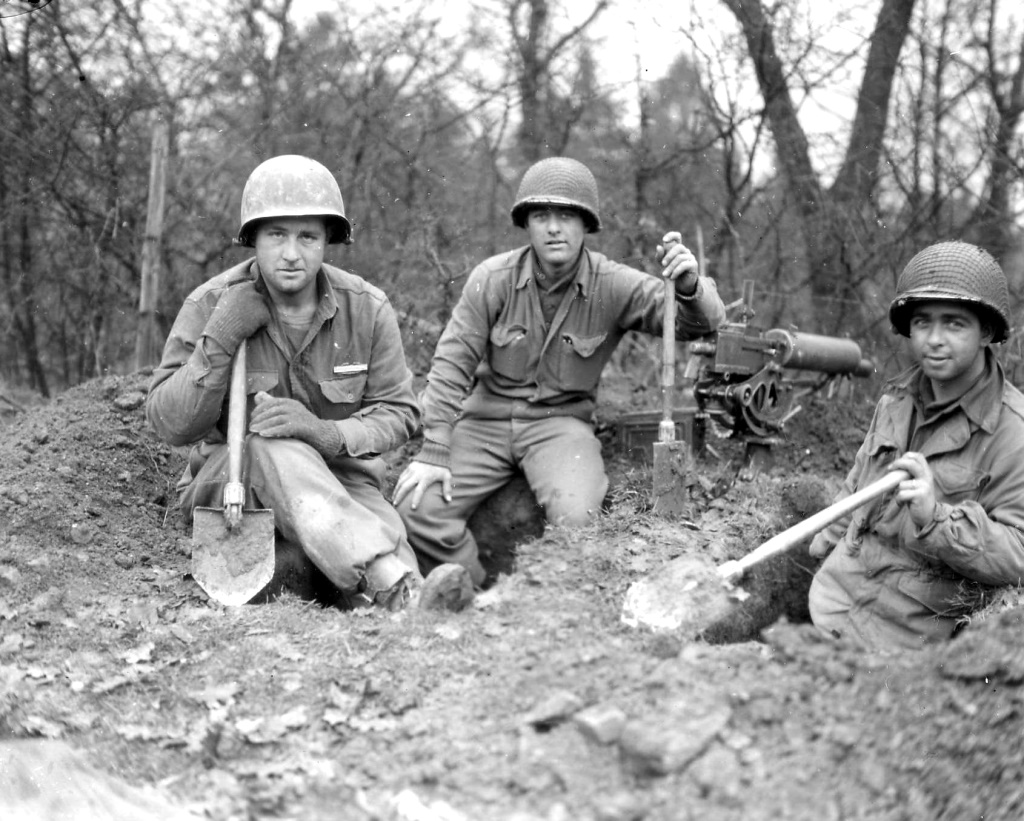
There was no rest after breaking the crust on the first day. On the night of October 2-3, the enemy started counterattacking. You can still see tank tracks stopped exactly two feet from the leading Baker Co foxhole, where you find the helmet and effects of Pvt Karvin Sirokin, who had put in the pole charge earlier in the day and then was killed in the first counterattack.
Over in the 2d battalion sector, there was bitter fighting around a cliff on the north edge of Palenberg, which became even more intense when the enemy launched first harassing and then larger-scale counterattacks. They came in with 240 infantrymen and some engineers carrying explosives to blow our river bridge, said Capt Hoppe, CO of Easy Co. That’s when T/Sgt Fred Leno’s platoon was in such close contact with the Krauts that he directed artillery fire on his own position. It covered his OP and hit even in the yard of the house he was in – but it stopped them.

The shelling we got in Ubach is the heaviest since the beaches in Normandy, said the regimental commander, Col Walter M. Johnson. But the third battalion ground through Ubach on October 3. All day, on October 4, it was one counterattack after another, relates Capt Wayne Culp, King Co commander. Tanks busted in and cut off a platoon; only two men came back. Then we countered and recaptured 7 of our guys. Love Co’s light machine gun section was cut off all day in a house on the east edge of Ubach, simply because there was a Jerry tank with his aerial in our second story window and another who forced us to look down the barrel of his 88 on the other side of the house. We had a field day sniping at Jerries, but those tanks were no fun, said Pfc Ira Reeder. We had real tank-infantry cooperation after we shook loose from that Ubach artillery and started rolling to Alsdorf, says Lt Dewy sandell, Item Co platoon leader. The tanks just machine-gunned the Jerries in their holes, and when the doughs came up it was mass surrender.
Alsdorf was a ghost town when we came in on October 7, says Capt John Kent, Able Co Commander, and it was so damned quiet it scared you. Col S. T. McDowell, 3/117-IR CO, can testify that it wasn’t a ghost town the next day. While the 3d and 1st battalions shoved off for Mariadorf, four tanks and a company of German doughs slipped in behind them and headed for our OP. We manned every window and took potshots; I got four sure and three probables. The tankers knocked out three of the tanks, but the fourth and another from somewhere wandered up and down the streets of Alsdorf all day.
After October 4, the enemy did not again counterattack the 117th Infantry Regiment.