


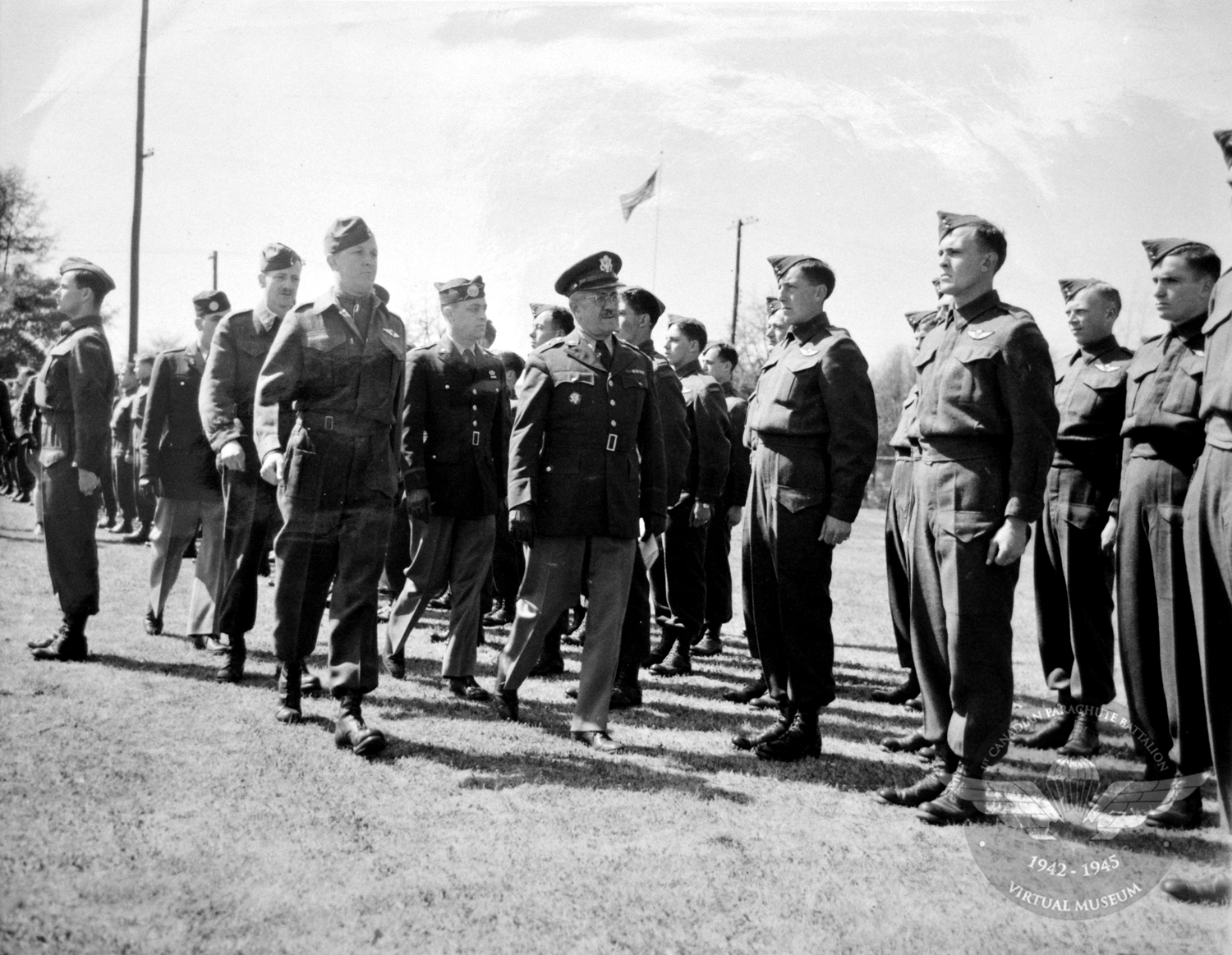
The initial response to the call for volunteers was disappointing, and on October 10, the VCGS cabled Gen Stuart, then in London, that he considered that the reason for this was probably because the unit was labeled for home defense and included in NRMA personnel, and suggested that the latter no longer be permitted to volunteers. The CGS was not in favor of this proposal, however, replying that because of the manpower situation such personnel must continue to be used. (HQS, 8846-1, Vol 10: Tel Murchie to Stuart, October 1, 1942; Tel Stuart to Murchie, October 5, 1942). The inclusion of Home Defense personnel continued to be a matter of great dissatisfaction, particularly among the members of the unit itself. On November 2, Gen E. G. Weeks, in a memorandum prepared for the CGS, stated there is a definite feeling that the inclusion of Home Defense personnel in the 1st Canadian Parachute Battalion is having an undesirable effect with respect to the type of man who volunteered to serve in this unit. The inference is that the unit would be used from employment in Canada only, whereas the type of soldier required for parachute training is the aggressive individual who is anxious to serve overseas. (HQS 8846-7: Memo DCGS(B) for CGS, Nov 2, 1943).
Gen Weeks strongly recommended that only active personnel be permitted to volunteer for service with the Canadian Parachute Battalion. He felt that it would not be necessary to announce that the unit was for service anywhere but that the restriction of volunteers to active personnel only would result in an improvement in the type of personnel obtained. (ibid). This proposal met with the approval of the CGS, and on November 19, an instruction was issued to the effect that, commencing with the quota due on November 30, all parachute volunteers for the 1st Canadian Parachute Battalion must be Active personnel; Home Defense personnel were to be accepted only if they ‘went active’ prior to their dispatch from their home district. (HQS, 8846-1, Vol 10: AG Circular Letter, November 19, 1942). The qualifying course at Fort Benning took place in four weekly stages, with a new course commencing each week. The training cadre completed this course in September and, as planned, the first quota entered the school on October 12. By early December 1942, a number of Canadian personnel were being used as instructors at the school (HQS 8846-1 Vol 15: Parade State 1 Canadian Parachute Battalion, December 5, 1942). On February 1, 1943, a Canadian school was set up within the American school and thereafter all training of Canadians was carried out by Canadian instructors. (HQS 8846-7: Progress Report, 1 Canadian Parachute Battalion, to Secretary, DND, February 4, 1943).
Between August 1942 and March 1943, when the 1st Canadian Parachute Battalion returned to Canada, 42 officers and 947 other ranks were dispatched from Canada to Fort Benning. Of these, 41 officers and 780 other ranks qualified as parachutists. Not all remained with the unit, however, 109 other ranks were posted to the 2nd Canadian Parachute Battalion (the Canadian component of the 1st Special Service Force). Of the remaining personnel, 151 failed to qualify, while a number of others were s.o.s. for such reasons as desertion, hospitalization, detention, etc. There were 2 accidental deaths, one of whom Maj H. D. Proctor, A/O.C., 1st Canadian Parachute Battalion, was killed on September 7, 1942, when making his first jump from an aircraft. (HQS 8846-1, Vol 22: Weekly Parade State, 1st Cdn Para Bn, March 20, 1943, WD, DAG, NDHQ, September 1942: Appx 1 Memorandum by DAG, Sept 8, 1942). When the 1st Canadian Parachute Battalion returned to Canada on March 22, 1943, it had a strength of 41 officers and 671 other ranks, of whom 39 officers and 621 other ranks were qualified paratroopers. At this time, the battalion was carrying 15 officers and 81 other ranks to the establishment as the nucleus of a proposed training center in Canada. As all ranks were granted leave immediately on arrival in Canada, it was not until April 15, 1943, that the battalion assembled at the Shilo Camp and resumed training. Using a Royal Canadian Air Force Lockheed Lodestar, the unit carried out its first jump from aircraft in Canada on May 4, 1943.
(Note: every Canadian Archives for Publishing are welcome)