







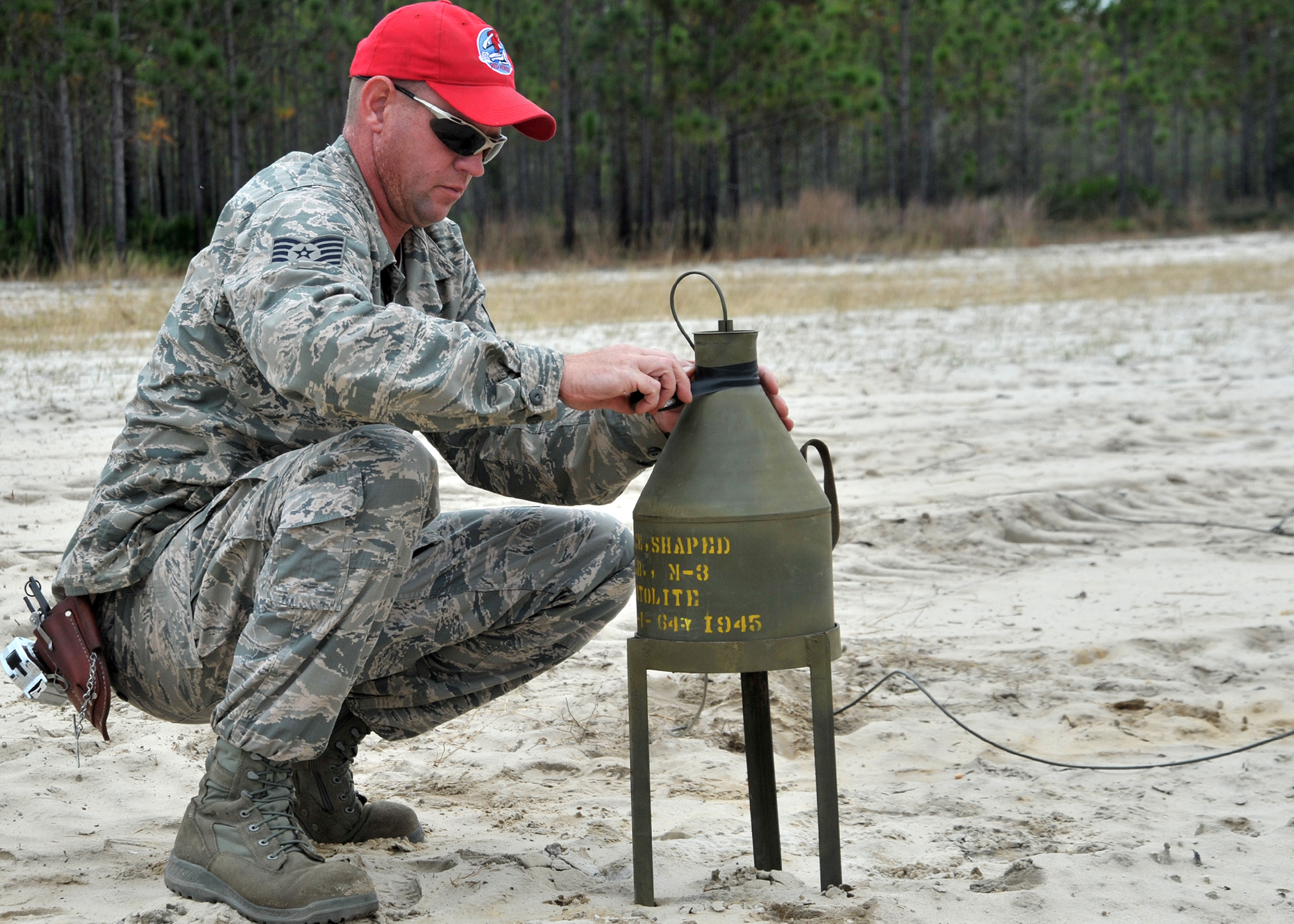
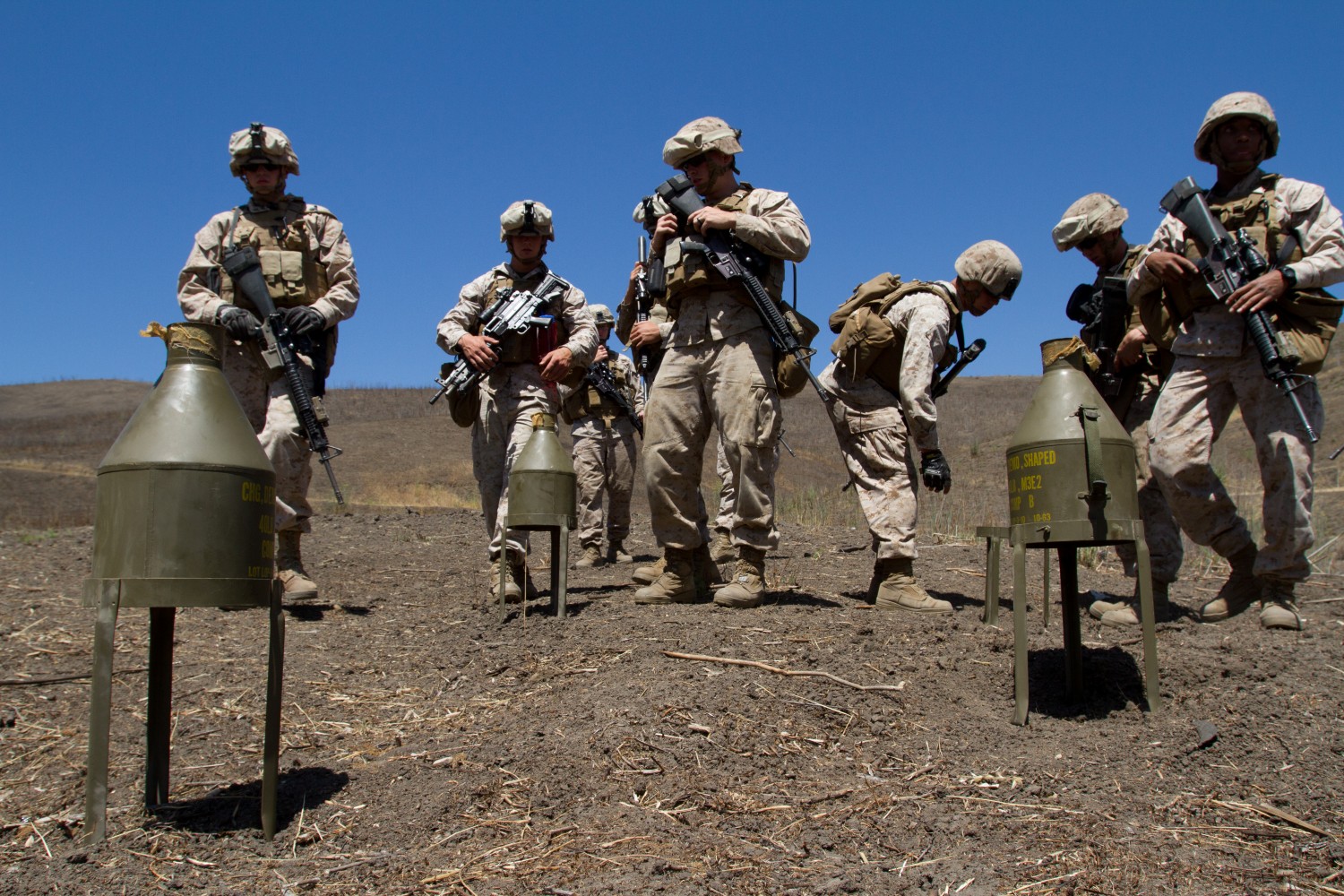
1. When the charge is fired, fragments from the target and container of the charge may fly in all directions. Therefore, the user should take adequate cover and allow a distance of 500 feet for training purposes. Under combat conditions, a distance of 100 feet should be adequate for men lying down and out of the direct line of the blast, or closer if under cover. 2. The charge contains a cast explosive that will be damaged – by rough handling. It should not be dropped on a hard surface as the efficiency will be decreased if the explosive is cracked. 3. Any obstructions placed in the cavity will have a detrimental effect on the results obtained and should, therefore, be avoided. 4. A high temperature is obtained in boreholes drilled by shaped charges, and these must be allowed to cool for at least twenty minutes or be cooled with water if they are to be filled with explosives. 5. The usual care that is accorded to any blasting cap should be exercised in priming the charge.
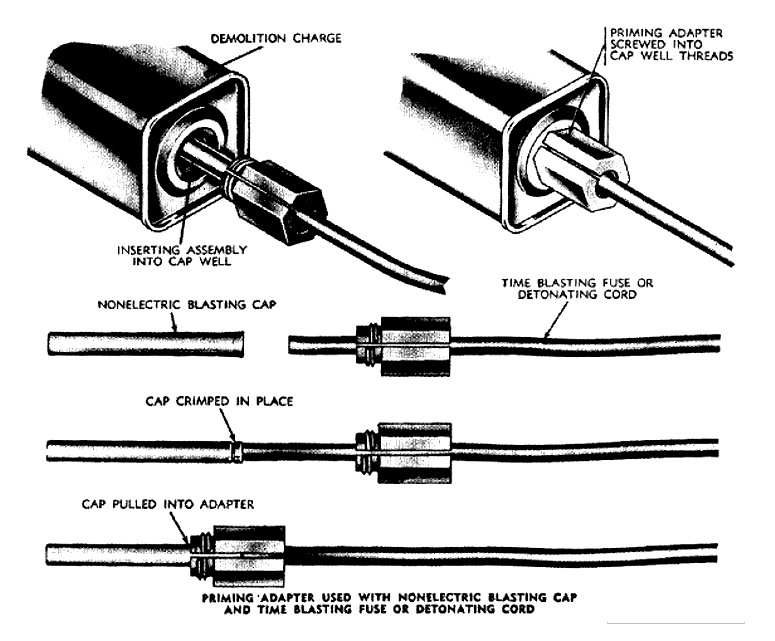
PRIMING ADAPTOR M-1
The Priming Adaptor M-1 consists of a plastic fitting with a 9/16 inch NC thread on one end, a slot to take electric lead wires, and a shoulder so designed that fuze or prima cord passes through it but it holds a cap. It is used in conjunction with all explosives containing a threaded detonator well. The priming adaptor is made of a suitable plastic, olive drab in color. The Priming Adaptor M-1 is used to hold detonators in place in explosive blocks or any explosive fitted with threaded detonator wells.
PIPING OF GASOLINE TO BUNKERS
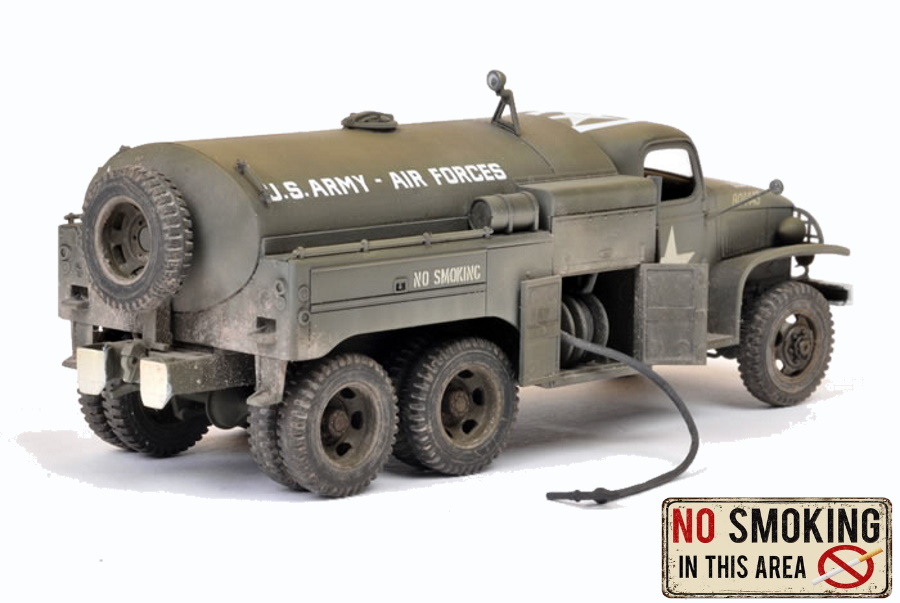
Destruction of bunkers and their occupants may be effected by piping gasoline into the bunkers and igniting the fuel by a burst from a flame thrower. The gasoline is allowed to discharge into the embrasure of the bunker for approximately 15 seconds before it is ignited. Ignition of the gasoline results in a definite explosion and in flames filling the interior of the bunker. The gasoline is introduced into the bunker through the medium of the standard 4-inch lightweight pipeline equipment. The pipe is brought as far to the front as possible and is then coupled to a flexible synthetic rubber hose. The hose, in turn, is connected to a 1-inch pipe, approximately 100 feet long, to which is attached a 0.5-inch nozzle. The 1-inch pipe is pushed into position until the nozzle is approximately 25 feet from the objective, at which point a valve provided at the connection of the hose to the 4-inch pipe is opened to allow the fuel to be ejected.
Pumping equipment forces the fuel through the pipeline, creating an emergent pressure of 300 pounds per square inch at the nozzle. This equipment is the standard Petrol Pumping Unit (PPU) now used for pipeline service. It is composed of a GMC-270 engine used in the standard 6×6 2.5-ton cargo truck, and a two-stage Byron-Jackson Centrifugal Pump. Further development of piping equipment is underway which may result in considerable modifications of the system described above.
SNAKE DEMOLITION M-2
The Snake Demolition M-2 consists of explosive cartridges 3-3/4 inches in diameter and 4 feet long clamped between 12 gauge corrugated metal plates 9 feet long, and 14 inches wide, the latter assembled in shingle fashion and bolted together. The forward end is equipped with a nose and its associated adaptor to guide the snake over or around obstacles. Hooks for towing and pushing by either the medium or light tank are provided at the front and rear ends. The snake may be assembled in any convenient length up to 400 feet. 20 feet of the forward end and 60 feet of the rear end are assembled without explosives to provide a safety section that may be straddled by the tank during pushing and to provide room for the insertion of tamping bags to control the explosion. The distance of 60 feet on the rear end has been determined by test to be the minimum distance at which the snake can be detonated without jeopardizing the safety of the pushing tank and crew.
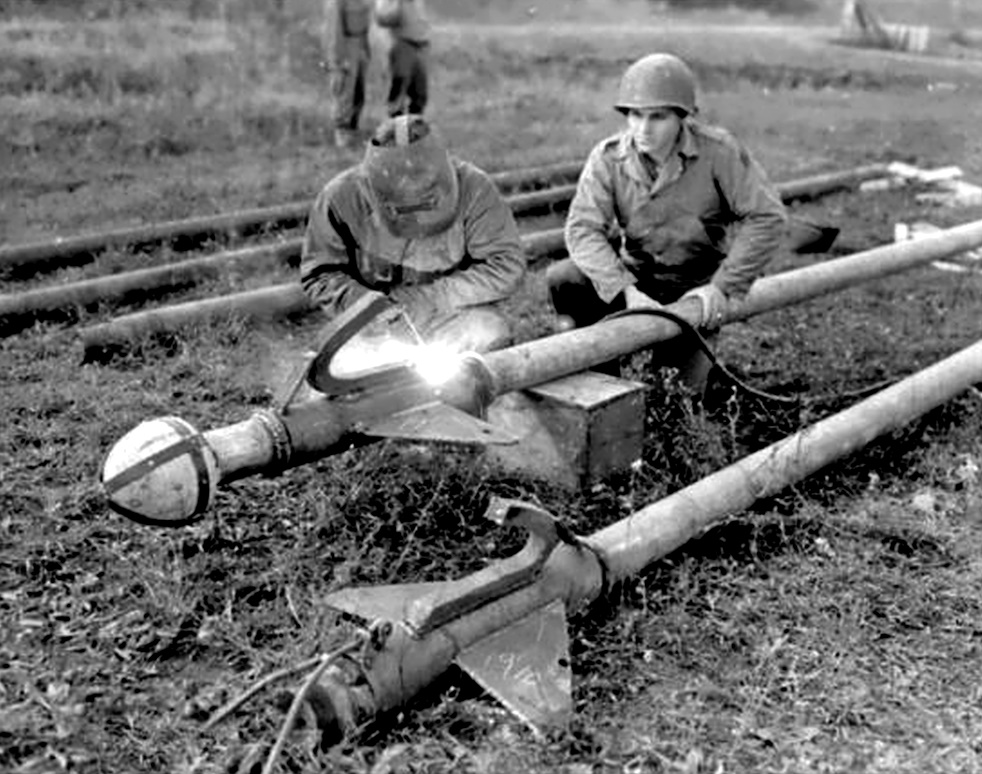
Several different explosive charges may be used in the snake. The charge specially designed for the purpose is a 3’3/l4 inch by 4 ft. cartridge in a metal container consisting of an 80/20 mixture of Amatol (8O% Ammonium Nitrate and 20% TNT) except for 6 inches of each end which is crystalline TNT. The loaded cartridge weighs from 22 to 24 pounds. 160 are required for a 400′ snake. An alternate recommended loading utilized the M-1 Bangalore Torpedo in which 8 torpedoes are accommodated within the two corrugations of the plates. This loading gives an explosive weight of 14.4 lbs. per ft. as compared to 10 pounds for the special cartridge. After being pushed into position on the target being attacked, the snake is detonated by directing the tank’s machine gun fire on the impact plate of the firing device which is located slightly over 60 feet from the rear of the snake.
The snake was designed for creating a path through antitank minefields but is very effective against other targets such as concrete tank obstacles and in clearing a path through thick natural growth. A 400 ft. snake loaded with 3-3/4″ cartridges will blast a crater approximately 100 yards in length, from 9 to 12 feet in width, and from 2 to 3 feet deep, depending on the type of soil and its moisture content. For shipment, the snake is packed in 85 packages occupying a total volume of 188.6 cubic feet. The gross weight when packed is 13,741 pounds, while the net weight, assembled, is 12,491 pounds. It is transported in two 2.5-ton trucks and can be assembled in two hours by a squad of twelve men.
BLOCK DEMOLITION CHAIN M-1
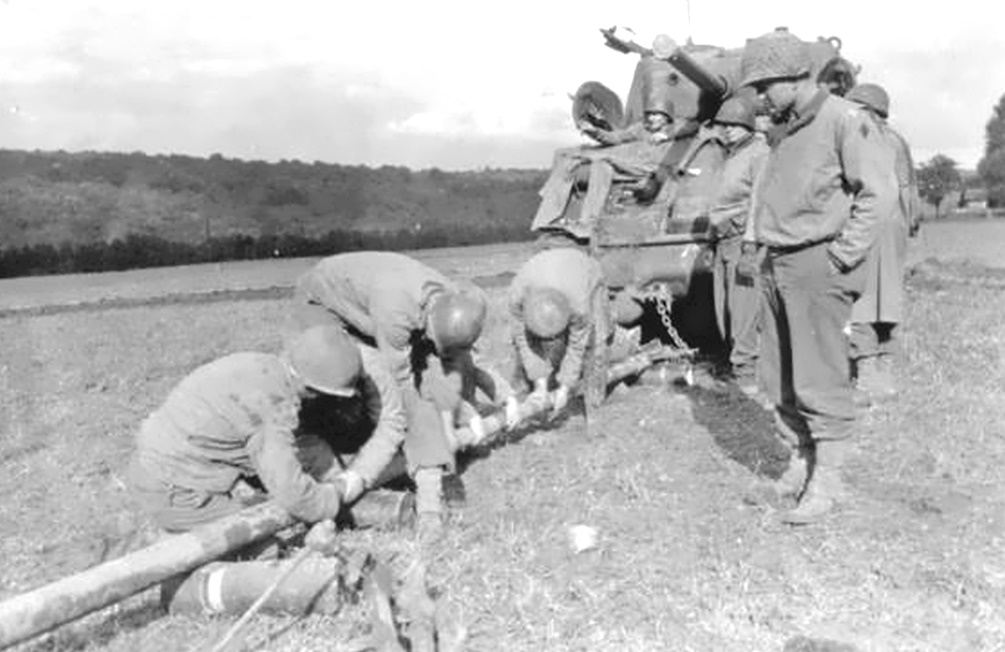
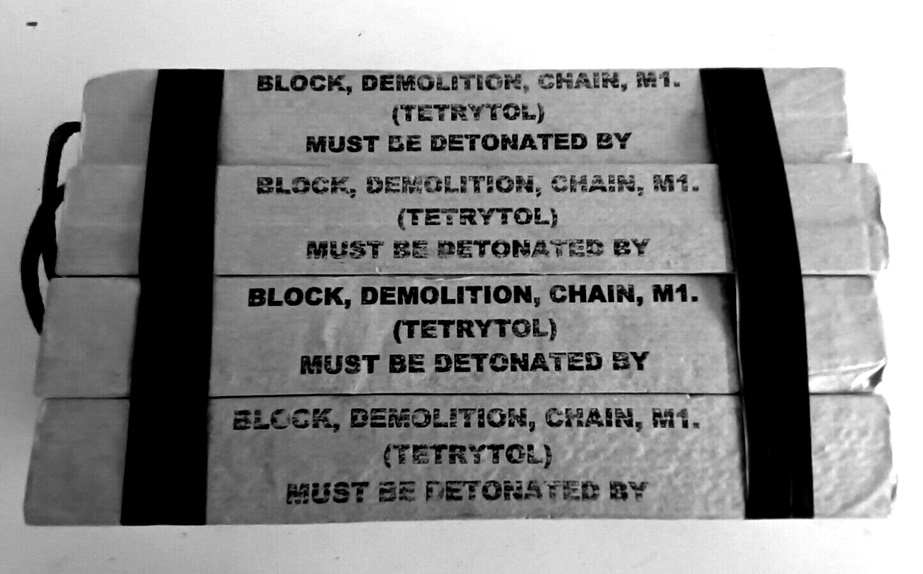
The Block Demolition Chain M-1 assembly consists of eight 2″ x 2″ x 10″ blocks of Tetrytol strung on a prima cord and packed in a haversack for ease of use and handling. The entire chain or any part of it may be used laid out in a line, wrapped around an object, or detonated as packed in the haversack. Each block is rectangular in shape and is enclosed in a white cotton bag. One block is equivalent to six 1/2-pound TNT blocks. The blocks are cast in place with 8 inches of prima cord between blocks and two feet of free prima cord at each end of the assembly. The eight blocks and prima cord as assembled weigh 21 pounds; the entire assembly 22 pounds. Two complete units are packed in a wooden box. Tetrytol is a more powerful explosive than TNT. It is also more brisant and therefore more effective where a cutting charge is needed. The prima cord is detonated by means of a blasting cap in order to fire the chain. The blocks and the cord are quite insensitive to shock but the assembled units are slightly more sensitive than TNT. Sympathetic detonation between unconnected blocks can be obtained when they are separated by as much as 10″ in air. The blocks are not affected. by moisture and can stand submergence in water for 24 hours without appreciable effect upon their characteristics. The care, handling, and storage of material are the same as for TNT blocks.
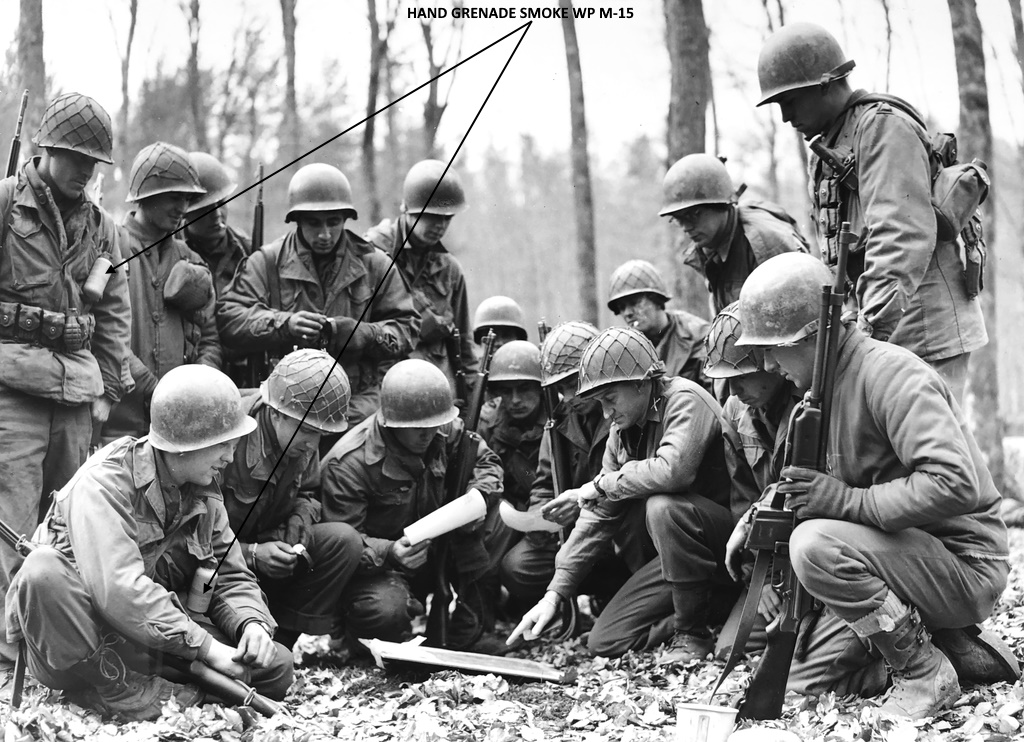
 b>GRENADE HAD SMOKE (WP) M-15
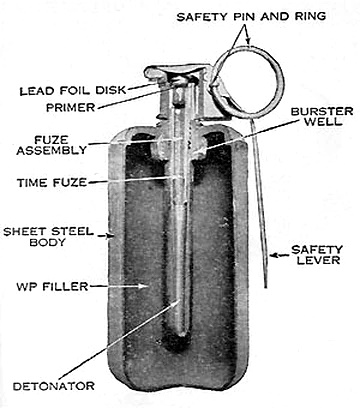
This hand grenade is designed for laying smoke screens, and for incapacitating enemy personnel by means of severe and slow healing burns caused by the white phosphorous filler of the grenade. The M-15 grenade is cylindrical in shape. It is 4 1/2 inches high, with a diameter of 2 3/8 inches. It consists essentially of a grenade body, a burster well, and a Fuze, Detonating, Hand Grenade, M-6A3.
b>Principal Charasteristics
Height 4 1/2 ins.
Diameter 2 3/8 ins.
Weight (empty) 9 ozs.
Weight (loaded) 24 ozs.
Weight of WP filler 15 ozs.
Range 30 to 40 yds (Hand).
Range 50 to 100 yds (Rifle).
Duration of screen 25 sec.
Radius of burst 20 ft.