


PREPARATION FOR CROSSIN3 THE RIVER
The Artillery Liaison Officer was present when the Regimental order was issued. He immediately contacted the commanding officer of the 359th Field Artillery Battalion, which was the direct support battalion for the 379-IR. He was assured that plenty of artillery support was available. The amount of artillery supporting the 95-ID previously has been mentioned. However, it will not be over-emphasizing the artillery to state that the XX Corps, and especially the 95-ID, had far more than the normal amount of artillery support. Division G—3 was present and assured the Battalion Commander that the 1st Battalion would have priority of fires from all Divisions and attached artillery. The Commanding General of the Division Artillery was contacted, and he promised priority of fire to the 1st Battalion from battalions reinforcing the 95-ID Artillery. There would be an abundance of artillery support. Time was very short for appropriate planning of these fires, but properly planned and executed they would do a great deal toward deceiving the enemy and covering the noise of moving vehicles. Before all the plans were completed, part of the artillery plan was being put into effect by Corps medium artillery firing heavy barrages into Saarlautern and deep into enemy-held territory. By the time the Liaison Officer and the Battalion Commander had finished their plan, it seemed like all of the many artillery battalions in support were trying to demolish everything across the River. It was certain that the noise made in the preparation for the crossing would not be heard by the enemy. (Statement by Capt Lawrence W. Slorah, Artillery liaison Officer, to the Author)
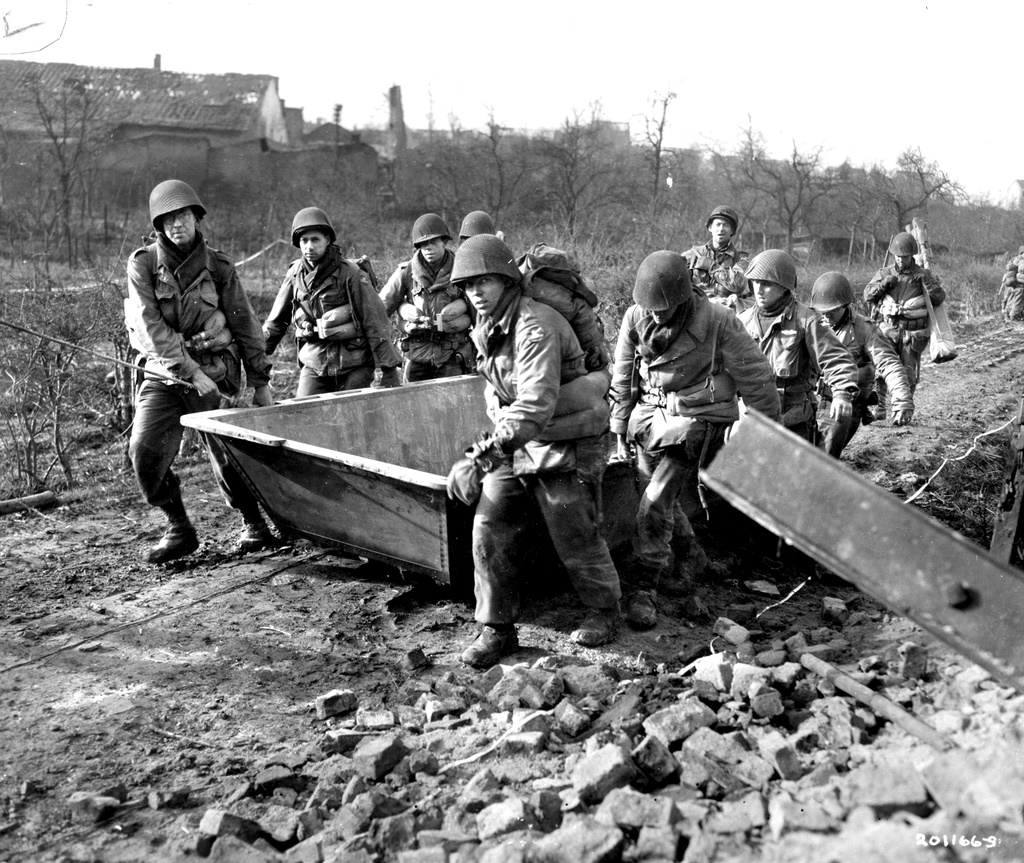
The Division Engineer and the Commander of Charlie Co, 320th Engineer Combat Battalion, who also were present when the Regimental order was given, immediately began preparations to move assault boats and bridging equipment to the barracks now occupied by the 1st Battalion. An engineer officer was to accompany the 1st Battalion Commander and aid in selecting a crossing site. Two light equipage platoons previously had been attached to the 95-ID by the XX Corps; and, due to the foresight of the Commanding General, were well forward and accessible. An engineer platoon already had cleared AT mines from the road, extending from the outskirts of Saarlautern to the German Barracks. The Battalion had not been idle during the absence of the commander. The barracks provided excellent cover and a warm place for the men to get some much-needed sleep. A hot meal was brought forward by the use of quarter-ton trucks and trailers, and weapons carriers had been brought forward by infiltration. All vehicles were put under the spacious sheds, which were so large that the vehicles could be dispersed almost as well as would be required for an outside bivouac.
The Battalion Commander, the S-3, and Artillery liaison Officer completed their coordination and left the Regimental Command Post at about 2230. Before reaching the Battalion, the S-3 shot himself in the left arm, becoming a casualty. The company commanders had assembled at the Command Post when the Battalion Commander arrived. The S-2 immediately was assigned the S-3 duties. (Author was an Eye-witness – and Statement by Col. Philbin). Before the Battalion Commander issued his order, he asked for one officer to volunteer to attempt to slip through the German defenses and cut the wires to the explosives. No one volunteered, so the idea was discarded. Finally, the Battalion Commander’s attack order was as follows: ‘The enemy holds the Saarlautern Area and the area across the River, strength is unknown. The strength of enemy fortifications is also unknown. Love Co will attacks at 0745 with the mission of securing intact the south end of the bridge across the 5aar River in Saarlautern. This Battalion, the 1st Battalion, with one Platoon AT Co attached; one Platoon of Baker Co of the 607th Tank Destroyer Battalion; and one Platoon Charlie Co of the 320th Engineer Combat Battalion in direct support, will force a crossing of the Saar River and capture the north approaches to the bridge to prevent the enemy from destroying It. Engineers will deliver assault boats by 0300, and the crossing will begin at 0545. Secrecy is vital; noise must be kept to a minimum, and no shots will be fired until necessary’.
‘The crossings will be in two waves: 1st Wave with Baker Co on right, Charlie Co on left; the 2nd Wave with Able Co on right, Dog Co D on left. The Battalion will move in columns of companies on the north bank of River in order: Baker, Charlie, Dog, and Able Cos. The machine gun Platoons of Dog Co will join Baker and Charlie Cos on the north bank. I will be in the center boat with the second wave and at the rear of Baker Co in the advance on the north side.

The Battalion Commander was perturbed over the fact that there had been no reconnaissance of the River. He gave orders for the company commanders to take all but one officer from each company and make a reconnaissance and select a crossing site. Three rifle squads were attached to furnish security for this group. The reconnaissance party moved onto the hard-surfaced road north of the barracks. At this time the group had only one map and one aerial photo. They were not very well organized and moved up and down the road, learning nothing. The moon shone so brightly that one could almost read the maps in the moonlight. However, the group could not agree on just how to get to the River. After having been out about an hour, the company commanders were very anxious to return to their planning. Dog Co’s Commander, the senior officer in the group, gave his executive officer the mission of finding the River and picking a crossing site. An engineer officer and one rifle squad accompanied him. Eight minutes later, they were on the banks of the River, lying close to the ground, as friendly artillery was pounding the north bank. The River was approximately 125 feet wide, and the banks were about two feet high. The reconnaissance party made a quick inspection of the River and immediately agreed on a crossing site. After choosing the terrain features as guiding marks to be used should the moon be covered by clouds later, they returned to the barracks, and the Battalion Reconnaissance Officer reported to the Command Post.
The Reconnaissance Officer reported to the Battalion Commander and gave a detailed description of the River and recommended a location for the crossing. The crossing site recommended was ideal if surprise was accomplished; but, if discovered, it would leave the Battalion in an open field at the mercy of the enemy. However, this crossing site had many desirable features, and it was approved by the Battalion Commander. The rest of the night was spent in preparation for the crossing. Each man was properly oriented and assigned to a boat. The 5-4 supplied enormous amounts of bazooka ammunition, particularly AT Rockets, hand grenades, and extra ammunition were issued. Two K rations which were to be carried by each man were not available in the kitchens, but the S-4 supplied them also. Everything needed by the men – even extra socks – was issued in the short time available. The engineer boats were in place by 0300, and each boat commander had made a personal reconnaissance of the River. Trucks loaded with bridging equipment were in the courtyard between the barracks. The noise of this movement was covered by the terrific artillery barrages.
CROSSING OF THE RIVER AND CAPTURE OF THE BRIDGE
The Battalion was fed a hot meal at 0330, and at 0515 began its movement toward the River. The moon was shining brightly, and movement was very easy. There was no noise – not even a boat scraped the ground. At 0545 the boats were placed in the water, and at 0556 every man in the Battalion was across the River. The companies rapidly formed into a column and moved forward. There was no artillery preparation in the bridge area, but both Corps and Division medium artillery were giving the German rear area sufficient quantities of fire to keep them quiet, and the Battalion was not receiving any enemy fire. It was about two thousand yards to the bridge, and half of that distance was on the flat open terrain in the triangle between Saarlautern, Saarlautern Roden, and the River. The ground was very wet and soft from recent rains, and the men heavily loaded with weapons and ammunition experienced great difficulty in moving. Baker Co reached the Saarlautern – Saarlautern Roden road at 0625 and captured a German soldier who was on his way to the bridge. When questioned, this German said other soldiers were on the way, and Baker Co made plans to capture them also.
The Battalion Commander, dissatisfied with the delay, moved forward from his position at the rear of the lead company and took a position behind the lead scouts. The Battalion, still in column, made a right-angle turn at the road; and moving on both sides of the road, advanced more rapidly toward the bridge. As the head of the column neared the bridge, an armored car was discovered on the road, close to the bridge. The scouts moved by on the flanks, and the Battalion Commander and Dog Co Commander approached the car. One man was inside the car sending a message; and when he failed to respond to a challenge, he was knifed by the Dog Co Commander. One German outside the car dashed for a detonator switch, and the Battalion Commander fired the first shot of the operation killing the German soldier. The detonator switch was removed, and all wires that could lead to demolitions were cut. The engineers who had marched near the front of the column moved onto the bridge to check for demolitions. Four American 500-pound bombs were located, disarmed, and rolled into the River. Continuing the inspection, the engineers moved across the bridge and found AT mines across the approaches. As they were attempting to remove them, four German soldiers approached, apparently unaware that they had lost the bridge. They were taken, prisoners. The engineers were unable to remove the mines, for by this time the Germans realized something was amiss and had begun pouring small arms fire onto the bridge.
At 0721, the Battalion Commander reported to the Regiment that the bridge was captured. Incredible as it may seem, it was later learned from captured prisoners that the Germans planned to blow the bridge at 0730. It was learned also from German engineer prisoners that artillery fire had knocked out generators with which the bridge was to have been blown; and when captured, these engineers had been on their way to hand blow the bridge. Love Co, reinforced, crossed the line of departure at 0730, and attacked aggressively. They encountered heavy small-arms fire; but, taking advantage of buildings, bypassed some of the strong points and proceeded as quickly as possible. By 0830, they had captured the south approaches to the bridge and contacted the 1st Battalion. The attack of Love Co forced several Germans to retreat across the bridge, and they were taken prisoner by the 1st Battalion. One group tried to fight its way across the bridge and was killed by heavy machine gun fire. By 0700, elements of the 320th Engineer Battalion had completed the construction of a footbridge, and work was progressing on an infantry support bridge. These bridges were being built at the exact location where the infantry had crossed. This location had been chosen for the purpose of aiding the infantry in its surprise attack but did not have any of the qualities necessary for bridging operations.
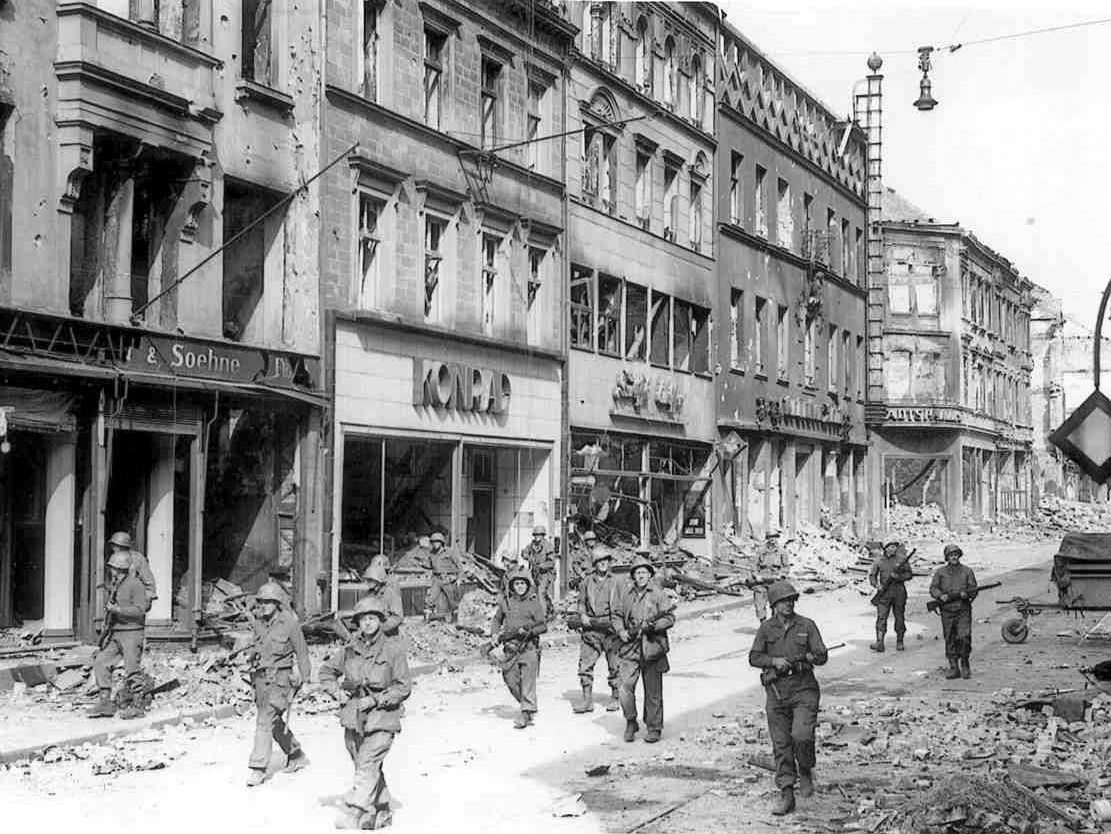
Shortly after daylight the enemy artillery destroyed the footbridge and damaged the infantry support bridge. Continuous artillery and mortar fire forced the engineers to abandon their efforts in this location. As soon as the bridge was captured, the 1st Battalion began clearing that part of Saarlautern north of the River. One platoon of Baker Co surprised Germans in a two-story bunker almost at the same time the first shot was fired. This bunker had no outside security, and the effects of a hand grenade dropped into it persuaded the Germans to surrender. Charlie Co, following close behind Baker Co, began occupying buildings east of the road and found an aid station and a small group of German soldiers, all seemingly unaware of what was happening. Able Co A moved into buildings in the north section of the town and thus completed cleaning out that part of Saarlautern north of the River. At this time the Battalion had not suffered a single casualty.
DEFENSE OF THE BRIDGE
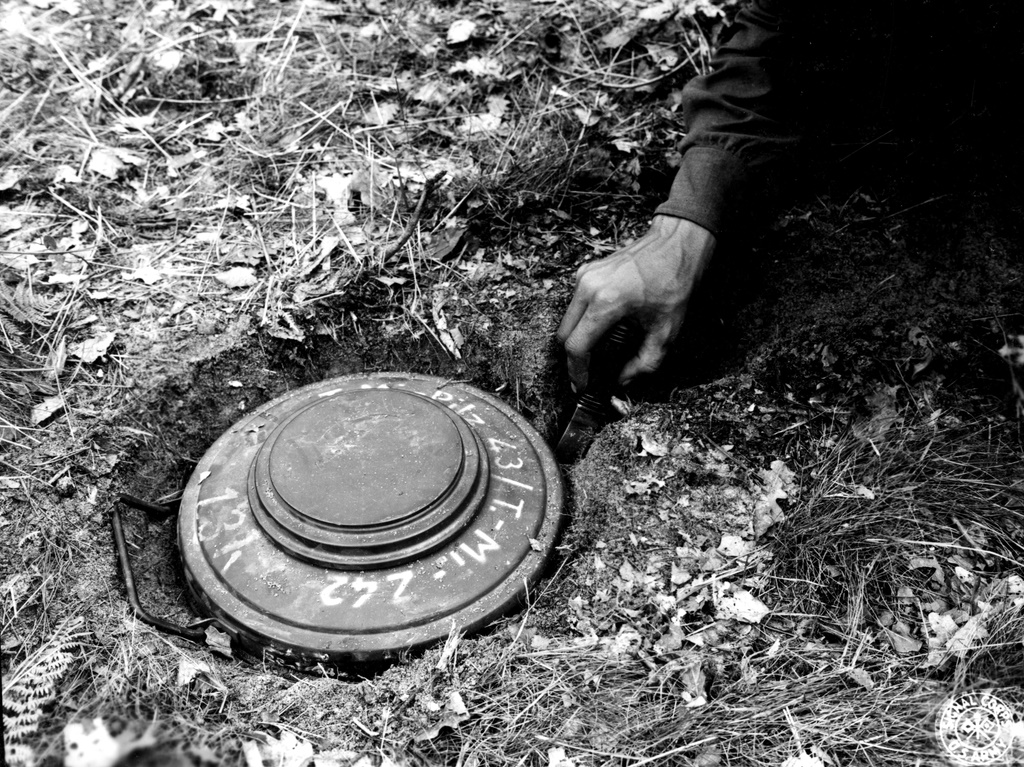
The Battalion Commander ordered that a strong defense be organized. This was to be an all-around defense with companies dispersed as follows: Baker on one side of the road and along the River; Charlie on the other side of the road and along the River; Able with its back to the rest of the Battalion and facing generally northwest – thus forming a triangular defense area. Dog Co already had both machine gun platoons in position. One was emplaced along the banks of the River, covering both sides of the bridge. The other platoon was in a building about 75 yards north of the bridge, with fields of fire covering all enemy approaches. The 81-MM mortar platoon was located near the center of the area. It was to conserve its ammunition and to fire only in case of a counterattack. Just after daybreak, the Germans apparently realized that they had lost the bridge. Small arms fire seemed to come from all directions. It was impossible to tell from which directions the Germans were firing. By 0900, the Battalion had repulsed two counterattacks. The strength of one was estimated to be about two squads; the other approximately two rifle platoons. These came from the woods along the River Bank, so the Battalion Commander ordered Able Co to clean out these woods. This was completed by 1130, and several prisoners were taken. The woods were found to have a tremendous amount of antipersonnel mines.
Enemy artillery and mortar fire began pounding the bridgehead at about 0900 and increased throughout the day. The artillery fire was the heaviest ever received by the 1st Battalion. Trees and buildings were gradually destroyed. The movement was reduced to a minimum, but casualties began to reach a high figure. Only the strongly constructed stone buildings prevented the number of casualties from being much higher. Fighting in Saarlautern south of the River continued until 1600, at which time the 2nd and 3rd Battalions made contact, and the main portion of the town was cleared. The capture of Saarlautern stopped the small arms fire on the bridge, and soon afterward the engineers removed the mines from the approaches. One platoon of the 607-TDB crossed to the north side to aid in defending the bridgehead. At 1700, the first infantry vehicles crossed the bridge with supplies – ammunition having first priority. Several weapons carriers crossed the bridge and were placed undercover in a large warehouse. A ration and ammunition dump was established. Due to mounting numbers of casualties, the Battalion Aid Station was established north of the River, but the first attempts to evacuate the wounded failed because of the heavy artillery fire. Vehicles not undercover would last only a few minutes. A few vehicles were destroyed by direct artillery hits, and traffic across the bridge was stopped and later limited to a small number of vehicles per hour.